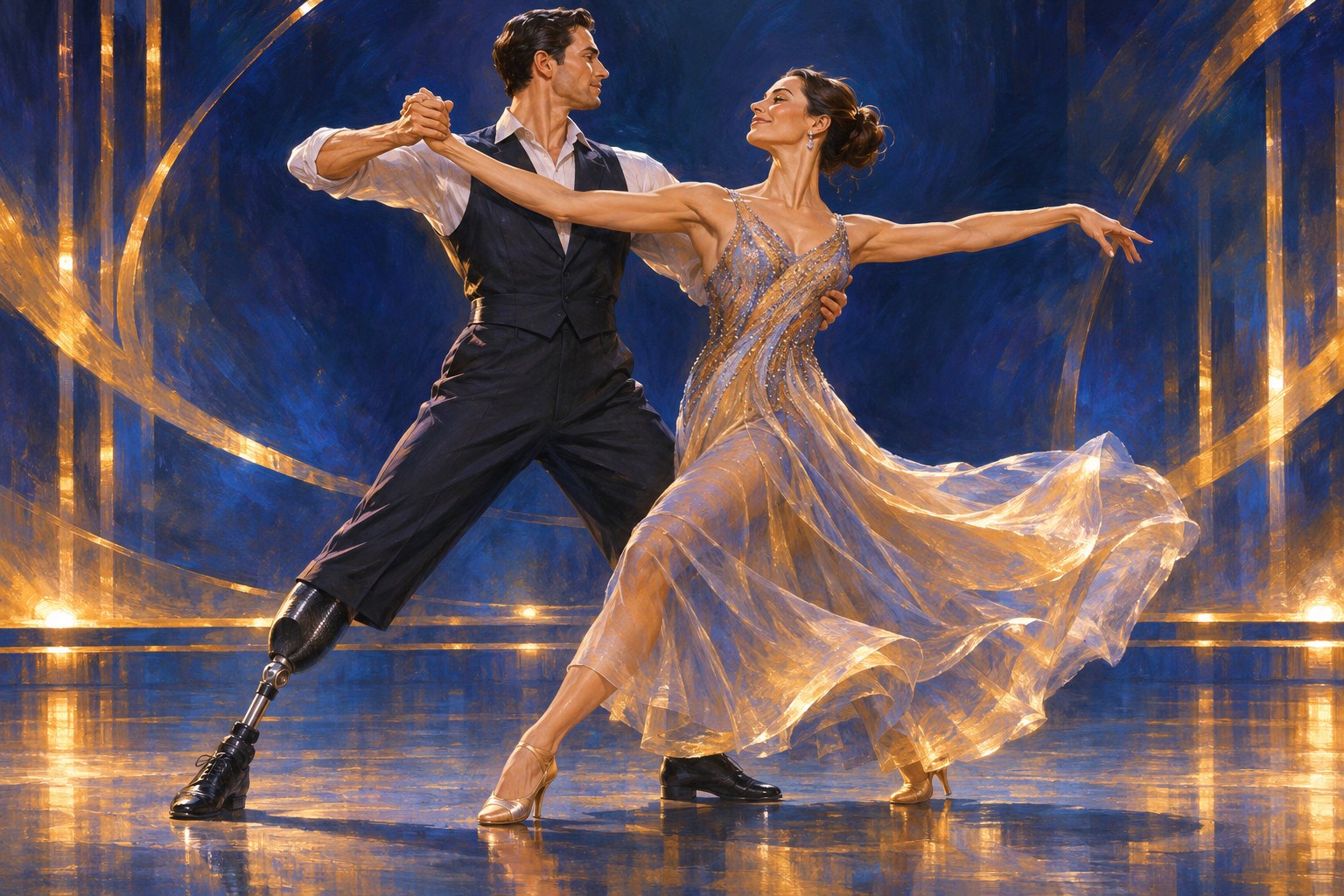
Daniella Karagach’s instruction to Ezra Frech was strikingly direct: “Put on your leg!” In the post-show interview with Extra recounted by TV Insider, that was how she described her shouted response after his prosthetic leg came off during their Dancing With the Stars freestyle. For viewers wondering what she said, the answer is practical, brief, and closely tied to the immediate problem facing her partner.
Frech and Karagach went on to win the season 35 Mirrorball Trophy. Yet the exchange invites a closer look than a simple progression from mishap to celebration. My reading is that its most compelling quality lies in the working relationship it reveals: two performers facing an unexpected interruption, with communication suddenly becoming as important as choreography.
Spoiler notice: This commentary discusses the finale incident and the winning partnership. It examines the reported event and its meaning as television, rather than offering a technical score for the complete routine.
What Karagach’s Shouted Instruction Tells Us
The words themselves contain no elaborate reassurance. They identify an action. That distinction matters because a dance partner has a different responsibility from someone watching at home. The viewer can react to the surprise; the person sharing the floor must respond to circumstances that are still changing.
Read in that context, Karagach’s bluntness is understandable. A polished sentence would have been poorly suited to the moment. Her reported instruction reduces a complicated situation to something concrete. It also keeps Frech involved as the person who must act, rather than turning him into a passive subject of someone else’s concern.
We should be careful about attaching a complete emotional story to five words. They do not establish everything she was thinking, how frightened either performer felt, or what private preparations preceded the routine. What they provide is a small, specific piece of communication. That specificity is more revealing than an invented account of their inner lives would be.
Frech Deserves to Remain the Performer at the Center
There is an obvious danger in discussing this incident: the prosthetic leg can become the entire subject, pushing the dancer out of his own performance. An unusual interruption is easy to describe and easy to remember. Musical interpretation, physical control, and the work of maintaining a partnership require more sustained attention.
A useful critical response keeps both levels in view. The incident matters because it happened during a performance. The performance matters for more reasons than the incident. Frech should remain legible as a competitor making decisions under pressure, with artistic ambitions that extend beyond giving an audience a dramatic surprise.
That means avoiding automatic conclusions in either direction. An equipment problem does not establish a lack of preparation. A compelling response does not, by itself, settle every question about dance quality. Those judgments require evidence from the routine, including its timing, movement, transitions, and relationship to the music.
It also means resisting the temptation to tell disabled performers’ stories only through adversity. Admiration becomes more meaningful when it names an actual skill. Attention, responsiveness, and coordination are useful subjects for criticism; a generalized declaration that someone is inspiring can leave the substance of their work strangely unexplored.
The Professional Partner’s Work Becomes Visible
Ballroom partnership depends on two people continually responding to each other. Choreography supplies a plan, but a plan cannot eliminate the need to notice what is happening in the present. A change in position or an interrupted movement can alter what the other dancer needs to do next.
Karagach’s reported instruction draws attention to that less glamorous layer of performance. Professionalism includes the ability to communicate something useful when the intended sequence no longer describes the immediate situation. The work is relational: what one dancer does changes the options available to the other.

This is also why an isolated image can be an inadequate account of a partnership. A photograph of surprise captures an expression. A description of the shouted instruction supplies a different kind of information: an attempt to influence what happens next. Understanding performance requires attention to that sequence of response and action.
The same viewing principle informs our discussion of how to assess an individual performance beyond its highlight. In both settings, the most memorable instant can obscure the surrounding coordination that makes it intelligible.
Why the Trophy Cannot Explain the Incident
Frech and Karagach’s victory gives the finale a decisive ending. It does not provide evidence that the prosthetic incident caused the result. Without a basis for separating the influences on the outcome, claims about a decisive sympathy response or a single victory-clinching moment would be speculation.
Competition television encourages viewers to connect dramatic events with final announcements. That connection feels satisfying because it resembles a familiar story structure: disruption, response, reward. But an emotionally persuasive sequence is not the same thing as an established explanation of voting or judging.
Our commentary on James Gray’s challenge to the logic of film festival competitions raises a related question about recognition and criticism. A prize identifies a winner within a competition. It cannot substitute for examining the qualities of the work being recognized.
Here, that distinction allows the Mirrorball win and the dance-floor exchange to retain their separate significance. One is the result. The other is a revealing episode in a performance partnership. Neither needs to become a complete explanation of the other.
A More Useful Way to Remember the Finale
For viewers revisiting the performance, three questions offer a better starting point than simply waiting for the interruption: How are the partners communicating before it? What changes when the expected sequence is disrupted? How does their interaction shape what follows? These questions direct attention toward observable behavior instead of assumed emotions.
My strongest response to Karagach’s words is that they bring the scale of the story back down to two people doing a difficult job together. A televised finale invites grand language. Her instruction belongs to the immediate present, where there is a problem and another person who needs to hear something useful.
That is the deeper interest of this episode. Performance involves preparation, but it also involves responding when preparation no longer supplies every answer. Frech and Karagach’s exchange makes that responsibility briefly audible. Remembering the dancer, the partner, and the communication between them gives the moment more substance than treating the fallen prosthesis as the whole story.
Original content by this site's editorial team. Published: November 25, 2026 at 06:57:27 PST (Los Angeles time)