The Dallas Cowboys’ Tape Talk look back at Cowboys vs. Giants concerns football game footage, rather than a feature film. Its premise nevertheless raises a question familiar to movie criticism: how does the way we see an event influence the story we tell about it? A replay can reveal an overlooked contribution, but its framing can also make one player seem responsible for an outcome that began elsewhere.
The announced subject establishes a retrospective on the matchup. It does not, by itself, establish which plays receive attention or what the breakdown concludes. This commentary examines the viewing questions that premise opens up; it does not rate an unseen installment or reconstruct unverified game action. There is no fictional plot, dialogue, or hidden scene to invent.
A replay already knows the ending
Watching a game unfold and revisiting its footage are different experiences. During live action, the next moment remains uncertain. On replay, the outcome pulls our attention backward. We search for the error before a failed play or the decisive movement before a successful one. That search can be illuminating, but it can also make a complicated sequence look inevitable.
For a Cowboys–Giants retrospective, the most interesting editorial challenge is preserving uncertainty long enough to explain it. A player moving into open space may look obviously available when the footage stops. Whether that opportunity was visible and usable at the relevant instant is a separate question. Distance, obstruction, timing, and the movement of other players can change the interpretation.
My critical preference is for a breakdown that first lets the action breathe. Show the sequence at its original pace, establish the question, then slow it down. Otherwise, the viewer receives a verdict before receiving an experience against which to test it. The replay becomes an illustration of the narrator’s certainty.
Players have perspectives, not scripted character arcs
Movie reviews often begin with what a character wants and what prevents them from getting it. That approach has a useful, limited application here. Watching from a player’s perspective means asking what information and space were available at a particular moment. It does not mean assigning thoughts, emotions, or intentions that the footage cannot establish.
Consider a hypothetical defender who changes direction while another player moves behind him. A freeze-frame might invite an accusation of hesitation. A longer sequence might instead reveal conflicting threats. Neither explanation should be treated as a finding about Cowboys vs. Giants without the relevant evidence. The example illustrates why visible movement and inferred responsibility belong in separate sentences.
There is an ethical distinction, too. A fictional character has been constructed to support interpretation. An athlete is a real person whose assignment may not be fully available to an outside viewer. Calling a movement late is a bounded observation when timing supports it. Calling the player indifferent turns that observation into a claim about character.
Our discussion of Nate Bennett and Baylor’s running game addresses the relationship between individual actions and surrounding opportunities. The additional issue here is narrative perspective: which person does the replay encourage us to follow, and whose contribution disappears as a result?
The edge of the frame can become the edge of the explanation
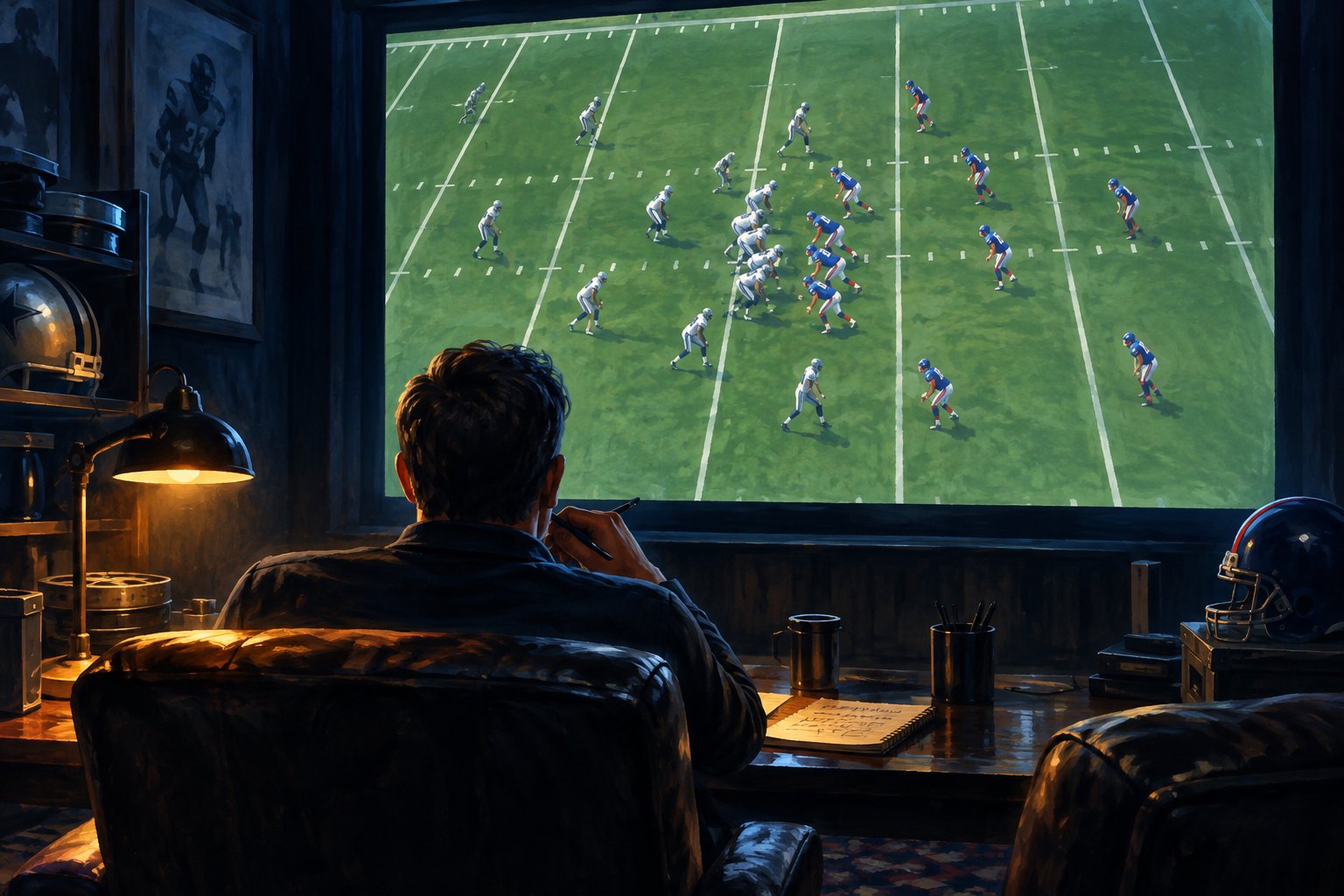
A close view offers physical detail: balance, contact, a turn of the shoulders. A wider view offers relationships: separation, spacing, and movement away from the ball. Neither view is inherently complete. Each answers some questions while making others harder to ask.
That matters when a Cowboys–Giants sequence becomes a compact story about one confrontation. The visible contest may be its dramatic center without being its sole cause. A movement elsewhere could influence the space available; the camera might simply leave that movement outside the frame. The proper conclusion in that situation is limited visibility, rather than certainty about what the missing area contains.
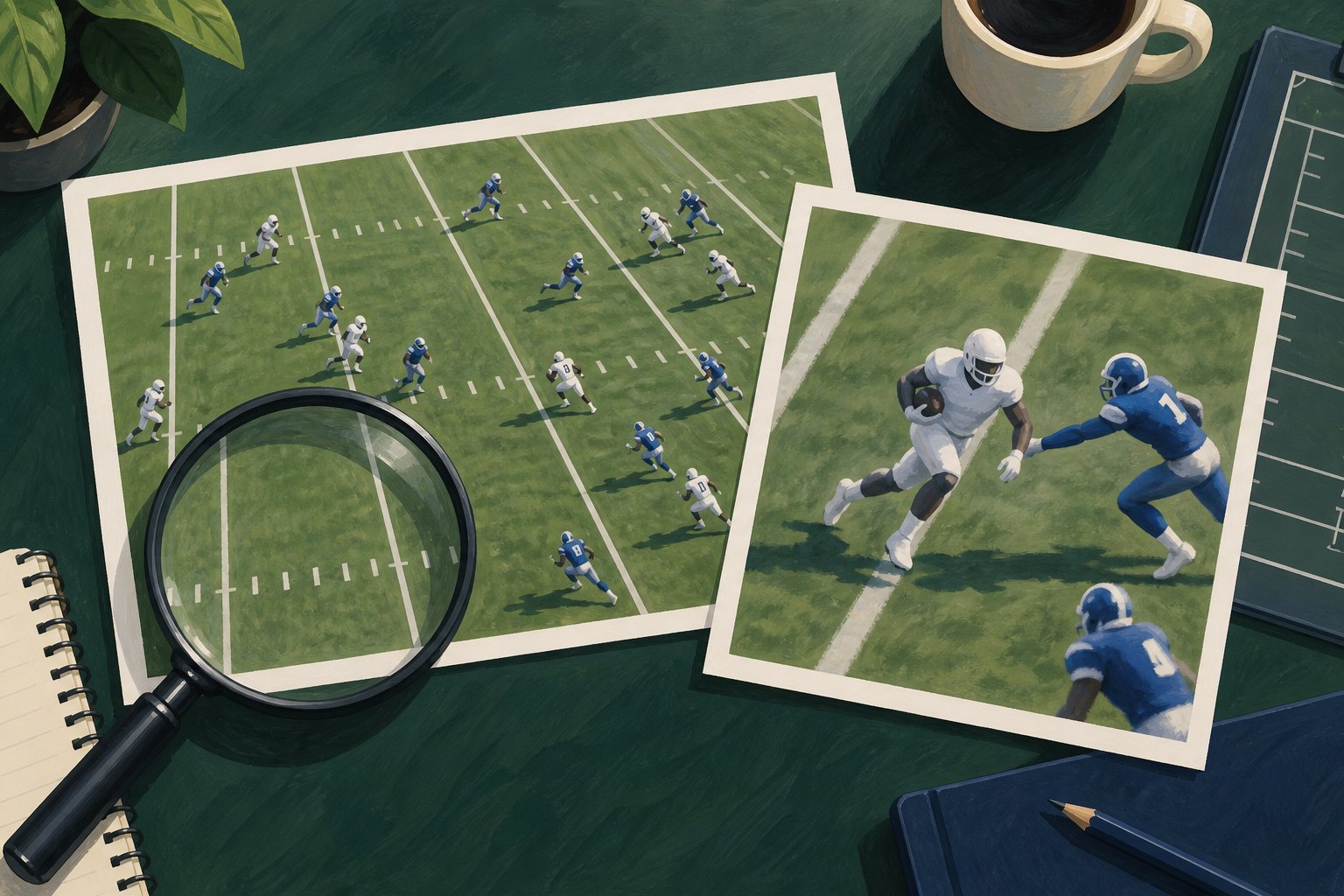
The accompanying illustration makes this a question of composition. A tight image gives us an encounter. A wide image asks us to consider the surrounding arrangement. In screen criticism, both are meaningful choices. In sports analysis, the choice also determines how much evidence a viewer has for the explanation being offered.
Editing can create a pattern—or exaggerate one
A retrospective necessarily selects. It cannot give every moment equal emphasis and still remain a focused piece of commentary. The important question is whether the selected moments support the size of the claim.
One sequence can demonstrate that something happened. Several comparable sequences may support an argument that it happened repeatedly. Neither automatically establishes the defining characteristic of an entire performance. A compelling montage can blur those differences because repetition feels persuasive even before the surrounding circumstances have been compared.
This is where a football replay and a movie montage share a storytelling device. Place similar images together and viewers begin to perceive continuity. The relationship may be justified, but the cut itself cannot prove it. A persuasive Cowboys–Giants breakdown would explain what makes its examples comparable and where that comparison stops.
Counterexamples are especially valuable. If a proposed weakness disappears under different circumstances, those circumstances may explain more than another replay of the original failure. The most revealing edit sometimes interrupts its own argument.
What a team-centered viewpoint should make visible
The Cowboys are the publisher identified with this Tape Talk item, so Dallas provides an understandable point of entry. That perspective does not settle the quality of the analysis. It does create a useful question for viewers: does the explanation give the Giants meaningful agency?
A team-centered story can describe every setback as its own side’s failure and every success as its own side’s execution. The opponent then becomes scenery. A fuller account considers that another group of players is acting, adapting, and influencing the available choices. Explaining Dallas requires taking New York seriously as a participant in the same sequence.
That attention to perspective also connects with our character-first approach to screen criticism: following a central figure becomes more revealing when the surrounding people retain their own purposes.
The deeper value of looking again
The promise of a Cowboys vs. Giants film-room retrospective is a change in attention. The first viewing gives us an outcome. A careful second viewing can reveal relationships, constraints, and contributions that the outcome initially obscured.
For me, the strongest replay commentary makes responsibility more precise without pretending that every uncertainty has vanished. It distinguishes what the image shows from what the analyst infers, restores the opponent’s role, and explains why a chosen moment deserves attention. The reward is a richer account of the game: one in which watching again means becoming more observant, rather than merely more certain.
Original content by this site's editorial team. Published: September 15, 2026 at 16:57:21 PDT (Los Angeles time)