The best movie quotes give us something worth repeating and a character worth remembering. A Reddit discussion about favorite film lines, reported by Fox News, brings that familiar argument back into focus. But recognition alone cannot settle it. A sentence can be instantly identifiable without being the most revealing thing its movie has to say.
Our critical test is simple: return the line to its scene. Does it expose a fear, change a relationship, or make a decision possible? Casablanca offers an especially rewarding case study. Its dialogue survives as conversational shorthand, yet the film becomes more moving when those familiar words recover their original stakes.
This is our own close reading, rather than an account of which titles Reddit commenters selected. Full spoilers follow for Casablanca, including its ending.
Why Casablanca belongs in the conversation
Michael Curtiz’s 1942 film stars Humphrey Bogart as Rick Blaine and Ingrid Bergman as Ilsa Lund. Their reunion turns a romantic grievance into a moral problem: Rick must decide what his feelings entitle him to demand of another person.
That is the foundation of the film’s quotability. Its lines rarely function as decorative wisdom. They are conversational tactics: ways to deflect an inquiry, conceal an injury, request forgiveness, or make surrender bearable. The screenplay gives characters polished language while allowing us to hear the less polished feelings beneath it.
For me, this remains the film’s greatest strength. Its elegance does not eliminate emotional messiness. Instead, it gives wounded people a way to conduct themselves while their certainty falls apart. The pleasure lies in hearing the gap between what Rick can say smoothly and what he cannot yet admit.
Rick: a memorable line can be a bad philosophy
Rick announces his detachment with a compact rule: “I stick my neck out for nobody.” In a city crowded with refugees, that position has consequences. His cafe offers the appearance of a space where business can continue while political commitments remain outside.
As a standalone quotation, the line can sound admirably tough. Within the film, it invites skepticism. A personal rule stated so firmly can also be a plea: do not ask anything of me, because caring has already cost too much.
Bogart makes that defensiveness compelling without making it entirely attractive. Rick’s restraint invites us to watch for cracks. His dismissiveness can be funny, but it also gives him control over conversations he does not want to have. The performance makes silence feel like something maintained through effort.
This is one useful distinction in any debate about the greatest movie quotes: a character’s most memorable statement need not express the film’s moral judgment. Sometimes the story exists to dismantle it. Repeating Rick’s rule as life advice means overlooking the movement that makes his story satisfying.
Ilsa: the listener changes the meaning
Ilsa’s arrival with resistance leader Victor Laszlo reopens Rick’s memories of Paris. He understands their separation as abandonment; she eventually explains that she had discovered her husband was alive after believing him dead. His private version of the past cannot survive her account unchanged.
From Ilsa’s perspective, the drama concerns competing loyalties that cannot be resolved through perfect phrasing. Bergman’s performance keeps uncertainty visible. Her attention matters as much as Rick’s speeches: a line reaches its emotional destination through the person receiving it.
Consider “Here’s looking at you, kid.” Its wording is casual, almost evasive. It becomes affecting because affection is being expressed through a familiar ritual rather than an exhaustive explanation. The phrase allows tenderness without requiring the speaker to describe every feeling involved.
That helps explain why audiences borrow movie dialogue. A remembered line can offer a little shelter when direct speech feels too exposed. We recognize the borrowed voice, but we also recognize the need behind the borrowing.
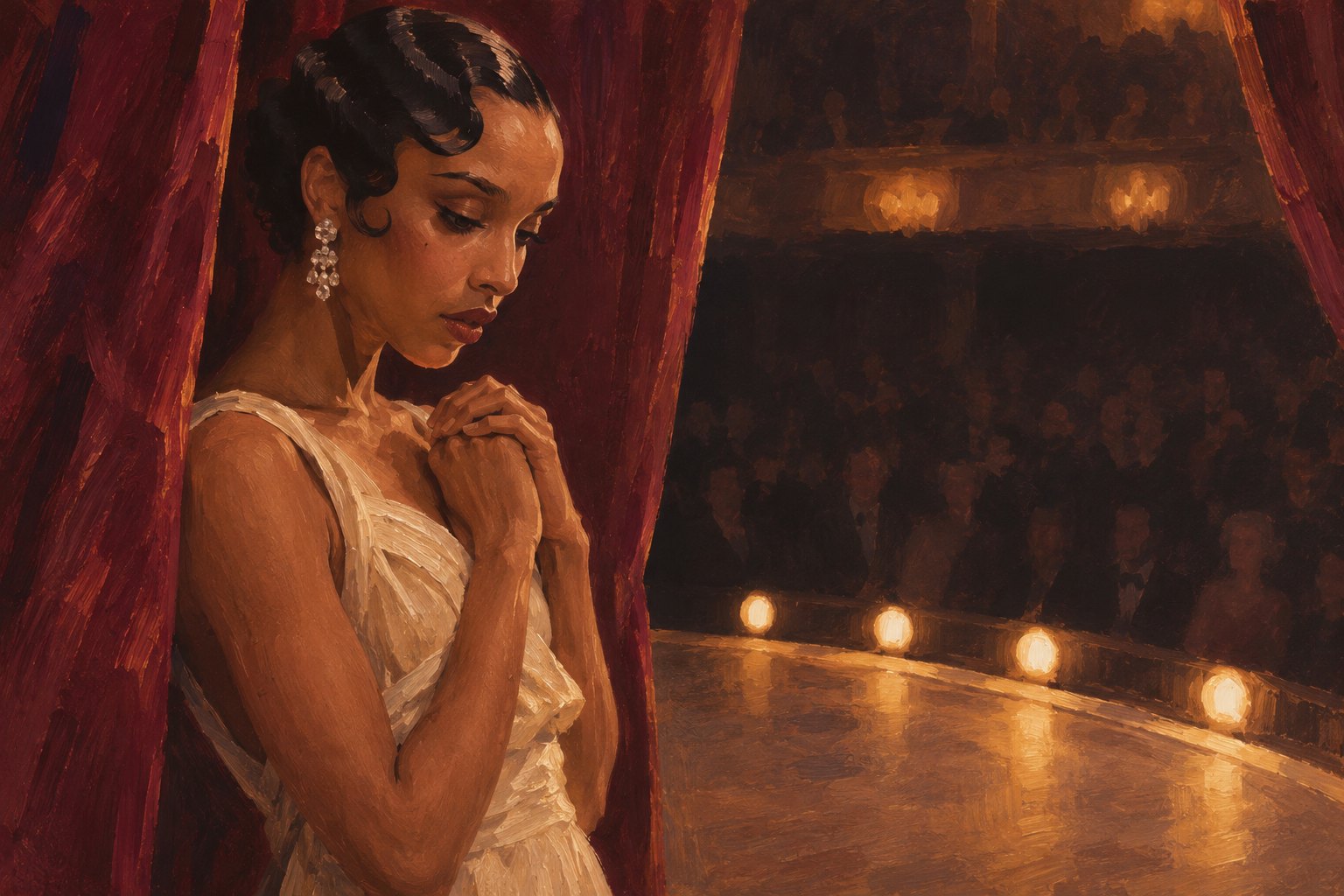
The relationship between an identifiable persona and a character’s inner life also informs our discussion of the performance challenge of portraying Josephine Baker. Recognition can draw attention; the acting must give that attention somewhere deeper to go.
Paris becomes a memory they can share
At the airport, Rick sends Ilsa away with Laszlo. “We’ll always have Paris” gives their relationship a future in memory while accepting that they will not continue it together.
The sentence matters because Rick has stopped treating the past as evidence in a prosecution. Earlier hurt demands an explanation and imagines repayment. Here, remembering becomes something less possessive. An experience can remain valuable even when it does not guarantee the outcome one person wanted.
In my reading, this is the film’s most mature emotional turn. Rick does not need to decide that the romance was meaningless in order to release it. Nor must he pretend that releasing it feels good. The line permits gratitude and grief to occupy the same breath.
There is a limitation worth acknowledging. The ending gives Rick substantial authority over Ilsa’s future. Viewers can admire his sacrifice while questioning how completely the film organizes her dilemma around his moral achievement. Bergman’s emotional presence complicates that arrangement, but it does not erase it.
Renault: a punch line becomes a choice
After Rick shoots Major Strasser, Renault protects him with the instruction “Round up the usual suspects.” The line’s familiarity can obscure its function: this is speech that changes what happens next.
Its humor comes from the mismatch between official procedure and the decision being concealed. Renault does not need a declaration of newfound virtue. His response demonstrates an allegiance while preserving his practiced manner.
That makes him an instructive counterpoint to Rick. Character development need not produce an entirely new vocabulary. A person can keep the same wit and social habits while directing them toward a different purpose. The recognizable voice helps us notice the changed choice.
It is also why delivery belongs in the best-quote argument. Timing tells us whether words are a confession, a joke, an order, or several things at once. A transcript preserves the sentence; the performance reveals the transaction.
A better way to judge your favorite movie quote
No single standard can fairly compare every romantic farewell, comic interruption, and threatening promise. Still, three questions make the discussion more useful:
- Who needs to say it? The strongest dialogue often reveals something specific about its speaker.
- What does saying it accomplish? Look for persuasion, concealment, reassurance, refusal, or a changed relationship.
- What does the surrounding film add? A great scene can make ordinary words devastating.
These questions also help separate a favorite quotation from a favorite movie. A film can contain one extraordinary line without sustaining that quality throughout. Conversely, deeply affecting storytelling may depend on accumulated behavior more than a sentence anyone can recite. Our character-focused review of It’s a Wonderful Life explores how emotional force develops through a life’s compromises and relationships.
What the familiar words finally reveal
Casablanca earns its place in this discussion because its memorable dialogue accompanies a change in Rick’s understanding of love. He begins by using language to restrict his obligations. He ends by finding words that allow him to accept them.
My verdict is that the film’s romantic power comes from this difficult adjustment: feeling deeply does not give someone unlimited claims on another person. Its wit makes that insight pleasurable to encounter, while its performances preserve the pain involved.
The best reason to revisit an iconic movie quote is therefore the possibility of hearing it differently. A sentence remembered as confidence may reveal fear. A farewell may contain respect. The words endure because the character’s choice remains worth thinking about after we know every syllable.
Original content by this site's editorial team. Published: November 12, 2026 at 02:38:14 PST (Los Angeles time)