
Ebenezer and Godzilla Minus Zero receive distinctly different assessments in Vail Daily’s Movie Guru coverage: the Christmas film is characterized as a conventional Dickens retelling, while the monster sequel receives enthusiastic praise. For readers weighing the two, the reported preference is clear. What deserves closer attention is the distinction behind it. Returning to familiar material can deliver reassurance, discovery, or merely recognition—and those experiences are not interchangeable.
This is an analysis of that critical contrast, rather than an independent viewing verdict on either release. The reported assessments do not establish specific performances, scenes, dialogue, or endings. The character discussion below therefore distinguishes Dickens’s established story from the questions facing the new films.
Spoiler note: The following discusses the transformation and ending of Charles Dickens’s A Christmas Carol. It does not reveal unverified plot developments from either new movie.
Ebenezer: Familiarity Is Part of the Attraction
Calling a Christmas Carol adaptation conventional does not automatically make it worthless. For many viewers, the return is the attraction: the wintry atmosphere, supernatural reckoning, and promise that an apparently immovable person can change. Surprise is only one pleasure a film can offer. Recognition can be powerful when a performance makes an old emotional movement feel immediate.
Scrooge also presents an unusual dramatic challenge. Audiences generally know where he will end up before he appears. The uncertainty lies in the journey: whether this particular man seems capable of recognizing another person’s suffering, and whether his resistance feels psychologically coherent.
My critical preference is for adaptations that make his conversion difficult. An entertainingly unpleasant miser can carry individual scenes, but sustained cruelty needs an internal logic. Otherwise, the final generosity becomes a costume change: the same recognizable figure wearing a happier expression.
The restrained assessment of Ebenezer leaves an important question open. Does its familiarity provide a satisfying emotional ritual, or does it make Scrooge’s awakening feel predetermined? Those are different possibilities, and the brief reported verdict cannot settle the distinction.
Scrooge’s Real Problem Is How He Sees Other People
In Dickens’s story, Scrooge reduces relationships to transactions. His treatment of Bob Cratchit makes that habit concrete: another person’s needs register chiefly as inconvenience and expense. Christmas challenges him because it proposes obligations that cannot be justified through personal profit.
The famous dismissal “Bah! Humbug!” is memorable because it compresses this defensive worldview into an impatient outburst. Quoted here from Dickens, rather than attributed to the new film, it expresses more than dislike of holiday festivities. Scrooge rejects the possibility that the people around him might legitimately ask anything of him.
That is why the ghosts’ intervention works as more than punishment. The past supplies context for his isolation; the present exposes lives continuing beyond his narrow attention; the future reveals what his habits will leave behind. The story changes the scale of his awareness before it changes his behavior.
A persuasive adaptation should let viewers feel those stages separately. Remembering pain is not the same as accepting responsibility. Feeling frightened is not the same as becoming compassionate. If all three experiences collapse into generalized distress, the supernatural machinery may remain intact while the character development grows thin.
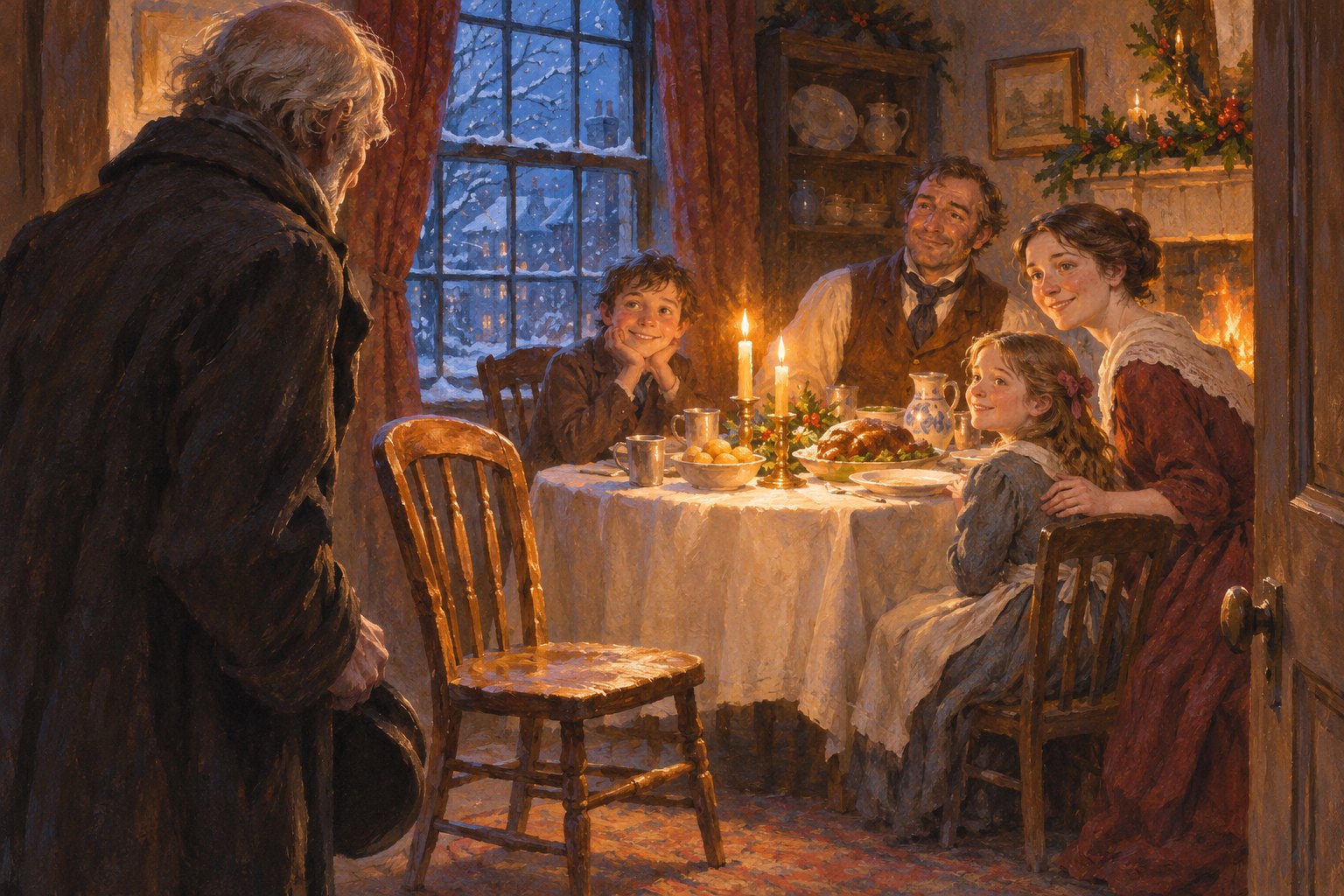
Bob Cratchit Is More Than Evidence Against His Employer
Looking at the story from Bob’s perspective changes its center of gravity. Scrooge experiences a remarkable night; Bob lives with the consequences of his employer’s ordinary decisions. The supernatural adventure belongs to one man, but the material stakes belong to a household.
That difference matters when judging any retelling. If the Cratchits function only as a touching spectacle, their hardship becomes an instrument for the wealthy protagonist’s improvement. Giving them humor, affection, and recognizable relationships allows them to exist beyond the lesson they teach him.
Marley’s declaration, “Mankind was my business,” identifies the ethical failure with unusual economy. Again, this is Dickens’s language, not a verified quotation from Ebenezer. The line turns Scrooge’s preferred vocabulary against him: a successful working life can still represent a catastrophic misunderstanding of responsibility.
For me, the decisive moment in this story is therefore not simply Scrooge’s relief at surviving his visions. It is the movement from private emotion to practical generosity. The ending earns its warmth when other people’s circumstances begin to change.
Godzilla Minus Zero Faces a Different Kind of Familiarity
A sequel carries a different burden. A retelling can revisit an established transformation, but a continuation must explain why there is more story to tell. Movie Guru’s praise positions Godzilla Minus Zero as the more successful return in this pairing. It does not, by itself, identify which narrative decisions produce that success.
The useful critical question is what continuation demands of the human characters. A renewed threat can expose consequences that an earlier ending could only begin to address. It can also reduce previous experiences to a reset button, returning people to familiar positions so that another spectacle can unfold.
Those possibilities should not be confused. A character who has endured catastrophe should bring some residue of that experience into the next crisis: changed priorities, damaged trust, new attachments, or a different understanding of survival. These are criteria for evaluating the sequel, not claims about its specific plot.
Our discussion of why enthusiasm for Cliff Booth raises deeper questions about returning characters approaches a related problem. Audience affection establishes interest. It cannot do the work of character development.
Scale Matters Only When Someone Has Something to Lose
The contrast between a Christmas ghost story and a giant-monster sequel can seem almost comically large. Yet both invite a similar test: can extraordinary events make ordinary lives more visible?
In a monster film, size becomes emotionally meaningful through perspective. Destruction viewed at a distance conveys magnitude; danger understood through someone’s obligations conveys cost. The difference is not simply visual. It concerns whose fear the film allows us to understand and whose future it asks us to imagine.
Craft helps establish that perspective. Sound, silence, framing, and duration can make a human reaction matter as much as an overwhelming image. Our examination of how film music shapes character perspective explores why emotional emphasis depends on more than memorable themes.
Those choices would require direct examination before becoming a verdict on Godzilla Minus Zero. What the reported praise offers is a reason to investigate its achievement, not permission to invent an explanation for it.
The Deeper Test Is Whether Returning Changes Our Attention
The most useful distinction between these films is not that sequels are inherently more adventurous than adaptations. Either form can become mechanical. Either can make familiar material newly affecting.
Scrooge’s story offers a particularly sharp standard: recognition must lead somewhere. He already knows that other people exist. His transformation begins when their lives acquire weight in his decisions. A continuation faces a comparable artistic demand: what audiences remember should change the meaning of what comes next.
On the reported assessments, Godzilla Minus Zero receives the stronger recommendation, while Ebenezer offers a more familiar encounter with Dickens. The larger question for both is whether revisiting their worlds deepens our investment in the people inside them. Familiarity becomes valuable when it gives us more to notice—and more reason to care.
Original content by this site's editorial team. Published: November 17, 2026 at 01:46:57 PST (Los Angeles time)