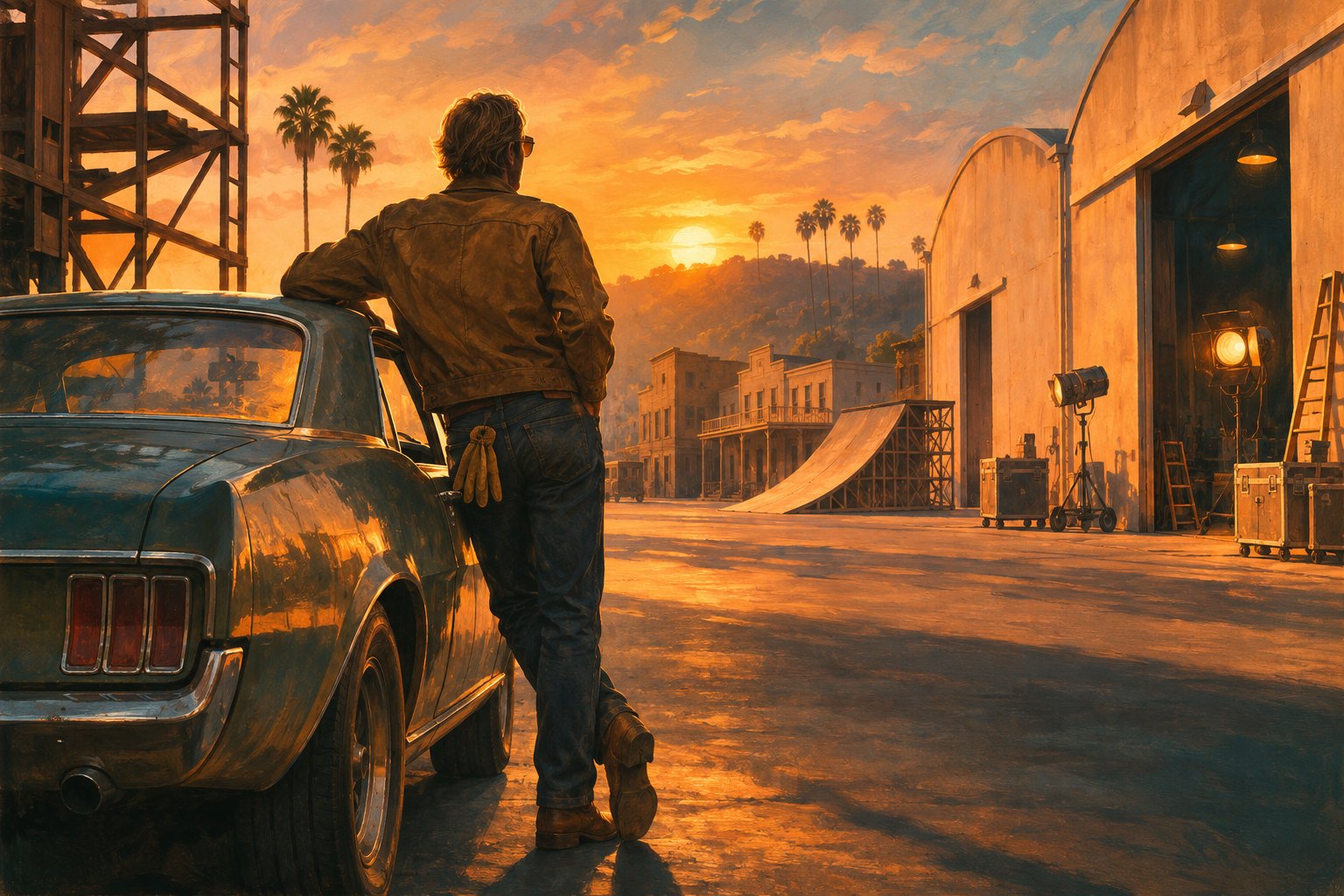
Cliff Booth’s return is attracting the kind of enthusiasm that makes a sequel feel like a welcome reunion. Variety’s first-reactions coverage highlights descriptions of Brad Pitt’s follow-up as an “absolute triumph,” “wildly entertaining,” and a “love letter” to Hollywood. Those phrases establish the excitement surrounding the film. They do not, by themselves, explain whether its central character has become more interesting.
That distinction matters with Cliff. His appeal has never depended simply on looking relaxed while everyone else panics. In Once Upon a Time in Hollywood, he is a friend, an employee, a reassuring presence, and a troubling source of physical power. A new film built around him invites a particular question: what happens when the man who supports somebody else’s story becomes the person whose choices must sustain it?
This is an analysis of the early reception and Cliff’s established characterization, not a firsthand review of the sequel. Spoilers follow for Once Upon a Time in Hollywood.
What the enthusiastic first reactions actually tell us
The most useful distinction in the initial praise is between entertainment and interpretation. Calling a movie entertaining describes an experience; calling it a love letter suggests a relationship with its setting. Neither automatically tells us how the film handles loyalty, responsibility, or the less attractive aspects of its leading man.
For viewers, the promising signal is straightforward: the reported reactions suggest enthusiasm for spending more time in Cliff’s company. The unresolved issue is whether that pleasure comes with dramatic development. An engaging character can carry an enjoyable scene through posture, timing, and a well-placed glance. Carrying a whole film also means giving those gestures something consequential to express.
It would be premature to convert those reactions into a definitive verdict. The stronger critical approach is to identify what made Cliff compelling in the first place, then ask whether the sequel develops those qualities. His original film provides a more demanding standard than effortless cool.
Cliff’s real job is keeping Rick Dalton functioning
Cliff is introduced through his relationship with Rick Dalton, the actor whose professional confidence is becoming increasingly fragile. Their connection extends beyond stunt work. Cliff drives, handles practical tasks, and absorbs emotional turbulence. Rick worries about his place in Hollywood; Cliff helps him get through the day.
That imbalance is essential to the performance. Pitt makes listening look active. Cliff’s pauses give Rick room to unravel without turning every exchange into a contest for attention. The friendship feels affectionate partly because Cliff recognizes when reassurance matters more than an argument.
His blunt encouragement—“You’re Rick fucking Dalton. Don’t you forget it.”—works as a miniature pep talk. Yet the line also reveals how much of Rick’s confidence requires maintenance. Cliff is reminding his friend of an identity that no longer feels secure from the inside.
My reading is that this makes their friendship moving and precarious at once. Cliff’s usefulness brings the men together, but usefulness is an unstable foundation for intimacy. When employment and affection overlap, it becomes difficult to tell where obligation ends and freely chosen loyalty begins.
That is also why Pitt’s screen chemistry deserves more attention than his character’s swagger. As our discussion of Pitt’s importance to the Ocean’s ensemble explores, the relationships surrounding a charismatic performer can be as important as the performance itself.
Hollywood looks different from the worker’s side
Cliff’s position gives the original film a useful angle on Hollywood. Rick must remain visible. Cliff’s work largely consists of helping things happen around that visibility. Even repairing a television antenna places him in a practical relationship with the machinery of someone else’s comfortable life.

The distinction is more revealing than a simple contrast between success and failure. Cliff possesses competence that does not necessarily translate into status. He can solve immediate problems without controlling the conditions of his employment. His composure can therefore be read as a way of living with uncertainty, rather than proof that uncertainty never touches him.
This is where the phrase “love letter to Hollywood” becomes critically interesting. Affection for the movies can include affection for the people who perform unglamorous work around them. A film does not need to interrupt its pleasures with a lecture about labor. It can make that labor visible by showing who waits, who fixes things, and who remains available when somebody important needs help.
For a Cliff-centered sequel, that perspective offers genuine dramatic possibilities. Moving him into the spotlight should ideally reveal more of the world he inhabits, including the limits of what his competence can purchase.
At Spahn Ranch, reassurance becomes menace
The original film’s Spahn Ranch sequence tests our comfort with Cliff. He wants to check on George Spahn, a man he knew through earlier work. His persistence has a recognizable human motive: he does not accept that everything is fine simply because strangers tell him so.
But the scene also changes how his calm feels. Among people who regard him as an intruder, his refusal to be intimidated becomes a source of tension. What looked easygoing in Rick’s company becomes confrontational in a different social setting.
The useful character question is not whether Cliff is brave. It is how quickly his confidence can make force seem like the natural solution. The sequence encourages relief that he can protect himself while leaving room to notice how readily he can frighten other people.
A sequel that preserves only the reassurance risks simplifying him. His dramatic value lies in the proximity of helpfulness and danger. The same certainty that makes him dependable can make him difficult to challenge. As with our analysis of confidence and vulnerability in James Bond, toughness becomes more interesting when a film examines what it conceals or costs.
Why “I try” matters more than a victory pose
After the original film’s violent climax, Rick tells Cliff he is a good friend. Cliff answers, “I try.” The brevity is the point. He does not turn the moment into a speech about everything he has done. He accepts the affection without making a grand claim for himself.
To me, that exchange supplies the clearest emotional standard for his return. Beneath the outrageous action, the original film recognizes friendship as something practiced through repeated acts. Cliff’s final response makes loyalty sound ongoing and imperfect, rather than like a title he has permanently earned.
It also leaves an important tension intact. Being a good friend to one person does not settle every question about a character. Affection can be sincere without providing a complete moral defense. A compelling continuation can let us enjoy Cliff while resisting the temptation to make enjoyment equivalent to approval.
The deeper promise of another Cliff Booth story
The early enthusiasm is encouraging, but the richest reason to revisit Cliff is his unusual position within Hollywood’s fantasy of itself. He helps preserve a star’s image while living outside the security that image promises. He offers calm without necessarily offering transparency. His loyalty feels intimate, even when his violence makes intimacy uncomfortable.
That combination is the real opportunity for the sequel. A meaningful love letter to Hollywood can cherish the movies while examining the bargains that keep their world functioning. Cliff is well placed to embody those bargains because he has spent so much time making another man’s life possible.
The question worth carrying into his return is therefore larger than whether Brad Pitt remains entertaining. It is whether the film allows Cliff to need something that charm and competence cannot immediately deliver. That would give the reunion emotional purpose—and make the praise matter beyond the first rush of excitement.
Original content by this site's editorial team. Published: November 17, 2026 at 00:02:14 PST (Los Angeles time)