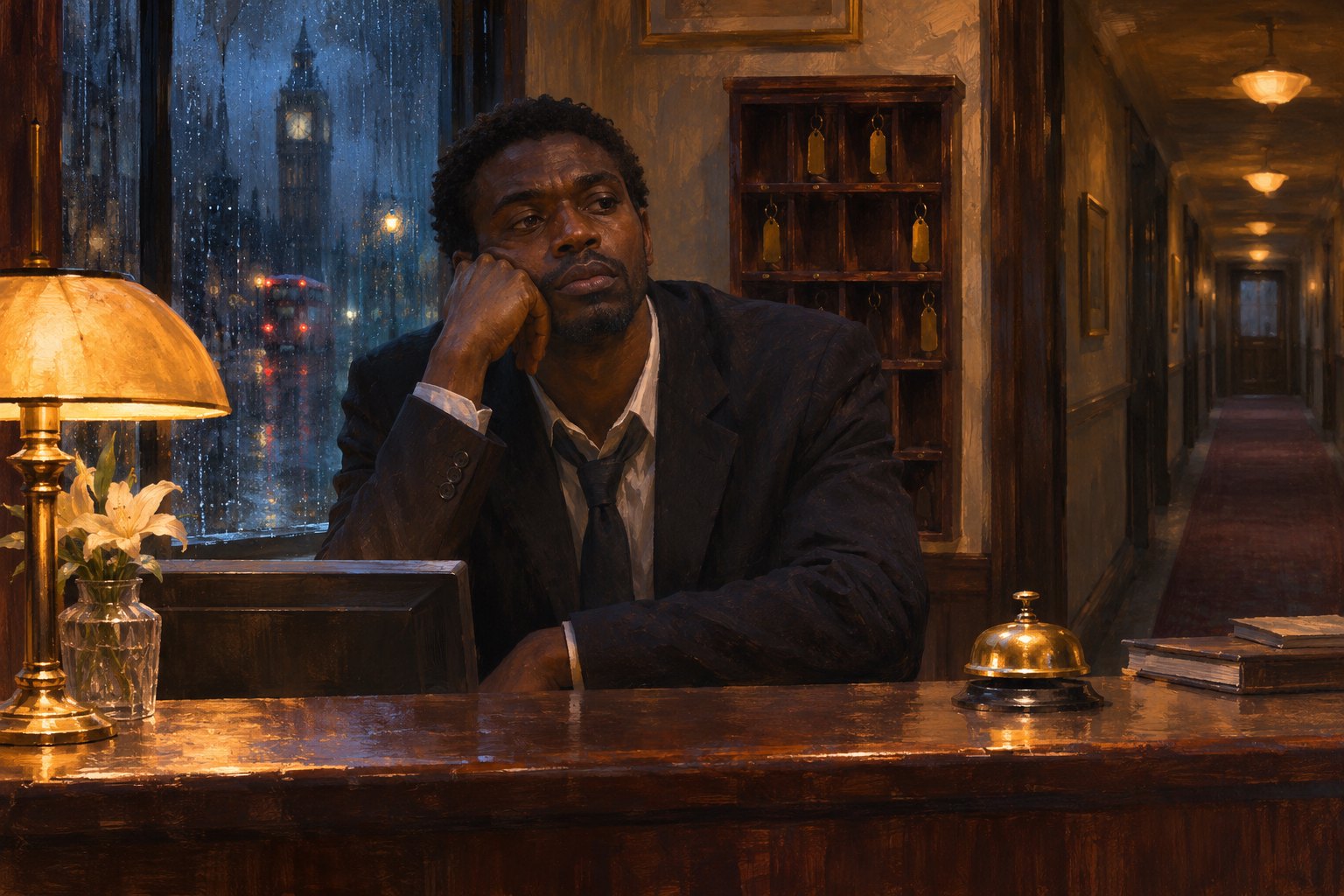
Chiwetel Ejiofor’s reflection on how Stephen Frears’ Dirty Pretty Things led him to fall in love with film makes an illuminating starting point for revisiting his performance. Variety’s coverage identifies the movie as a formative experience for the actor. On screen, the reason to return is equally compelling: Ejiofor makes a man’s efforts to conceal himself impossible to overlook.
Released in 2002, directed by Frears, and written by Steven Knight, the film builds a thriller around workers whose livelihoods depend on remaining useful and inconspicuous. Its strongest achievement is turning those conditions into character drama. Okwe’s restraint, Senay’s longing, and their uncertain trust give the mystery consequences that extend beyond discovering who committed a crime. The production credits and premise are documented by [Miramax’s film overview](https://www.miramax.com/movie/dirty-pretty-things/).
Spoiler warning: This review discusses the organ-trafficking plot and the ending. It also addresses sexual coercion and exploitation.
Okwe’s exhaustion gives the mystery its stakes
Okwe, played by Ejiofor, drives a minicab and works at a London hotel. He is also a medically trained Nigerian exile carrying a history he does not readily disclose. When he discovers a human heart blocking a hotel toilet, his knowledge makes the discovery especially dangerous: he understands that something terrible has happened, while his precarious position makes seeking official help frightening.
That conflict is the engine of Ejiofor’s performance. Okwe cannot simply become an enthusiastic amateur detective. Every question threatens the fragile arrangements that allow him to work, sleep, and remain in the country. Curiosity costs him something before it produces a single answer.
Watch how the performance balances alertness with depletion. Okwe often seems to be conserving his reactions, withholding the energy that another thriller protagonist might spend on anger or surprise. His composure reads as a practiced defense. The unsettling discovery does not introduce danger into an otherwise secure life; it exposes another danger inside a life already organized around avoiding it.
For me, this is where the film earns its suspense. We care about what Okwe discovers because we understand how little protection he has while discovering it.
Senay wants the freedom to choose her own life
Audrey Tautou’s Senay, a Turkish woman working as a hotel cleaner, offers Okwe a place to sleep. Their arrangement creates intimacy without providing security. A sofa can offer refuge, but it cannot remove the pressures surrounding the apartment.
Senay’s desire to reach New York gives her a future to imagine. The destination matters less as a guaranteed paradise than as somewhere she believes she could begin again. Her hope has practical force: it helps explain why she continues searching for an exit when each available route seems to come with another demand.
The film subjects her to sexual coercion and eventually the prospect of surrendering a kidney for documents. These are different forms of exploitation, linked by the same assumption: someone with power believes her vulnerability makes her body negotiable.
There is a limitation here. The screenplay puts Senay through so much that her suffering sometimes threatens to become its principal method of demonstrating injustice. Tautou’s guardedness helps resist that reduction. Senay can be hopeful, angry, embarrassed, and decisive; she does not exist solely to provoke Okwe’s protective instincts.
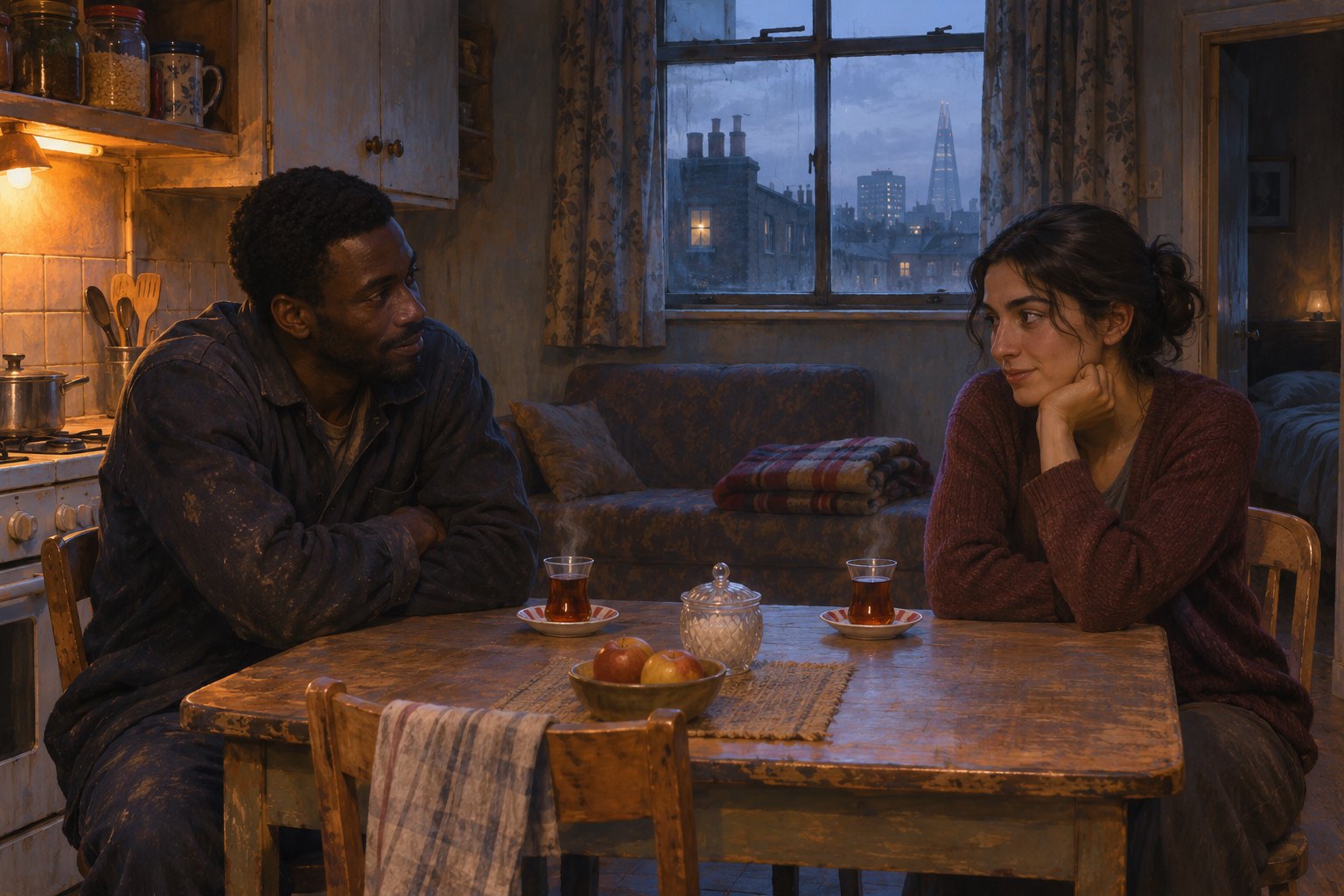
The tenderness between them works because neither can offer easy reassurance. Their relationship raises a question also explored in our analysis of care and attention in All of a Sudden: what does helping another person require when good intentions cannot change the conditions hurting them?
Sneaky makes exploitation sound like an ordinary transaction
Sergi López plays the hotel manager, Juan, known as Sneaky, whose operation exchanges fraudulent passports for organs. His menace comes partly from his managerial manner. He treats an appalling arrangement as a service with costs, benefits, and willing participants.
That reasoning depends on ignoring how severely the supposed participants’ choices have been restricted. A desperate person’s agreement becomes his excuse for refusing responsibility. The hotel’s hierarchy gives the argument a physical setting: the man who controls work also controls access to a possible escape.
From Okwe’s perspective, the offer is particularly corrosive. His medical knowledge could make the operation more effective. A skill associated with care becomes something the manager wants to recruit into exploitation. Refusal preserves a moral boundary, but it does not automatically protect Senay.
Frears and Knight make that dilemma more interesting than a simple contest between decency and greed. Okwe must decide what his decency can accomplish under pressure. Remaining personally untainted may still mean leaving someone else exposed.
The people around Okwe make survival possible
The supporting characters give the film a social world beyond its central couple. Benedict Wong’s Guo Yi, Sophie Okonedo’s Juliette, and Zlatko Burić’s Ivan provide different kinds of assistance and companionship. They matter because Okwe’s intelligence alone cannot solve every practical problem.
By the final movement, that network of favors becomes essential. The people treated as peripheral by the hotel’s respectable surface prove capable of organizing events behind it. Their knowledge of rooms, routines, and one another becomes a source of power.
Okwe’s declaration, “Because we are the people you do not see,” makes the film’s argument explicit. It is a conspicuously written line, but its force comes from the people standing behind it. The story has already shown their labor and cooperation before asking us to recognize the pattern. The dialogue and closing events are recorded in [GradeSaver’s account of the final sequence](https://www.gradesaver.com/dirty-pretty-things/study-guide/summary-part-5).
This is also why an actor’s recollection can be a useful invitation without becoming a verdict. As our discussion of festival judgment and film criticism argues, the work still needs to earn our response. Here, the ensemble earns much of it through the relationships surrounding the thriller’s machinery.
The ending offers escape with a moral cost
Okwe and Senay turn the operation against Sneaky, drugging him and taking his kidney instead. The reversal supplies the satisfaction of a trap sprung on its architect. It also complicates Okwe’s position: the man resisting bodily exploitation performs a nonconsensual operation himself.
I find that complication more compelling than the revenge. The scheme succeeds, but success does not make the act ethically clean. Their escape uses the market that endangered them; it does not dismantle it.
The farewell then changes the emotional scale. Senay heads toward New York, while Okwe intends to return to his daughter in Nigeria. Her line, “Always we must hide,” punctures the expectation that defeating the villain should make everything else simple.
Their separation respects the lives they had before meeting. Affection cannot erase Okwe’s responsibilities or turn Senay’s hopes into an accessory to his story. The ending grants movement without pretending that movement settles every loss.
What Dirty Pretty Things ultimately asks us to see
The film’s deepest subject is the difference between being needed and being valued. Its workers are necessary to the city’s comfort, yet that necessity offers them little security. The organ trade takes this contradiction to its grotesque extreme: a person can become commercially valuable while their wishes and welfare remain disposable.
Ejiofor gives that idea a human center. Okwe’s abilities, grief, and attachments exceed every role imposed on him. His quietness asks the audience to pay attention long before the screenplay announces its argument.
That makes Dirty Pretty Things a revealing film to revisit alongside Ejiofor’s reported affection for the experience. Whatever it unlocked for him professionally, its lasting achievement is visible in the performance: cinema can make a guarded face carry an entire moral struggle, then make us reconsider the people we routinely pass without looking.
Original content by this site's editorial team. Published: November 26, 2026 at 17:50:31 PST (Los Angeles time)