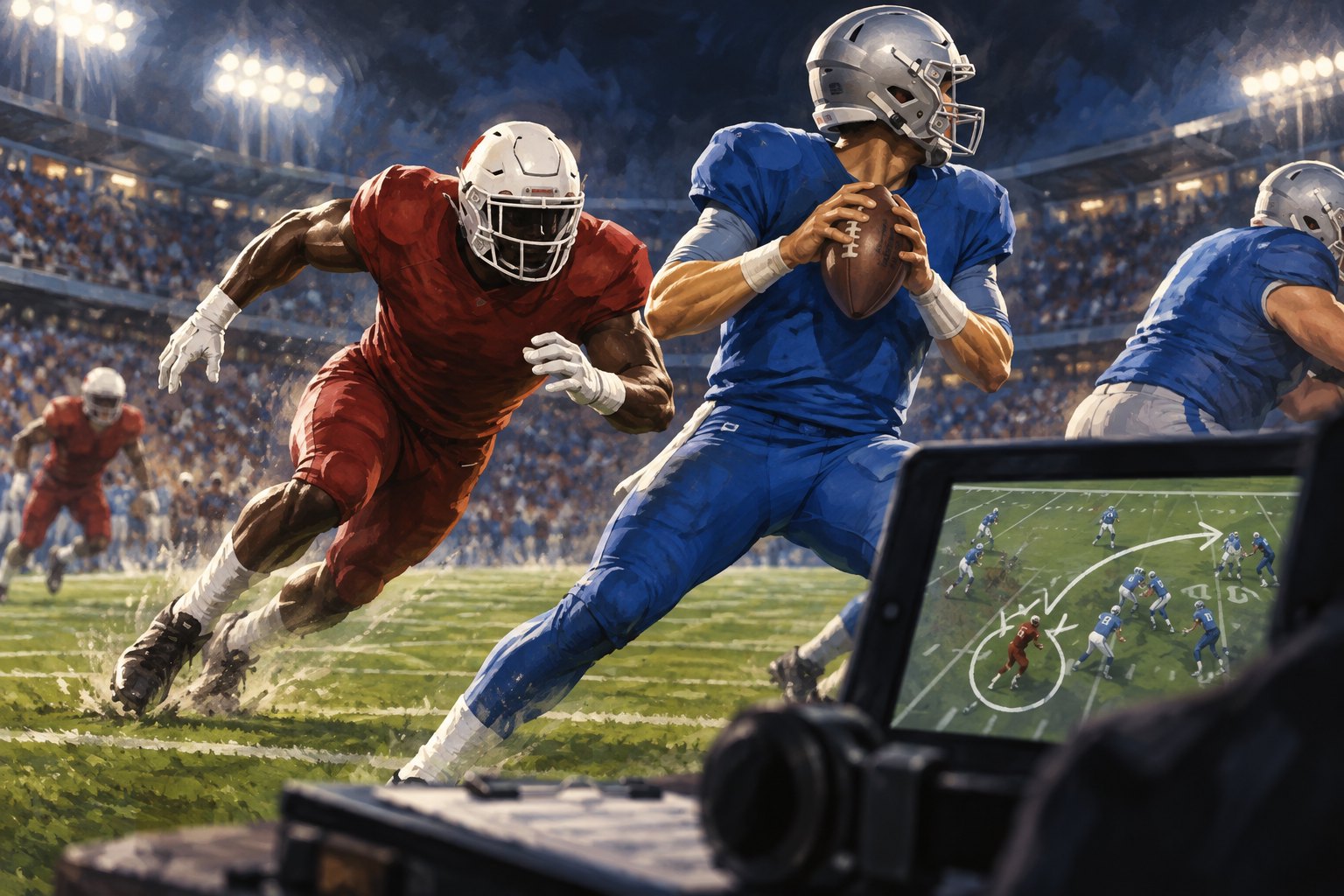
Budda’s blitz sack against the Lions is the subject of the Arizona Cardinals’ Film Room installment, and its appeal begins with a familiar football pleasure: a defender reaching the quarterback before a passing play can develop. The finish supplies the excitement. The more interesting viewing question is what made that finish possible.
This is football film study, with real players and assignments rather than fictional characters and a screenplay. A useful critical approach therefore begins with perspective: what must the defender accomplish, what must the offense protect, and what can a viewer actually establish from the images? The sack is the reported outcome. Its precise route, protection responsibilities, and surrounding circumstances should not be filled in from assumptions.
My view is that a play like this becomes more compelling when the tackle stops being the whole story. Watching the approach can turn a brief burst of action into an examination of timing, shared responsibility, and decisions made with limited information.
Why the Blitz Is More Than a Burst of Speed
A blitz adds pressure by sending a defender who might otherwise have a coverage responsibility. It is an attempt to change the offense’s problem: someone expected to defend space may instead attack the passer. The resulting challenge involves recognition and numbers as much as physical speed.
That distinction matters when considering Budda’s sack. The outcome establishes that he reached the quarterback successfully; it does not, by itself, establish whether the decisive advantage came from disguise, an overload, a favorable matchup, or another player’s contribution. Those are different explanations, and each requires evidence.
The first useful question is where the advantage appeared. Did a rushing lane become available immediately, or did it emerge as players moved? Was there an opportunity for contact before the finish? Could the quarterback move elsewhere? These questions direct attention toward observable relationships without pretending that an unfamiliar defensive call can be identified at a glance.
Speed remains part of the spectacle. But speed has meaning in relation to distance and opportunity. A defender can arrive quickly because of an exceptional first step, a short path, a delayed response, or some combination. Good analysis keeps those possibilities separate until the footage supports a conclusion.
Watch Budda as a Participant, Not a Scripted Hero
A highlight naturally organizes attention around the player who completes the play. For this installment, that player is Budda. Following him through the action is a productive starting point, provided the viewer does not turn movement into an invented account of his thoughts.
In general, a blitzing defender faces competing demands. He needs to attack quickly while maintaining enough control to finish. A direct path can close. An open angle can become an escape route for the quarterback. Reaching the backfield and completing a sack are related accomplishments, but they are not identical.
That gives viewers something more precise to examine than apparent aggression. Watch the relationship between the defender’s path and the quarterback’s position. Look for changes in direction, the space remaining at the approach, and whether the defender arrives under control. These are viewing criteria, not claims about particular movements in this play.
The character-centered habit of asking what someone wants still helps: the defender’s immediate objective is legible. The boundary is equally important. Football footage cannot automatically tell us what he anticipated, heard, or recognized. Describing an action accurately is more revealing than assigning the player a triumphant internal monologue.
The Lions’ Side of the Same Moment
For the offense, a blitz creates a problem that can involve several players at once. Blocking, route development, and the quarterback’s response all operate within the same shrinking interval. A defender’s successful arrival is visible; the distribution of responsibility may be much harder to identify.
A blocker appearing close to the rusher does not necessarily mean that blocker was assigned to him. Nor does an apparently open receiver necessarily prove that a viable throw was available. Timing, sight lines, and the intended structure of the play affect what those images mean.
From Detroit’s perspective, the useful question is where a manageable situation became unmanageable. That question leaves room for both defensive execution and offensive difficulty. It also avoids treating every sack as evidence of one obvious mistake.
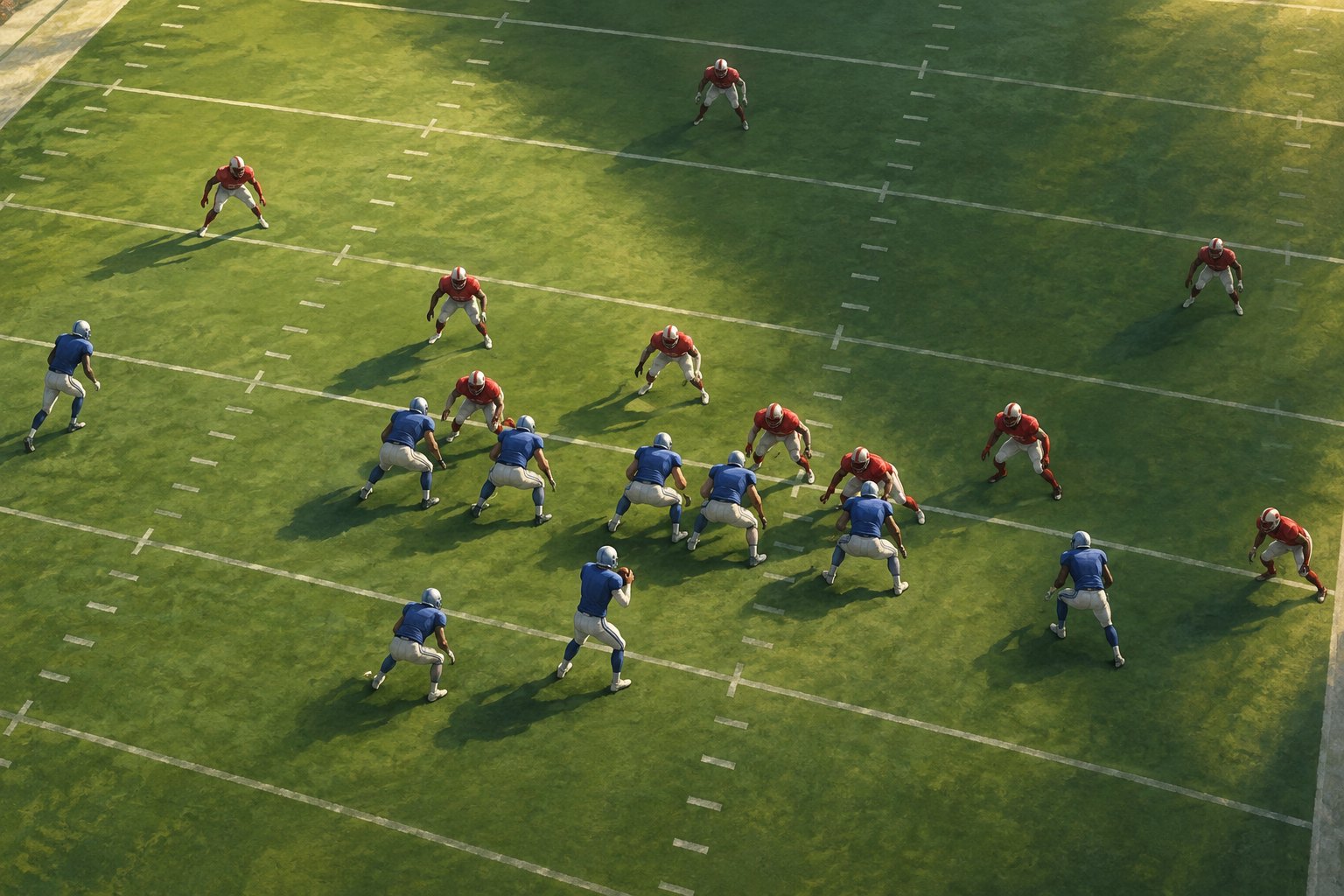
The illustration above represents the broader viewing problem rather than reconstructing the actual sack. The player attracting attention occupies only one part of a larger arrangement. Understanding pressure means watching how that arrangement changes around him.
What a Replay Can Explain—and What It Cannot
A replay gives the audience an advantage no participant had: knowledge of the ending. Once we know a sack is coming, the successful rusher becomes easy to follow. Other possibilities fade into the background, even though they may have mattered while the play was unfolding.
Slow motion can clarify an approach or a moment of contact. It can also make a short decision window feel generous. A freeze-frame helps establish positions, but it removes the movement that gives those positions meaning. Neither technique is misleading by itself; the explanation needs to preserve the difference between analysis time and playing time.
This is also the central concern in our discussion of how to read an offense through game footage: a persuasive explanation should connect a visible detail to its consequence. Simply circling the eventual winner does not explain why the play developed that way.
There is a parallel with our examination of watching beyond a mystery’s final answer. Knowing the outcome can narrow attention too much. Here, the sack is the answer; the interaction leading to it is what rewards closer viewing.
A Practical Way to Watch the Sack
- Start at full speed. Establish the rhythm of the action before pausing. Notice how little time separates the beginning of the play from its outcome.
- Follow Budda through one replay. Concentrate on his starting position, path, and finish. Separate what is clearly visible from what the camera leaves uncertain.
- Watch the nearby offensive players next. Look at their initial movement and interactions. Avoid assigning a blocking error solely because someone is closest to the rusher.
- Return to the wider action. Consider whether other players affect the available space. If the frame excludes them, leave that part of the explanation open.
- Check the explanation at normal speed. A convincing reading should still make sense when the action returns to the pace at which the players experienced it.
This sequence gives each replay a purpose. It also makes disagreement more useful: viewers can point to a movement or an interval instead of arguing over a broad label such as effort or awareness.
The Deeper Appeal of a Defensive Highlight
Budda’s sack has an immediate focal point, but its broader appeal lies in the relationship between an individual finish and a collective contest. The defender completes a visible action within a structure that includes teammates, opponents, assignments, and space.
That does not diminish the achievement. It gives the achievement dimensions. The most rewarding way to watch is to appreciate the impact, then look backward carefully enough to understand what the images can show. A sack lasts a moment. The attention it invites can extend well beyond the player bringing the quarterback down.
Original content by this site's editorial team. Published: October 15, 2026 at 01:42:58 PDT (Los Angeles time)