Choosing books to read with kids before watching their screen adaptations works best when you start with a story your family wants to spend time inside. For a shared chapter-book experience, E. B. White’s Charlotte’s Web is a particularly rewarding choice: its questions about friendship, belonging, and loss remain worth discussing after the credits roll.
Pair it with the 2006 film, and the conversation becomes more interesting than whether the movie included every scene. What makes Wilbur worth saving? Why does Charlotte help him? And how does watching a character change the feelings we formed while reading?
Spoiler notice: The review below discusses the film’s ending, including Charlotte’s death. Families should also know that the story includes the threat of a pig being killed for food. These concerns are documented in the [Common Sense Media parents’ guide](https://www.commonsensemedia.org/movie-reviews/charlottes-web-2006).
Choose the reading experience before choosing the movie
A long list of adaptations can make family reading feel like a completion challenge. A more useful approach is to choose one manageable pairing. Consider how much reading your child enjoys at a sitting, which subjects hold their attention, and whether the story’s emotional difficulties are ones you want to explore together.
Independent reading ability and readiness for a movie are different considerations. An adult can make a challenging chapter accessible by reading aloud, explaining a word, or stopping for a question. A film supplies voices, faces, movement, and sound all at once. A scene that felt distant on the page may become immediate on-screen.
- Before reading: Identify the central concern—friendship, separation, danger, or belonging—and decide whether it suits your child right now.
- During reading: Ask which character they understand best. Avoid turning each chapter into a comprehension test.
- Before watching: Confirm the adaptation and year. Different films of the same book can create very different experiences.
- After watching: Begin with something they noticed, rather than asking them to declare a winner.
For Charlotte’s Web, that preparation matters because the appealing animals do not remove the story’s sadness. Reading first offers room to meet that sadness at your own pace.
Charlotte’s Web: a rescue story about learning to notice
Gary Winick directed the 2006 adaptation, with Dakota Fanning playing Fern, Dominic Scott Kay voicing Wilbur, and Julia Roberts voicing Charlotte. Its combination of live-action surroundings and talking animals gives an ordinary farm an intimate social life. The cast and credits are recorded in the [film’s release listing](https://www.rottentomatoes.com/m/charlottes_web).
My strongest response to the film is to its scale. Wilbur does not need to save a kingdom or uncover a secret destiny. He needs someone to recognize that his life matters. That modest desire makes the film’s central predicament understandable without making it emotionally small.
Fern sees an individual where adults see a problem
Fern’s intervention on behalf of the newborn runt establishes the story’s moral starting point. She responds to vulnerability before anyone can establish that the animal will be useful. Her affection is not a prize Wilbur earns through exceptional behavior.
That distinction gives families a productive question: would Fern’s decision be less right if Wilbur never became famous? My reading is that the answer must be no. The story would lose much of its force if his eventual public recognition were what justified her original kindness.
Fanning’s role also gives young viewers a human point of entry. Fern’s attention carries authority even when the adults around her have more power. Children watching her can recognize the frustration of seeing something clearly and still needing a grown-up to listen.
Wilbur’s neediness gives the friendship its weight
Wilbur wants company and reassurance. Those needs make him an unusually useful character to discuss with children: he is lovable without being self-sufficient, consistently brave, or especially capable.
The film’s emotional logic depends on allowing that dependence. If Wilbur could solve every problem himself, Charlotte’s work would become decorative. Instead, their unequal abilities make cooperation necessary. One friend has language and ingenuity; the other has an openness that allows affection to cross an unfamiliar boundary.
Wilbur’s declaration, “I think she’s beautiful,” expresses that openness. Later, Charlotte says, “I was only describing what I saw.” Together, these brief lines suggest that both characters rescue the other from a dismissive first impression. The wording appears in the [film dialogue transcript](https://www.springfieldspringfield.co.uk/movie_script.php?movie=charlottes-web).
Charlotte understands the power—and limits—of words
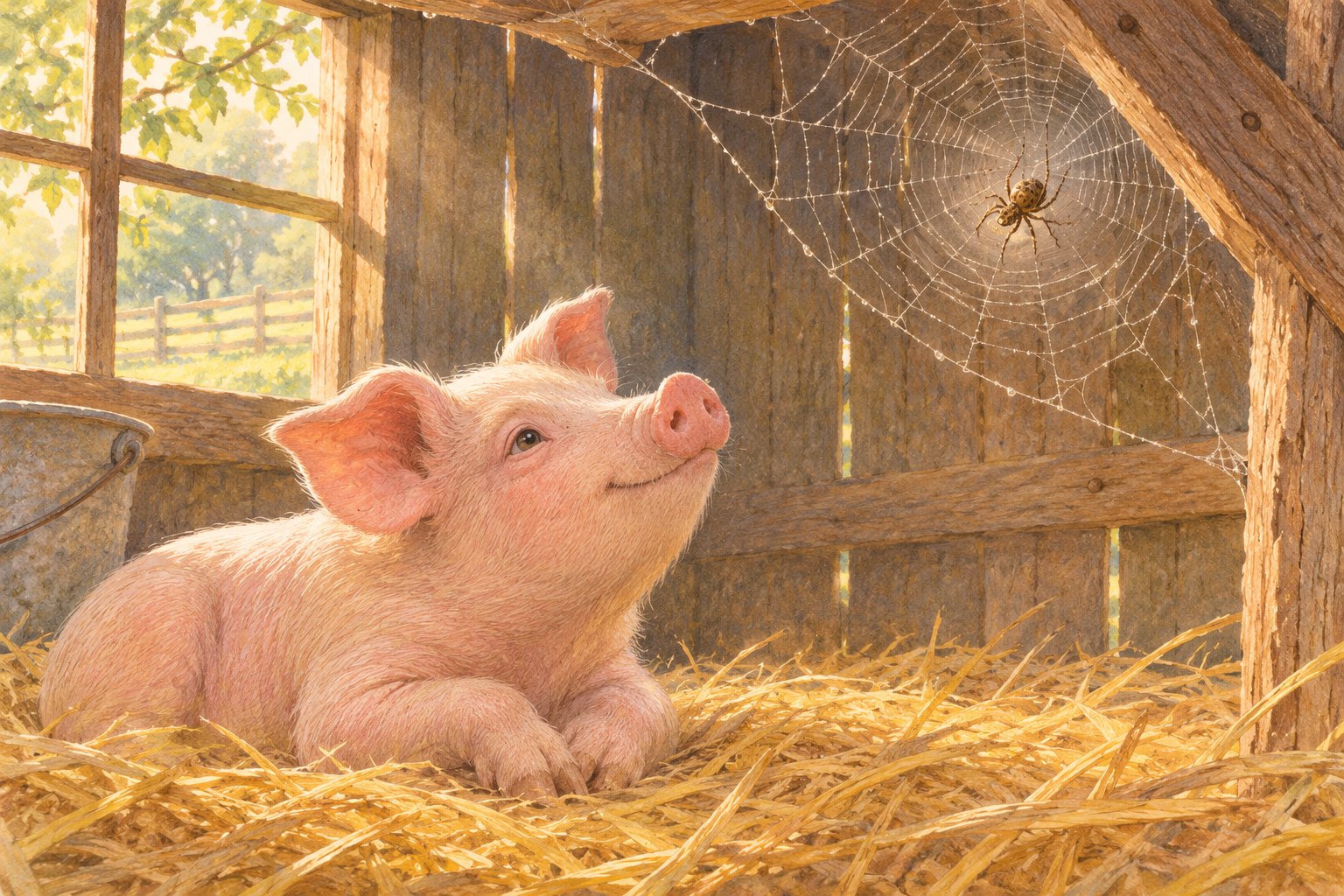
Charlotte’s web messages change how people regard Wilbur. “Some pig” is both wonderfully simple and quietly unsettling: the pig has not suddenly become a different creature, but the humans now look at him differently. Paramount’s [official film synopsis](https://www.paramountpictures.com/movies/charlottes-web-2006) identifies that effort to persuade the farmer as the heart of her plan.
For me, this is the adaptation’s richest idea. Charlotte uses spectacle to make ordinary worth visible. Her achievement is not merely flattering a friend. She finds a language that an inattentive audience will finally stop to read.
There is a useful tension here for children to notice. Praise can help others recognize us, but being praised cannot be the condition of deserving care. Ask whether Wilbur becomes more valuable after the web appears, or whether the people have become better at seeing him.
Where the movie helps—and where reading offers more space
The film makes companionship tangible. Sharing a physical space, hearing a voice answer, and watching another creature react can bring the barn’s relationships close to a young viewer. Roberts’s measured delivery gives Charlotte a reassuring steadiness against Wilbur’s uncertainty.
My reservation is that the comic animal business sometimes competes with the quieter relationship at the center. The liveliness makes the barn accessible, but it can also encourage viewers to wait for the next amusing interruption. White’s prose offers a different pleasure: the reader can linger without needing another visual event.
This is why adaptation discussions benefit from looking beyond missing scenes. A change in medium alters emphasis even when the basic events survive. Our discussion of how an adaptation’s setting changes its relationships explores a related issue: fidelity includes what a story makes us feel, not simply what it retains.
The ending turns gratitude into responsibility
Charlotte’s death prevents the film from offering an easy bargain in which goodness guarantees protection. Wilbur survives, but he cannot secure the same outcome for the friend who helped him. His effort to bring her egg sac home gives his grief a practical expression.
The important change is in the direction of care. Wilbur begins as someone whose future depends on others. By the ending, he can accept responsibility for lives beyond his own. That does not erase his loss; it shows what the friendship has taught him to do.
Families interested in how films handle painful transitions may also find a useful comparison in our analysis of loss and inherited responsibility in The Transformers: The Movie. The films differ enormously in tone, but both invite viewers to consider what remains after a protective figure is gone.
Three questions to carry from the page to the screen
- Who notices someone being overlooked? Follow acts of attention, including the small ones that do not receive applause.
- Which moment felt different when you watched it? Discuss the contribution of a voice, an image, or the pace of the scene.
- What can Wilbur do at the end that he could not do at the beginning? Look for emotional growth rather than a new skill or power.
The deeper achievement of Charlotte’s Web is that it connects storytelling with care. Charlotte changes a life by choosing words carefully; Wilbur honors that care by carrying it forward. Read the book together, watch the film when your family is ready, and leave room for different reactions. The most valuable result is a conversation in which a child’s interpretation receives the same patient attention the story asks its characters to give one another.
Original content by this site's editorial team. Published: November 26, 2026 at 05:02:38 PST (Los Angeles time)