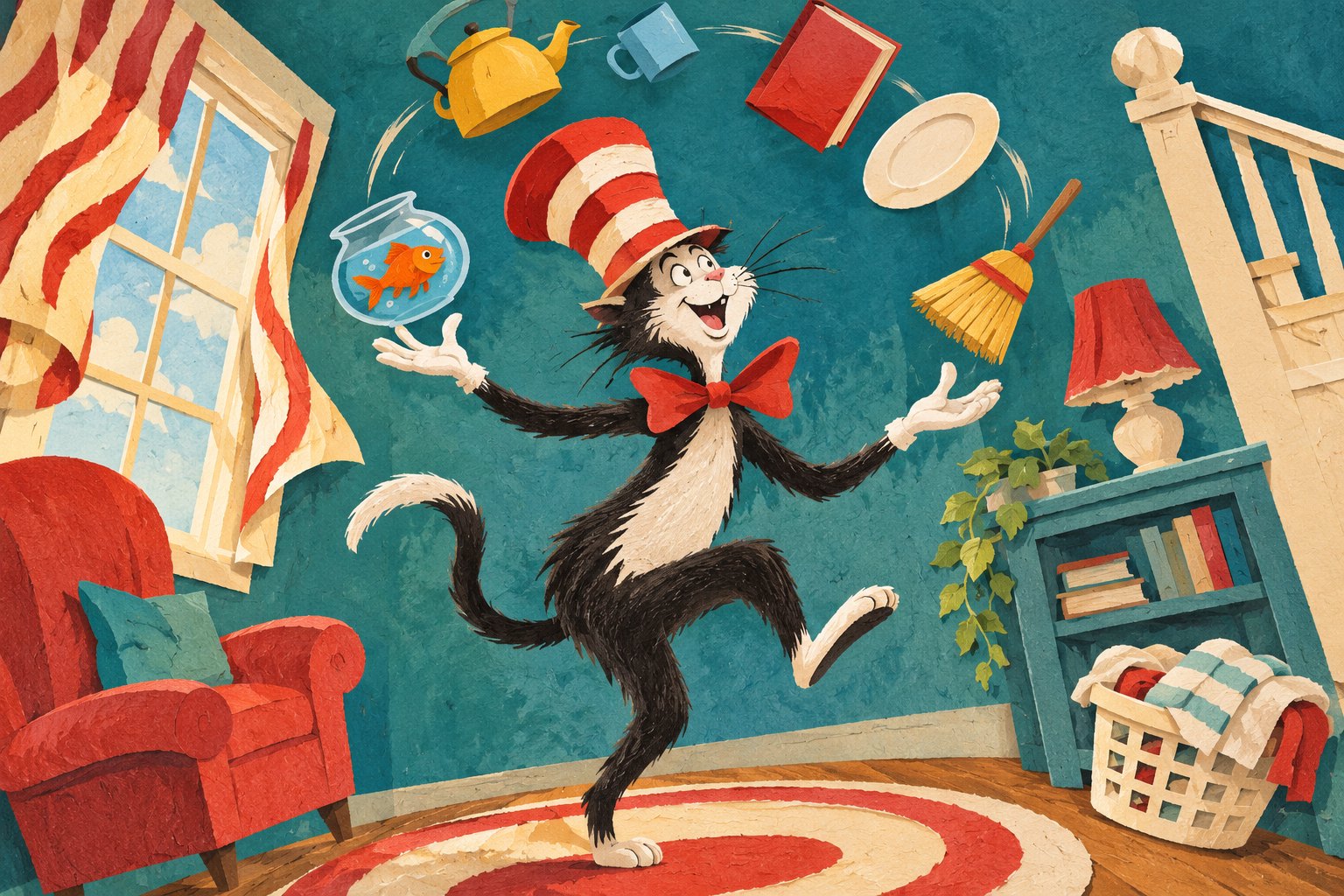
Bill Hader’s The Cat in the Hat gives its celebrated troublemaker an unusually revealing problem: making children happy is his job, but enthusiasm does not automatically make him good at understanding them. The animated adventure places his appetite for chaos alongside two siblings struggling with a move. That pairing offers a compelling way into the character. His greatest obstacle may be the assumption that everyone needs the kind of fun he enjoys delivering.
Scope and spoilers: This is a critical analysis of the confirmed setup, filmmaker interviews, and publicly released dialogue, rather than a review based on a complete screening. It discusses premise-level details without claiming to evaluate the ending or the finished film’s overall execution.
A professional troublemaker with something to lose
Warner Bros.’ synopsis identifies Hader’s Cat as an employee of the Institute for the Institution of Imagination and Inspiration, LLC. His assignment is to help Gabby and Sebastian, siblings adjusting to a new town. His tendency to overdo things has consequences: failure could cost him his magical hat. Erica Rivinoja and Alessandro Carloni direct from their own screenplay.
Giving the Cat an employer changes how we can read his behavior. A visitor who causes trouble because he enjoys it is an uncomplicated comic force. An employee who must prove his usefulness has a competing motive. He can want the children to feel better while also needing their happiness to validate him.
That tension is the most interesting implication of the premise. If cheering someone up becomes a test of your own worth, their sadness can begin to feel like an accusation. The temptation is to perform harder, enlarge the distraction, and mistake resistance for a request for more entertainment.
My concern with the workplace framework is that explanations can diminish a mysterious character. Yet it also creates an opportunity: the Cat’s confidence can become something the story examines. His magic may be spectacular, but his judgment remains open to question.
Hader’s voice and the danger of effortless confidence
In his NPR interview with A Martínez, Hader explained that the directors wanted his own voice rather than an elaborate vocal invention. That choice makes sense for a character whose persuasive power depends on sounding comfortable with the unreasonable.
A publicly aired film excerpt captures the Cat’s salesmanship in miniature: “I can balance if you wish.” The wording presents a stunt as a favor. He sounds like someone responding generously to an audience, even as he controls the terms of the entertainment.
For me, that is where the casting becomes more interesting than the simple appeal of a funny performer playing a funny animal. The role needs confidence that can remain charming while becoming questionable. A Cat who knows he is behaving badly is one kind of comedian; a Cat convinced he is being helpful is a richer dramatic problem.
The performance’s ultimate effectiveness depends on changes that a short excerpt cannot establish. Does his rhythm alter when someone refuses his invitation? Can he listen without immediately converting the moment into another routine? Those are the revealing tests of this characterization.
Gabby and Sebastian deserve more than a distraction
The siblings’ move gives their unhappiness a specific context. They are not simply waiting for something entertaining to happen. Their surroundings have changed, and the familiarity that makes ordinary life comfortable has been interrupted.
From their perspective, another unpredictable presence need not feel liberating immediately. Adults often describe change as an adventure because they understand its reasons or control its timing. Children can experience the same change as a sequence of decisions made elsewhere.
This makes the Cat’s arrival dramatically useful. His invitation to play offers a possible way to participate in an unfamiliar world. But participation matters only if the children can respond as individuals. Agreement, reluctance, curiosity, and annoyance should all carry weight.
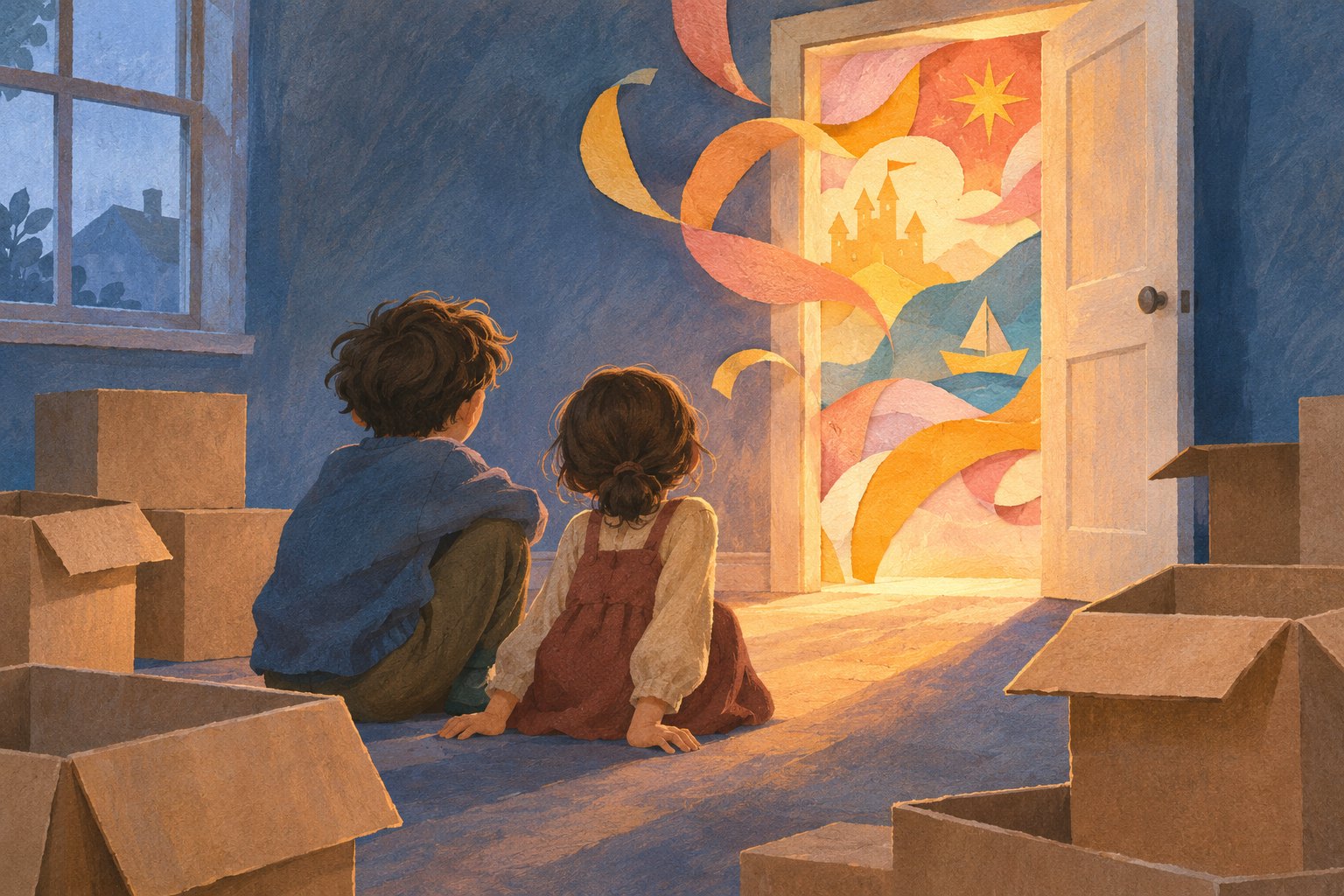
The distinction between being entertained and feeling understood is essential here. A successful joke can interrupt sadness; it cannot, by itself, explain what someone has lost. The strongest version of this premise would let pleasure coexist with homesickness instead of treating one laugh as proof that the problem has disappeared.
That is also why character continuity matters when familiar properties change form. Our analysis of the emotional foundations of an animated John Wick approaches a very different franchise through the same question: what human need must survive the new spectacle?
The fish makes the comedy a conversation
The film excerpt broadcast by NPR gives Matt Berry’s fish a succinct response to the Cat’s antics: “Put me down, you crazy cat.” It is a useful counterweight to the Cat’s self-assurance. One character experiences an amusing demonstration; another experiences being handled without permission.
That difference in perspective gives physical comedy its shape. The audience can enjoy the outrageous image while recognizing why someone inside it objects. Without that resistance, a succession of impossible tricks risks becoming a display with no dramatic friction.
I would resist reading every objection as evidence that a character needs to loosen up. Sometimes the sensible voice is funny because it is correct. Letting the fish retain that credibility would make the Cat work harder for our affection—and make their exchanges more satisfying.
Expanding the world without losing the children
In George Pennacchio’s report for ABC’s local stations, Carloni described the book as a launching point for following the Cat beyond the familiar encounter. America Ferrera also discussed animation changing with the worlds the characters enter. These comments establish creative intentions, rather than proof of how effectively the finished transitions work.
Visually distinct worlds could serve the story if they express different ways of experiencing change. A space can feel inviting to one character and overwhelming to another. Animation has the freedom to make that difference tangible through scale, movement, and composition.
The risk is that each new environment becomes another attraction requiring attention. The children’s emotional situation should remain legible through the expansion. Viewers should be able to explain what an adventure changes between the characters, beyond identifying the next unusual place they visit.
For families, that emphasis on perspective also matters more than familiarity with a title. Our discussion of judging family viewing beyond a recognizable character explores why emotional context deserves attention alongside spectacle.
The deeper question: who gets to decide what fun means?
The most promising interpretation of Hader’s Cat is a character who must distinguish helping from directing. He arrives with extraordinary abilities and an existing definition of a good time. The children bring experiences that his confidence cannot automatically resolve.
Seen that way, the magical hat represents more than a threatened possession. It can be read as an emblem of identity: who is this entertainer when his usual methods stop working? The premise becomes meaningful when success involves understanding another person, rather than demonstrating greater power.
That is the standard against which I would judge this adaptation. Mischief should produce laughter, but it should also reveal relationships. The Cat earns lasting affection when the people around him become more than an audience—and when his imagination leaves room for theirs.
Original content by this site's editorial team. Published: November 5, 2026 at 20:54:09 PST (Los Angeles time)