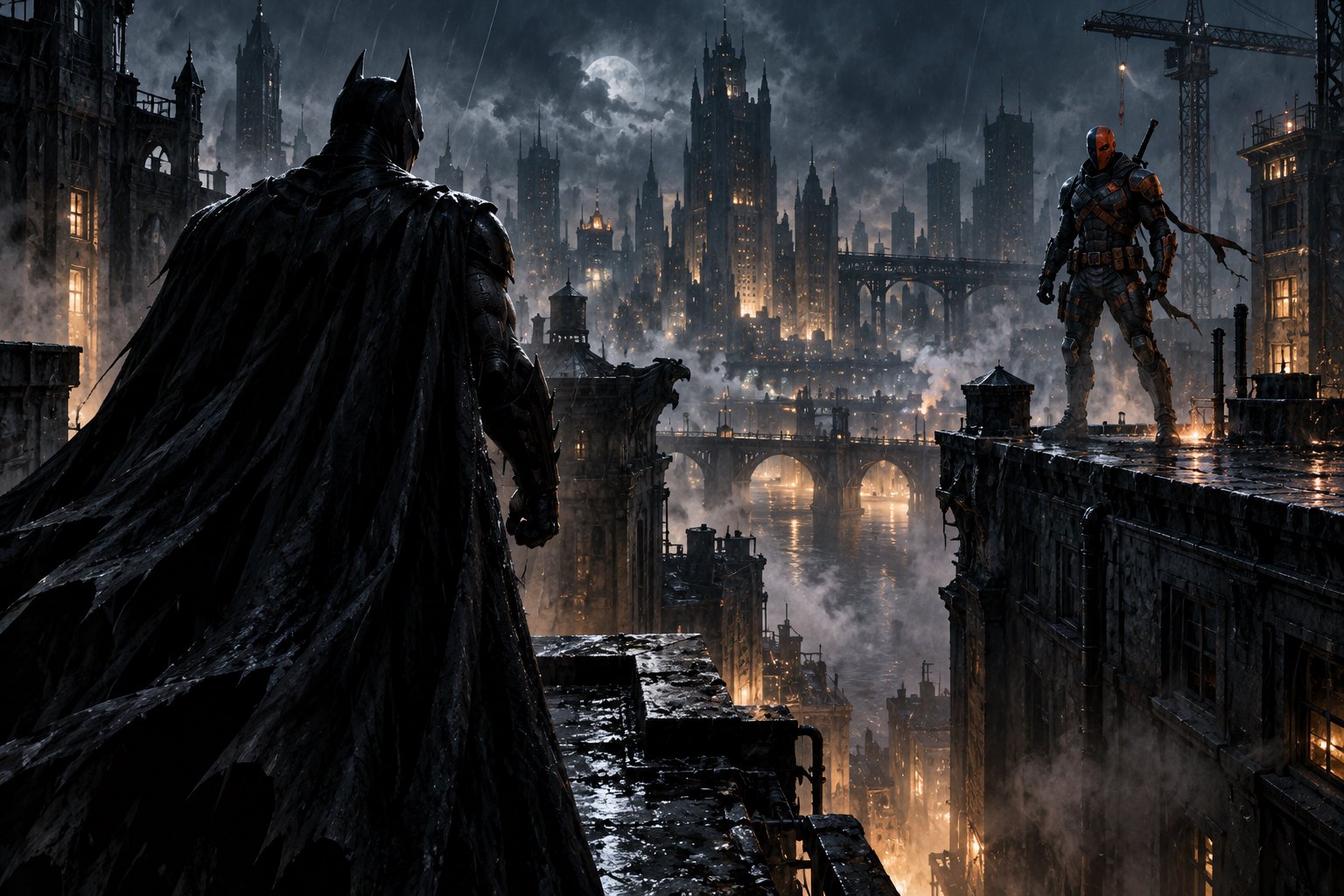
Ben Affleck’s scrapped Batman film would have made Deathstroke a threat to the people around its hero, according to Joe Manganiello. Variety reports that Manganiello described a plan to “dismantle Batman’s entire life,” including killing Commissioner Gordon. That proposed death gives the abandoned project a particularly unsettling dramatic premise: Batman’s ability to survive a confrontation would offer little comfort if someone else paid the price.
The appeal is clear. A villain who attacks the foundations of a hero’s life can create suspense that physical strength cannot resolve. The difficulty is equally clear: destroying those foundations only means something if the audience first understands why they matter.
Story disclosure: This article discusses reported plans for an unmade film, including Gordon’s proposed death. It is critical commentary on that premise, not a review of a completed movie. The character interpretations below should not be read as additional plot revelations.
What Manganiello’s account establishes
The central reported ideas are specific but limited: Deathstroke would have set out to devastate Batman’s life, and Commissioner Gordon would have been among his victims. These details establish an intended direction for the conflict. They do not, on their own, establish how individual scenes would have played, how much time Gordon would have received, or what emotional conclusion the film would have reached.
That distinction matters when discussing abandoned projects. A description can preserve the strongest idea in a screenplay while leaving its transitions, repetitions, and compromises invisible. We can assess the dramatic potential of this conflict without awarding an imaginary finished film the status of a lost masterpiece.
There are also no finished scenes here from which to evaluate performances, editing, or memorable dialogue. Manganiello’s quoted description is an account of the proposed story, not a line spoken by Deathstroke. Treating it as movie dialogue would give the project a false sense of completeness.
Batman’s perspective: protection becomes the pressure point
From Batman’s perspective, the most interesting implication is the separation of personal survival from successful protection. A conventional victory might mean identifying an opponent, surviving an encounter, and stopping an immediate threat. A campaign against his wider life would make that definition inadequate. He could remain standing and still experience catastrophic failure.
In my reading, that is where the premise has its strongest psychological potential. A protector’s confidence rests partly on believing that vigilance makes a difference. An enemy who deliberately harms someone close to him could turn that conviction into a source of doubt: was the failure a mistake he could correct, or evidence that his whole approach has limits?
A strong version of this story would need to distinguish responsibility from self-blame. Batman might feel responsible for every consequence of the conflict, but the film would not have to endorse that feeling. Deathstroke’s choice to kill would remain Deathstroke’s responsibility. Allowing both ideas to coexist would give the drama more depth than simply making Batman suffer.
That distinction also creates room for meaningful character development. The interesting question would be how Batman responds when control fails him—whether he becomes more isolated, accepts help, or reassesses what protection can realistically mean. Those are possible directions suggested by the premise, not confirmed events in the abandoned screenplay.
Deathstroke’s perspective: making the hero measure the damage
The phrase Manganiello uses suggests an antagonist concerned with cumulative destruction. Dramatically, that changes the relationship between the two characters. Deathstroke would not merely present a physical obstacle; his campaign could force Batman to interpret each loss as part of a larger design.
Such a structure can make even a quiet stretch of a thriller feel threatening. The audience begins asking what the antagonist values enough to target and what the protagonist has overlooked. Suspense depends on relationships and knowledge as much as movement or spectacle.
But there is a risk in making a villain seem capable of anticipating everything. If every setback happens simply because the story requires another punishment, strategic intelligence becomes a screenwriting shortcut. A convincing Deathstroke would need limits, choices, and opportunities the audience could understand. Otherwise, Batman’s helplessness might feel imposed rather than earned.
Our discussion of how character creates a thriller’s promise offers a useful companion perspective: an intriguing pairing establishes interest, while the decisions made under pressure give that interest substance.
Commissioner Gordon must matter before his death does
Gordon’s proposed death is the detail that deserves the closest scrutiny. A familiar character can bring immediate audience recognition, but recognition is not a substitute for a relationship developed within the story. A film cannot assume that viewers will supply all the affection and history necessary to make its loss devastating.

Viewed from Gordon’s side, the essential question would be whether he gets to participate meaningfully in the drama before becoming its casualty. Does he make consequential decisions? Does he have a position Batman must take seriously? Does the story allow him concerns that extend beyond the hero’s emotional state? Manganiello’s reported premise does not answer those questions.
My concern would be a version in which Gordon exists primarily to demonstrate Deathstroke’s cruelty. That could deliver a sharp shock while diminishing the person whose death is supposed to matter. Giving Gordon agency would make the loss harder, because the audience would understand what ends with him.
The aftermath would deserve similar attention. If Gordon’s death served only as fuel for the next confrontation, its emotional significance could disappear into momentum. A more persuasive treatment would let absence alter behavior and relationships. Grief becomes dramatically credible when it changes how people act, not merely how intensely they announce their pain.
A darker premise still needs an emotional argument
There is a temptation to treat severity as evidence of ambition. Killing a major supporting character certainly raises the stakes, but darkness alone does not tell us what a movie understands about its people. The more useful test is whether the suffering reveals something that could not emerge through spectacle alone.
That concern connects with our analysis of the human cost behind The Prestige’s rivalry. In character-driven conflict, the people affected by an obsession need emotional weight of their own. Otherwise, escalating damage can become a repetitive way of insisting that the central struggle is important.
For Affleck’s unmade Batman film, the deepest possibility lies in challenging the fantasy of the self-sufficient hero. If an enemy can wound Batman through Gordon, then Batman’s life is larger than his armor, abilities, or determination. It includes relationships that give his mission meaning and that he cannot completely control.
That is why Manganiello’s account remains compelling as a premise. Its strongest potential is a story about the limits of protection and the obligations that survive failure. Whether the film would have realized that potential is unknowable from these reported details. But the standard is clear: Gordon would need to matter as a person, Deathstroke as a choosing adversary, and Batman as someone whose response to loss reveals more than his capacity to endure it.
Original content by this site's editorial team. Published: October 20, 2026 at 21:36:04 PDT (Los Angeles time)