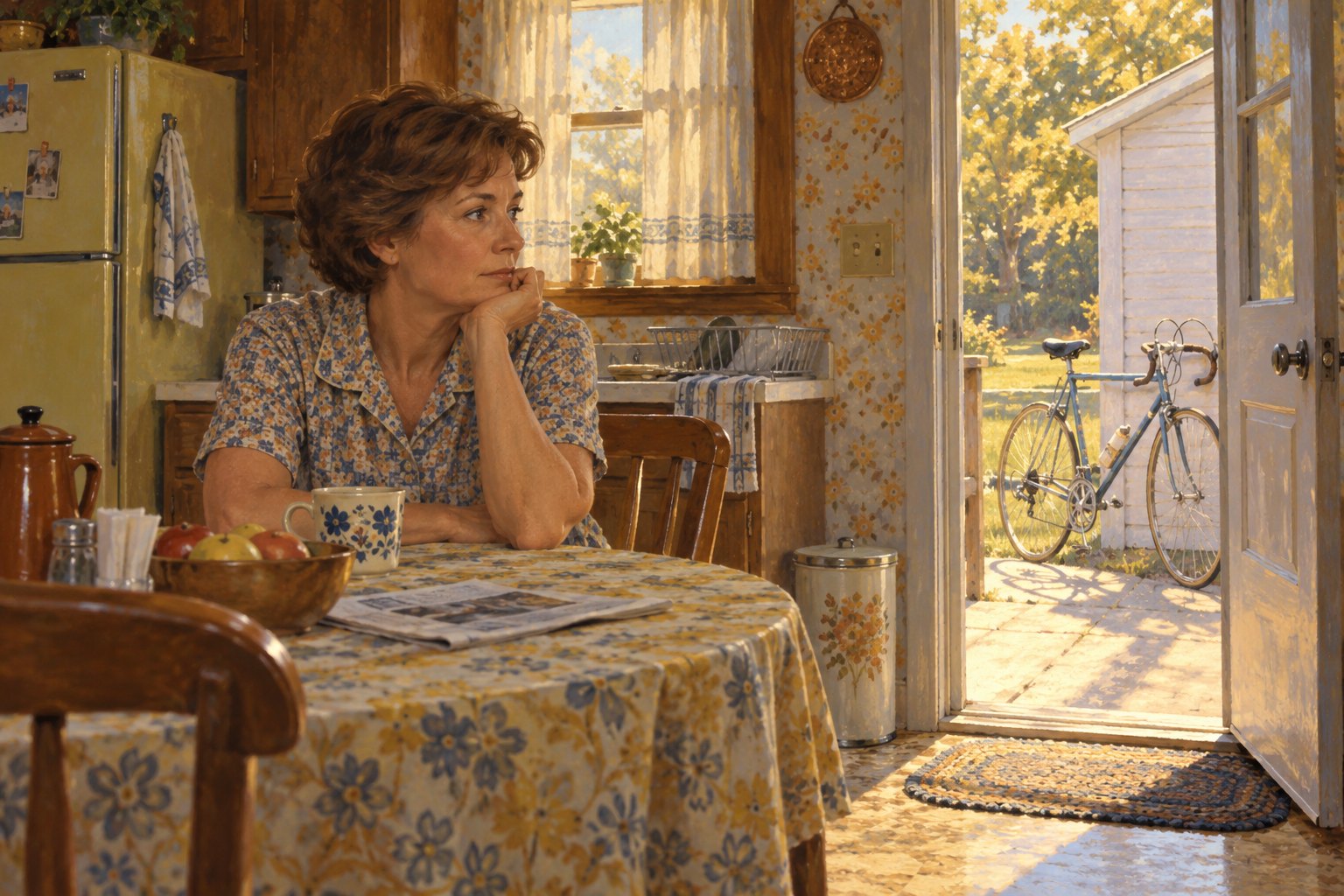
Barbara Barrie, the actor whose work in Breaking Away gave its young hero’s mother a memorable inner life, has died at 95, according to the Los Angeles Times. Returning to that performance offers a particularly revealing way to appreciate her: watch how she makes encouragement feel like a choice informed by experience.
In the 1979 film, Barrie plays Evelyn, mother of aspiring cyclist Dave. She understands something that the surrounding arguments about employment, college, and responsibility can obscure. A young person’s strange enthusiasm may contain a serious wish to become someone. Her performance gives that wish room to breathe.
Spoiler warning: This retrospective review discusses the passport scene, Dave’s disillusionment with his cycling heroes, and the final race.
A mother who understands the desire to escape
Directed by Peter Yates and written by Steve Tesich, Breaking Away follows Dave, played by Dennis Christopher, and his friends in Bloomington, Indiana. They have finished high school but remain uncertain about their next steps. The university nearby makes their uncertainty especially uncomfortable: other young people seem to have arrived with futures already attached.
Dave’s response is an extravagant devotion to Italy and Italian cycling. His adopted mannerisms frustrate his father, Ray, played by Paul Dooley. Evelyn is more receptive. Where Ray hears an avoidance of ordinary obligations, she recognizes the pleasure of imagining a larger world.
My reading of Barrie’s performance is that Evelyn’s sympathy depends on recognition. She can enjoy her son’s absurdity without dismissing the need beneath it. That distinction gives their relationship its warmth. She does not need to believe every part of his fantasy to believe that his longing matters.
It also keeps her from becoming merely the parent who says yes. Barrie gives Evelyn an independent emotional perspective, even when the conversation revolves around somebody else. Her attention feels active: she is assessing what Dave needs, what Ray fears, and how much pressure the household can bear.
The passport scene reveals a life beyond motherhood
The clearest expression of that perspective arrives when Dave considers missing the race against the visiting Italian cyclists. After an argument at Ray’s used-car business and his father’s subsequent illness, Dave feels responsible for staying home. Evelyn responds by showing him something of her own.
“It’s a passport.” The simplicity of the announcement is essential. This is an ordinary object carrying an extraordinary amount of possibility.
Evelyn explains that she carries it with her. She imagines presenting it as identification while cashing a check at the grocery store. The imagined occasion is funny because it is so modest. A document associated with international travel might receive its grand unveiling during a neighborhood errand.
Yet the scene’s emotional force comes from the distance between those two uses. Evelyn has something that could take her abroad, and the future she describes remains close to home. Barrie allows amusement and yearning to coexist. The character does not demand pity, which makes the suggestion of postponed experience more affecting.

Her advice follows naturally: “I think you should do all those things while you can.” The line changes the meaning of her support. She is speaking from an awareness that opportunities can narrow while people are occupied with being sensible.
For me, this is the performance’s defining achievement. Evelyn briefly becomes the center of a story the film has only partly told. We can imagine ambitions, compromises, and private pleasures beyond the scenes we see. Barrie creates that impression without turning the moment into a separate speech about sacrifice.
Ray’s anxiety gives Evelyn’s patience weight
Dooley’s Ray supplies some of the film’s broadest comedy. His repeated cry of “Refund?” turns a business dispute into an escalating expression of outrage. Barrie’s quieter presence helps that comic register sit alongside the family’s more vulnerable exchanges.
Ray’s frustration is rooted in recognizable concerns. Work, money, and a useful place in the world matter to him. His son’s theatrical reinvention can look like a rejection of the life that supported him. Evelyn has to understand that hurt while resisting the conclusion that Dave should immediately surrender his eccentricity.
The film becomes richer when both parents are allowed a point of view. Ray’s later conversation with Dave about his stonecutting past reveals pride complicated by social exclusion. Evelyn’s passport has already introduced another kind of limitation: the distance between having permission to go somewhere and actually going.
Those details suggest a marriage between people whose horizons have narrowed in different ways. Barrie’s generosity toward Evelyn makes her patience feel earned. She knows something about living within limits, and she wants Dave to test his before accepting them.
Dave must lose his fantasy without losing his ambition
Dave’s encounter with the Italian racing team punctures his idealized world. Their cheating exposes the mistake in treating sporting excellence as proof of admirable character. His heroes can ride beautifully and behave cruelly.
The disappointment also exposes the fragility of the identity he has borrowed. If being Italian was supposed to make him more interesting or worthy, rejection by those he admires threatens more than his confidence as a cyclist.
Evelyn’s earlier encouragement survives this reversal because it was never dependent on the Italians deserving his admiration. She wanted him to participate in life. Taking that chance includes discovering things he would rather not know.
This is where Breaking Away earns its emotional generosity. Dave’s embarrassment does not invalidate his capacity for joy. The task is to keep the energy of his enthusiasm while becoming more honest about himself. Readers interested in the harsher possibilities of frustrated ambition will find a useful counterpoint in our character-focused review of Pearl.
The final race turns belonging into action
The Little 500 gives Dave and his friends a public opportunity to compete as themselves. Their team adopts the name Cutters, taking ownership of an identity used to diminish local people. Evelyn supplies their team shirts, connecting her domestic support to their collective appearance.
When Dave is injured and his friends take turns riding, the race makes cooperation physically necessary. The cyclist with the greatest talent still needs other people. That development gives the sports climax a stronger emotional foundation than individual determination alone could provide.
I find the race satisfying because the film has made belonging feel difficult beforehand. Winning cannot settle every question about class or opportunity. It can give these friends a shared achievement that nobody else gets to define for them.
The same attention to relationships informs our review of Ghosts: The Possession of Button House, which considers how shared space becomes a home through responsibility and care.
What Barrie adds to the meaning of Breaking Away
Barrie received an Academy Award nomination for her supporting performance. Watching Evelyn closely makes the recognition understandable: she expands the film’s emotional scale while working within a relatively small portion of its action.
The screenplay still gives the younger men more freedom to act than it gives Evelyn. Her own possibilities remain largely implied. That limitation matters, especially when the passport scene makes us curious about a life beyond the family. Barrie makes that curiosity part of the experience rather than allowing the character to disappear into her usefulness.
The deeper meaning of Breaking Away, as I see it, lies in learning to pursue a future without treating your origins as something shameful. Evelyn adds another insight: helping someone leave requires an imagination generous enough to picture a life different from your own.
Remembering Barrie through this role means remembering the person she lets us glimpse behind the encouragement. Dave has a bicycle and a race ahead of him. Evelyn has a passport. Barrie makes us care where both might go.
Original content by this site's editorial team. Published: October 29, 2026 at 07:58:41 PDT (Los Angeles time)