All of a Sudden locates its emotional stakes in a deceptively ordinary question: what happens when someone gives another person their full attention? Ryusuke Hamaguchi’s drama brings together Marie-Lou, a nursing-home director played by Virginie Efira, and Mari, a Japanese theater director played by Tao Okamoto. Their friendship connects two experiences usually kept apart: the exhaustion of providing care and the vulnerability of needing it.
The result invites a more useful response than simply calling it miraculous. Its central relationship asks us to consider what makes connection possible, who has time for it, and whether compassion can survive the institutions supposed to deliver it. The film’s premise and central roles are documented in the [Irish Film Institute’s festival program](https://cms.ifi.ie/uploads/downloads/Peugeot-IFI-French-Film-Festival-2026.pdf).
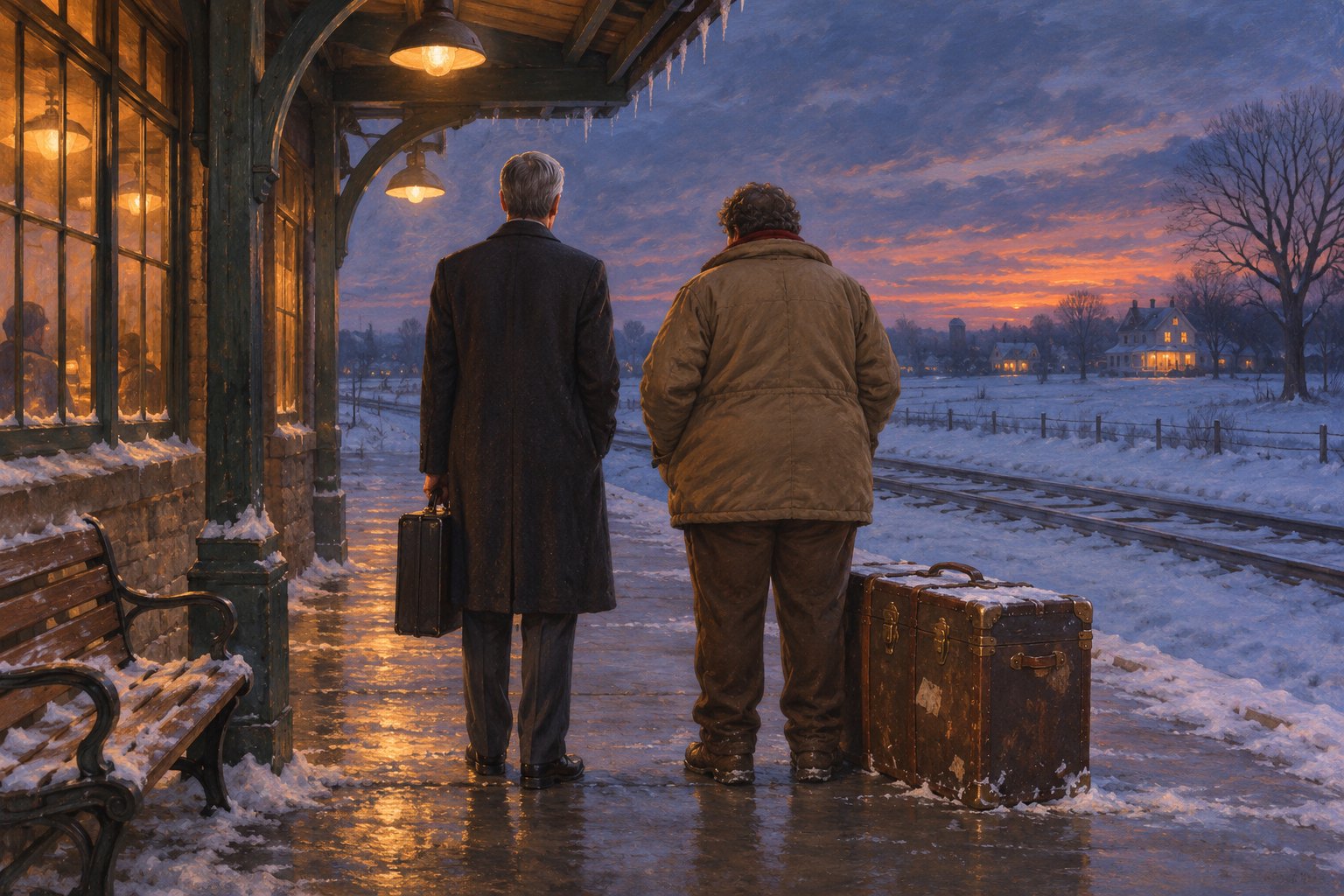
Spoiler notice: This character analysis discusses the women’s relationship, Mari’s illness, and later developments. The accompanying illustrations interpret the film’s themes; they are not movie stills.
Marie-Lou’s problem: believing in care while running out of strength
Marie-Lou is trying to introduce Humanitude, an approach to care that emphasizes recognizing residents as people through direct attention and respectful interaction. Her difficulty is practical as well as philosophical: workers resist additional demands, while management resists spending. The Associated Press describes this conflict as the professional pressure surrounding her first encounter with Mari. See its [account of the film’s central relationship](https://apnews.com/article/fc49bca77f86873ea52537413ccc6e4a).
What makes that setup dramatically valuable is the distance between having a humane principle and possessing the resources to practice it. From Marie-Lou’s perspective, an ordinary workplace disagreement becomes a question about the meaning of her work. If the institution cannot make room for attention, how can it honestly claim to provide care?
There is also a troubling possibility inside her commitment: someone can advocate tenderness while becoming too exhausted to extend it consistently. That contradiction gives her more substance than a tireless reformer would have. Her convictions do not place her outside the pressures affecting everyone around her.
My reading is that Marie-Lou needs more than encouragement. She needs a relationship in which her value does not depend on keeping everything functioning. The person responsible for seeing others must also be seen.

Mari’s presence challenges the role of the patient
Mari has terminal cancer, but treating that diagnosis as her entire identity would reproduce precisely the narrowing of personhood the film questions. She remains an artist and a thinker, someone capable of stimulating another person’s imagination. Her illness changes the conditions of the friendship without supplying its whole meaning.
That distinction matters. Stories about terminal illness can make a dying character function primarily as a lesson for someone who will survive. A more demanding interpretation of Mari asks us to recognize her needs and contributions simultaneously. Dependence does not cancel agency; receiving care does not mean having nothing left to give.
The connection with Marie-Lou consequently has an important imbalance without becoming a simple hierarchy. Their situations differ, but neither woman possesses everything the other lacks. One has professional responsibilities she cannot easily put down. The other faces a future she cannot secure. Conversation gives them a shared present.
The play makes listening visible
Mari’s theatrical work provides an early bridge between their lives. After a performance, the women communicate in Japanese, leaving some audience members outside the literal meaning of their exchange. The actor Gorô observes, “You can tell they shared something important.” The dialogue and the surrounding scene are documented in [Film Comment’s discussion of the film](https://www.filmcomment.com/article/a-way-with-words-all-of-a-sudden/).
The line offers a useful way into Hamaguchi’s dramatic method. Understanding is not always identical to possessing all the information. A listener can recognize hesitation, relief, or urgency before knowing the complete story. That does not make language irrelevant. It makes attention larger than translation.
For Marie-Lou, the theater also creates a space where vulnerability can be encountered without immediately becoming a problem to manage. Her professional life asks her to respond. Art allows her, briefly, to receive.
A friendship that refuses an easy label
“I don’t want this night to end,” Mari says. Marie-Lou answers, “I don’t want to leave you, either.” These brief exchanges, also recorded by Film Comment, express the relationship more directly than any definitive category could.
Their force lies in the modest scale of the request. Neither woman asks for a promise about an indefinite future. They ask for more time together now. Under the pressure of illness, that wish carries considerable weight, but it also remains familiar: the pleasure of discovering someone with whom conversation feels unfinished.
I find the ambiguity productive. Insisting on a single label could turn the relationship into a classification exercise and distract from what each woman actually offers the other. The more revealing question is how their bond changes their capacity to act, listen, and endure uncertainty.
Readers interested in friendship as a force that changes someone’s self-understanding may also appreciate our analysis of admiration and reconciliation in Mistress America. The emotional textures differ, but both subjects reward attention to what one person makes possible for another.
When conversation becomes an argument
The film’s extended discussions include an explanation of capitalism using a whiteboard. Its care-home setting also develops through bodily interaction and shared routines. These elements are described in [Sight and Sound’s examination of the film’s philosophy of care](https://www.bfi.org.uk/sight-and-sound/reviews/all-sudden-hamaguchi-questions-philosophies-care-radically-tender-enriching-drama).
This is where the film’s ambition invites scrutiny. An argument can reveal character: what someone chooses to explain tells us what they fear, value, and hope to change. But explanation can also overpower drama if the listener seems present only to validate the speaker.
The useful critical question is therefore whether the exchange changes the relationship. Does an idea become an invitation, a defense, or a gesture of trust? A conversation earns its duration when speaking and listening alter the people involved. Intellectual seriousness alone cannot do that work.
Conversely, the practical setting gives these discussions something concrete to answer to. A theory about human value matters differently when the next task involves attending to another person’s body. The film places belief beside obligation.
The deeper meaning: care cannot depend on a cure
Mari’s death prevents the friendship from becoming a reassuring story in which emotional connection defeats mortality. My interpretation is that this limit strengthens the film’s central claim: care matters even when it cannot produce recovery.
That is a difficult proposition because we often measure an action by its outcome. The film asks for another measure. Was someone heard? Did they retain room to think, contribute, and be more than their condition? Did another person stay present when there was no solution to offer?
This attention to dignity also connects with our reading of kindness in Planes, Trains and Automobiles: recognizing someone’s humanity should not require a complete explanation of their suffering.
The wonder in All of a Sudden is best understood at that human scale. One person cannot remove another’s vulnerability. She can help make it bearable without reducing that person to it. The friendship’s value survives its limits because the time they share was never merely preparation for a happier ending.
Original content by this site's editorial team. Published: November 26, 2026 at 11:51:07 PST (Los Angeles time)