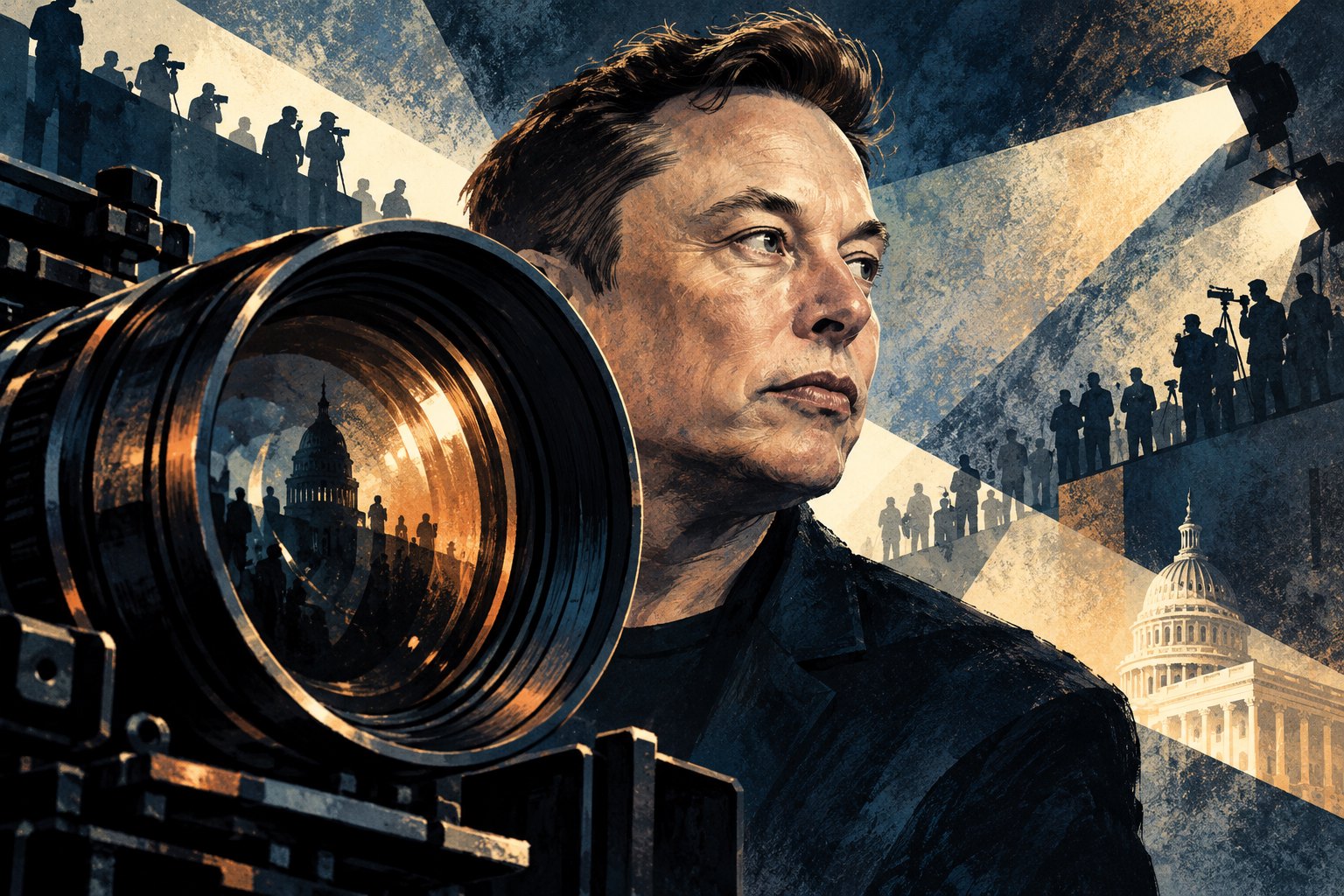
Alex Gibney’s Musk puts a difficult relationship at the center of the conversation: a filmmaker examining a public figure whose influence extends beyond the screen. Democracy Now!’s interview framing brings together the new film, legal threats, and a reported $366 million in spending to help Republicans in the midterms. Those subjects make the documentary timely. They also create a challenge for criticism: the controversy surrounding a movie cannot establish how well the movie works.
The most interesting question is what cinema can make legible about power. Does a portrait help viewers understand decisions, incentives, and consequences? Or does its famous subject occupy so much attention that everyone else becomes background?
This is spoiler-free commentary on the film’s public framing, rather than a screening-based review. Specific scenes, dialogue, and the ending are not assessed here. That distinction matters when a documentary’s publicity raises claims that deserve more scrutiny than a dramatic headline can provide.
What the Gibney interview establishes—and what it leaves open
The interview announcement connects Gibney with Musk and identifies legal threats and political spending as discussion topics. It does not, by itself, establish the precise nature of those threats, their legal merits, or how the spending figure was calculated. Nor does it demonstrate that every subject discussed in the interview appears in the finished documentary.
For prospective viewers, that last distinction is useful. A filmmaker can discuss developments that happened after an edit was completed, explain research that never became a scene, or offer an interpretation broader than the film’s argument. An interview is a companion to a documentary, not a substitute for watching its evidence unfold.
Likewise, the reported $366 million should retain its attribution. A headline does not tell us the accounting period, the recipients, or whether every dollar represents the same kind of political expenditure. Those details affect meaning. Treating the total as a self-explanatory verdict would skip the very work an investigative documentary ought to perform.
Musk as a subject: the limits of reading a personality
A documentary centered on Elon Musk faces an immediate storytelling temptation: make personality explain everything. A recognizable face offers continuity. A strong statement supplies momentum. A contradiction can become the hinge between two sequences. Together, those devices can make a complicated subject feel accessible.
But accessibility has a cost if the viewer begins confusing a coherent screen character with a complete explanation of a real person. Editing can reveal a pattern; it can also make a pattern look cleaner than the underlying record. The critical question is whether an interpretation remains attached to observable conduct.
From Musk’s perspective as the subject, a fair portrait would distinguish his public explanations from the filmmaker’s conclusions about them. That does not require accepting those explanations. It requires making disagreement intelligible. Viewers should be able to recognize what is being claimed, what challenges it, and where an inference begins.
This is also why private motives need careful treatment. Ambition, resentment, conviction, and calculation are compelling dramatic explanations, but none becomes established simply because a close-up makes it feel plausible. My preference is for documentary characterization that allows uncertainty to remain visible. A person can be responsible for an action even when the camera cannot settle everything happening inside his head.
Gibney’s perspective: authority has to be earned on screen
The filmmaker occupies another position in this relationship. Gibney chooses what the audience sees, how long it sees it, and which voice follows which image. Even when a director stays outside the frame, those decisions create a perspective.
For Musk, the important test is how that perspective handles resistance. Does an objection receive enough context to be understood? Does a disputed assertion arrive with evidence that viewers can evaluate? Does the sequence distinguish a witness’s experience from the director’s broader interpretation?
Access presents a related problem. Being close to a subject can produce revealing material, but closeness does not automatically produce understanding. Our discussion of perspective and access in the Elizabeth Holmes documentary explores a comparable question: whose account organizes the audience’s encounter with a public figure?
Here, the strongest possible approach would let supporting voices possess their own experiences and limits. They should contribute more than confirmation of a thesis already decided. That is an artistic standard as well as a journalistic one: people become more compelling when the film permits them complexity.

Legal threats are context, not a review score
Legal threats can become a powerful part of a documentary’s public identity. They suggest conflict before an audience has encountered the film itself. Yet their existence alone cannot establish either the accuracy of an allegation or the quality of the filmmaking.
For criticism, the useful distinction is between pressure surrounding a production and the argument presented on screen. Both may deserve attention, but they answer different questions. One concerns the conditions under which a film is made and circulated; the other concerns what its images, testimony, and structure actually demonstrate.
The announcement’s reference to legal threats therefore warrants interest without supplying a verdict. It would be premature to infer particular demands, proceedings, or outcomes from that phrase. A reviewer should resist allowing the drama outside the theater to prewrite the response inside it.
What the $366 million claim demands of the storytelling
A large spending figure creates scale instantly. Explaining influence takes longer. Money needs a timeline and a destination before a viewer can understand its significance, and a connection between two events needs more than their placement in adjacent shots.
If political spending is part of the film’s argument, the essential narrative task is to separate amount, purpose, and demonstrated effect. These are related questions, but they are not interchangeable. A stated intention does not prove an outcome; an outcome does not, on its own, establish a single cause.
This is where documentary form can either clarify or blur. A well-placed pause can give viewers time to read a record. An accelerating montage can make several claims feel settled before their differences register. The meaning of a number depends on what surrounds it.
A similar discipline informs our examination of what a headline box-office figure can actually tell us: numerical precision should not be mistaken for completeness. In Musk’s political context, that distinction carries much greater consequences.
The deeper question: who gets to explain power?
The title Musk concentrates attention on one person. The interpretive opportunity lies in whether that attention can eventually expand. A portrait of influence becomes richer when it helps an audience understand the relationships surrounding its central figure: who makes decisions, who describes them, and whose consequences remain outside the spotlight.
That is the standard I would bring to Gibney’s film. Its most valuable contribution would be an account that makes power more understandable while preserving the distinction between evidence and persuasion. Admiration and hostility can both simplify a person. Documentary criticism should ask what survives after those immediate responses have passed.
The interview’s combination of filmmaking, legal pressure, and reported electoral spending makes Musk worth examining. Whether the documentary turns that combination into persuasive cinema remains a question for the film itself. The decisive achievement would be giving viewers enough clarity to form a judgment they can explain.
Original content by this site's editorial team. Published: October 17, 2026 at 11:24:41 PDT (Los Angeles time)