An AI film’s reported failure at the Chinese box office brings a familiar filmmaking challenge into sharper focus: getting an audience interested is only the beginning. A theatrical feature also has to give that interest somewhere to go. The novelty of how an image was produced can attract attention; a character’s unfinished business can sustain it.
IndieWire has reported on a Chinese box-office flop in the context of AI’s difficult path into theaters. That establishes the subject of this discussion, but it does not establish a particular storytelling defect or explain individual ticket buyers’ decisions. The useful creative question is what an AI-driven feature must accomplish once the technical demonstration ends and the audience expects a movie.
This is spoiler-free film commentary, not a review based on a screening. No unverified scenes, character details, or dialogue are attributed to the reported release.
The theatrical promise extends beyond a striking image
A remarkable image can be appreciated almost instantly. A feature asks for a different investment: remember this person, notice this detail, wait through this uncertainty. Its strongest effects may depend on something the audience saw much earlier. A doorway can begin as an ordinary setting and eventually become the place a character cannot bring themselves to enter.
That accumulation is central to my standard for theatrical storytelling. Visual invention matters, but its value increases when the film gives us reasons to remember it. An extraordinary landscape becomes dramatically interesting when crossing it means abandoning someone, accepting danger, or returning to a place associated with shame.
The Chinese box-office setback makes this distinction worth examining without pretending to diagnose the film itself. A production breakthrough and a compelling viewing experience are separate achievements. The creative task is to connect them so thoroughly that curiosity about the process develops into concern about the outcome.
Our earlier discussion of what an AI movie’s box-office failure can actually establish addresses the limits of the commercial verdict. Here, the focus is the experience a feature needs to deliver across its running time.
Character continuity means more than a consistent face
When judging a character, viewers need more than the ability to recognize the same person from shot to shot. We also need some understanding of what that person knows, wants, fears, and refuses to admit. Those elements can change, but their changes should create meaning.
A useful critical test is to follow a character’s knowledge through a sequence. What information have they received? What have they misunderstood? What are they withholding from someone else? Suspense can emerge from the distance between those answers. If that distance becomes muddled accidentally, an attractive sequence can lose its emotional direction.
Consider a hypothetical example, unrelated to the reported film: a woman hesitates at a doorway, reaches for it, and finally crosses the threshold. The physical action is simple. Its dramatic significance depends on what she expects on the other side and what has made her willing to face it. Without that context, three elegant images remain three elegant images.
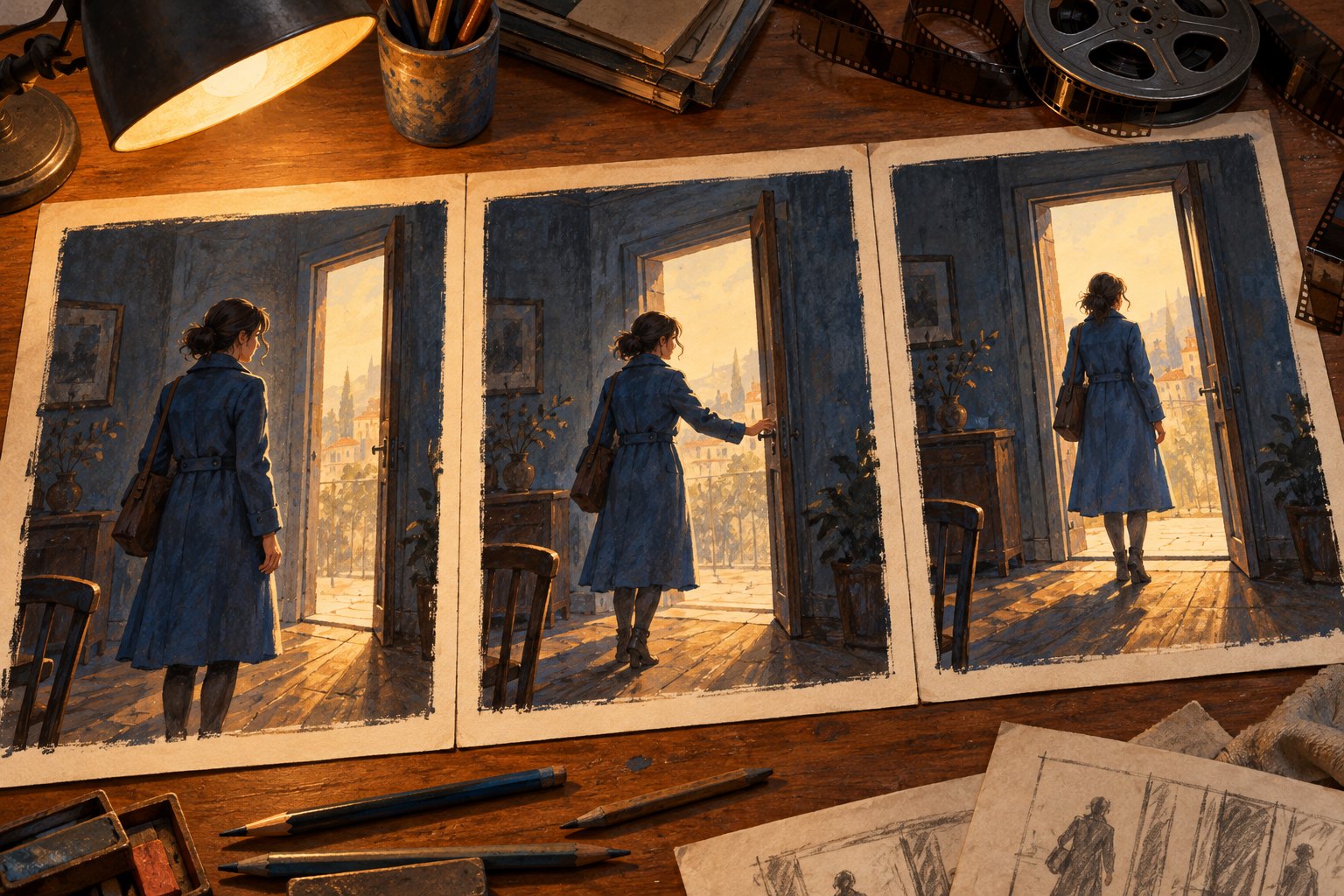
For me, convincing characterization lies in that connection between action and internal pressure. A hesitant movement can reveal courage when the danger is understood. The same movement can suggest calculation when the character is concealing a plan. The film earns the distinction through context, timing, and perspective.
A reaction shot has to carry the previous moment
One demanding test for any feature is the quiet exchange between people. Watch what happens after a question is asked. Does the listener answer too quickly? Does their expression conflict with their words? Does the cut arrive before we can decide whether to trust them?
These choices give a scene its social texture. A reaction must belong to the particular remark that preceded it, and to the relationship already established. A generally sad expression cannot automatically communicate embarrassment, grief, jealousy, or the effort to conceal relief.
This is where a character-centered evaluation becomes more useful than a checklist of visual imperfections. The important question is whether a scene preserves the relationship between stimulus and response. Even deliberately artificial or highly stylized figures can support that relationship. Photographic realism alone cannot guarantee it.
The related challenge appears in our commentary on why perspective matters when adapting Mouthwashing: controlling what the audience understands about a character is a fundamental storytelling decision. A production method does not make that decision disappear.
Memorable dialogue needs a dramatic life
A memorable movie line usually carries more than an appealing arrangement of words. It may expose a lie, reverse a relationship, or return with a meaning it did not have the first time. Its force comes partly from who says it, who hears it, and what saying it costs.
Without verified dialogue from the Chinese release, quoting supposed highlights would manufacture evidence. But the critical standard is still clear: listen for whether different characters use language differently. One person may evade a question with a joke; another may answer precisely to avoid revealing anything personal.
A useful viewing exercise is to ask what changes after an important line. Has someone gained leverage? Has a secret become harder to protect? Has a relationship become more intimate or more dangerous? Dialogue can be spare, flamboyant, awkward, or lyrical. What matters is its participation in the scene.
What would make an AI feature worth the ticket?
My standard would begin with three practical questions:
- Does the film create a specific attachment? There should be something distinctive about the people, conflict, or world that makes the next development matter.
- Do scenes leave consequences? An encounter should change what becomes possible afterward, even when that change is small or initially hidden.
- Does the ending transform earlier material? A resolution can be ambiguous and still deepen our understanding of an earlier gesture, choice, or image.
These are critical preferences, not a formula for predicting revenue. They also leave room for experimental cinema, where atmosphere, repetition, or disrupted expectations may organize the experience. Even then, the question remains whether the film’s formal choices reward sustained attention.
The deeper issue is the value of staying
The reported flop invites an argument about AI’s theatrical future. The more revealing artistic question concerns duration: what does a movie give us because we stayed with it? A feature can make patience productive by allowing suspicion to grow, affection to become complicated, or a seemingly minor detail to acquire devastating significance.
That is the promise I would want an AI-driven film to fulfill. Its images should develop relationships with one another; its characters should carry the consequences of what has happened; its ending should feel shaped by the journey. The strongest case for a place in theaters would be a film whose next scene matters because of the scene we have just watched.
Original content by this site's editorial team. Published: October 29, 2026 at 19:06:20 PDT (Los Angeles time)