A new movie filming in San Francisco has an attention-grabbing combination: a star-filled cast and a director identified as an heir to the Hyatt hotel fortune. SFist reports that the production is shooting in the city. For moviegoers, that establishes a project worth following, although it leaves the most interesting question open: what will these people and this place become on screen?
The appeal is easy to understand. Recognizable performers invite expectations, a filmmaker’s family background adds a public narrative, and San Francisco offers an immediately evocative setting. Yet none of those ingredients establishes the quality of a performance, the emotional logic of a scene, or the strength of an ending. Those judgments require the film itself.
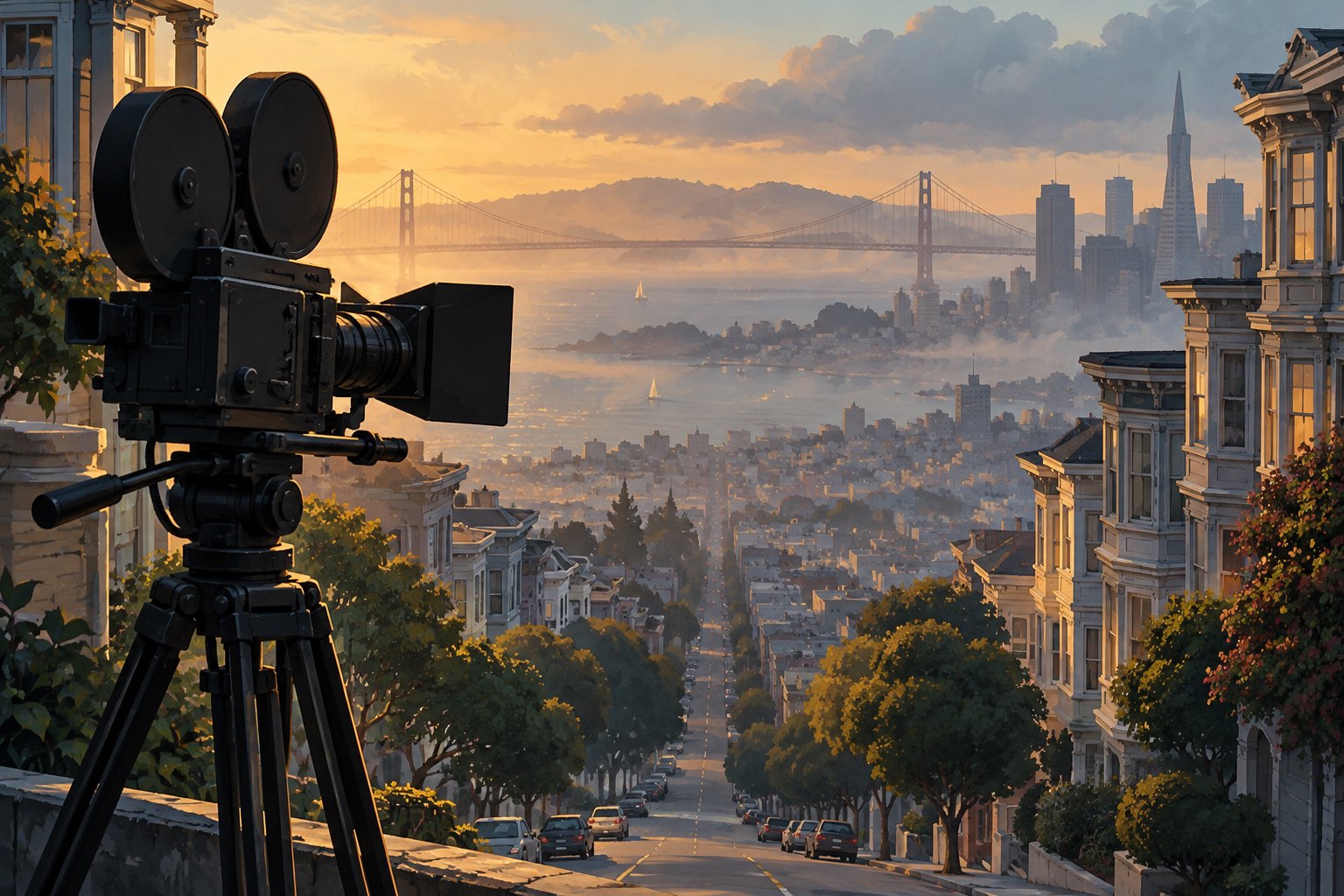
This is production-stage commentary, not a review of a completed film. It contains no plot spoilers. The illustrations are conceptual images, not production photographs or scenes from the movie.
What the filming news tells viewers
The central news is straightforward: a movie described as having a prominent cast is filming in San Francisco under a director with a connection to the Hyatt family fortune. Those details explain why the production attracts attention. They do not, by themselves, establish its genre, narrative viewpoint, release plans, or artistic ambitions.
It is particularly important to distinguish a filming location from a story setting. A production can use a city as itself, select individual streets for a different setting, or assemble a fictional geography from several locations. The fact of a San Francisco shoot cannot tell us how much of the finished movie will take place there or how prominently the city will figure in its story.
Likewise, production activity is not a release announcement. Readers looking for a viewing date should wait for a confirmed distribution announcement rather than infer one from cameras being on location. Filming is a meaningful milestone, but it provides no reliable shortcut to a premiere date.
The Hyatt connection is context, not a verdict
Identifying a filmmaker through inherited wealth creates a frame before audiences encounter the work. Some viewers may anticipate lavish production values; others may become skeptical about access and opportunity. Both reactions concern the circumstances surrounding filmmaking. Neither is evidence of what this particular film achieves.
A family fortune also does not automatically establish a production’s financing arrangements, budget, or degree of creative independence. Those are separate factual questions. Treating a biographical description as a complete account of how a movie gets made would obscure the contributions and decisions of everyone else involved.
My critical preference is to keep that context visible while making the eventual judgment specific. Does the direction give actors room to listen and react? Does visual polish sharpen a conflict, or merely decorate it? Does the film allow an uncomfortable moment to develop without explaining away its ambiguity? These are questions a finished work can answer.
The distinction resembles the one explored in our analysis of how film-industry leadership news relates to the movies audiences eventually see: production circumstances matter, but their artistic consequences have to be demonstrated.
A star-filled cast needs relationships, not just entrances
The phrase “star-filled” describes an attraction, not an ensemble’s dramatic structure. A collection of recognizable faces can generate anticipation before a single character has been introduced. Once the movie begins, however, recognition has to give way to something more particular: a desire, a vulnerability, a habit, a reason to watch this person respond to someone else.
For this production, the useful question will be whether its performers inhabit a shared dramatic world. Ensemble chemistry is not simply a matter of actors appearing comfortable together. Friction, avoidance, mismatched energy, and carefully sustained silence can be equally persuasive when they reveal relationships.
One revealing test is to watch the person who is not speaking. Does a reaction complicate what we have just heard? Can a character change the temperature of a scene without taking it over? Does the editing preserve that contribution? A movie with prominent performers gains depth when attention moves according to dramatic need rather than celebrity status.
No assessment of those qualities is possible from the filming announcement. Nor would it be responsible to supply memorable dialogue without verified access to the film or its text. Eventually, a line deserves quotation because of what the surrounding scene makes it mean—not simply because it sounds impressive in isolation.
How San Francisco could shape the characters’ experience
The location offers a more fruitful avenue for anticipation than prestige alone. San Francisco’s slopes, tightly arranged buildings, and contrasting sightlines can make movement through space unusually expressive. A street can expose someone to view; a doorway can interrupt that visibility; a window can turn the city into something a character observes but cannot easily enter.
These are possibilities of film form, not descriptions of this movie’s scenes. Their value lies in connecting setting to experience. A location becomes dramatically meaningful when it changes what a character can do, what they notice, or how they understand their position in relation to other people.

The strongest use of a recognizable city need not involve its most recognizable view. An ordinary interior can reveal more than an expansive skyline if its arrangement clarifies who feels at home, who is waiting for permission, and who has the freedom to leave. The distinction is between looking at a location and experiencing it through someone.
That concern also informs our discussion of who gets to own a film’s perspective. Screen time alone does not determine whose experience organizes a story. Framing, access to information, and the consequences attached to a choice matter just as much.
What to look for when footage arrives
A trailer or official clip could begin to answer several practical questions. Does the material introduce relationships, or primarily display its cast? Is the location connected to an action or decision? Do exchanges have enough room to establish a distinctive rhythm? These observations can support an informed first impression without pretending to settle the quality of the complete film.
Promotional footage will still be selective. A striking image may be representative or exceptional; a forceful exchange may play differently in context. The useful response is to identify what the material actually demonstrates and keep larger judgments provisional.
The real promise is a point of view
What makes this San Francisco production potentially interesting is the opportunity to turn public attractions—celebrity, pedigree, place—into private experience. A cast becomes compelling through relationships. A city becomes meaningful through the people navigating it. A director’s resources become artistically relevant through the choices those resources enable.
My standard for the finished movie would be whether it makes us understand something from a character’s position that we could not grasp from outside it. The filming news gives audiences a reason to pay attention. The eventual film will have to give that attention somewhere worth going.
Original content by this site's editorial team. Published: October 14, 2026 at 19:26:46 PDT (Los Angeles time)