
A grittier Sense and Sensibility has a strong dramatic foundation: the Dashwood sisters experience romance while their financial security and freedom of choice are shrinking. The Hollywood Reporter’s feature frames the new adaptation around “respect rather than reverence.” That distinction becomes meaningful when respect means taking the characters’ circumstances as seriously as their feelings.
The reported approach invites a specific question: will greater physical realism make the sisters’ predicament more immediate? Ang Lee’s 1995 film, adapted by Emma Thompson, offers a useful benchmark. Beneath its pleasures lies an unsparing account of people whose private happiness depends on money, family permission, and promises made elsewhere.
Spoiler notice: The discussion below examines major developments and the ending of the 1995 film. It evaluates the possibilities of the new adaptation’s reported direction, rather than claiming to review its finished scenes or performances.
The first wound is losing a home
The 1995 film begins by making inheritance personal. After Mr. Dashwood’s death, the estate passes to his son John, leaving his widow and daughters dependent on much smaller means. John’s willingness to help then dwindles under his wife Fanny’s persuasive self-interest.
What makes this opening so effective is its ordinary conversational cruelty. Assistance becomes something the comfortable can debate, reduce, and congratulate themselves for reconsidering. The women whose lives are being rearranged have little influence over that discussion.
From Elinor’s perspective, bereavement immediately requires practical work. Someone must consider housing, expenses, and the family’s next move. From Marianne’s perspective, the same circumstances feel like an intolerable violation of emotional truth: their father has died, yet other people are already treating the family home as an available possession.
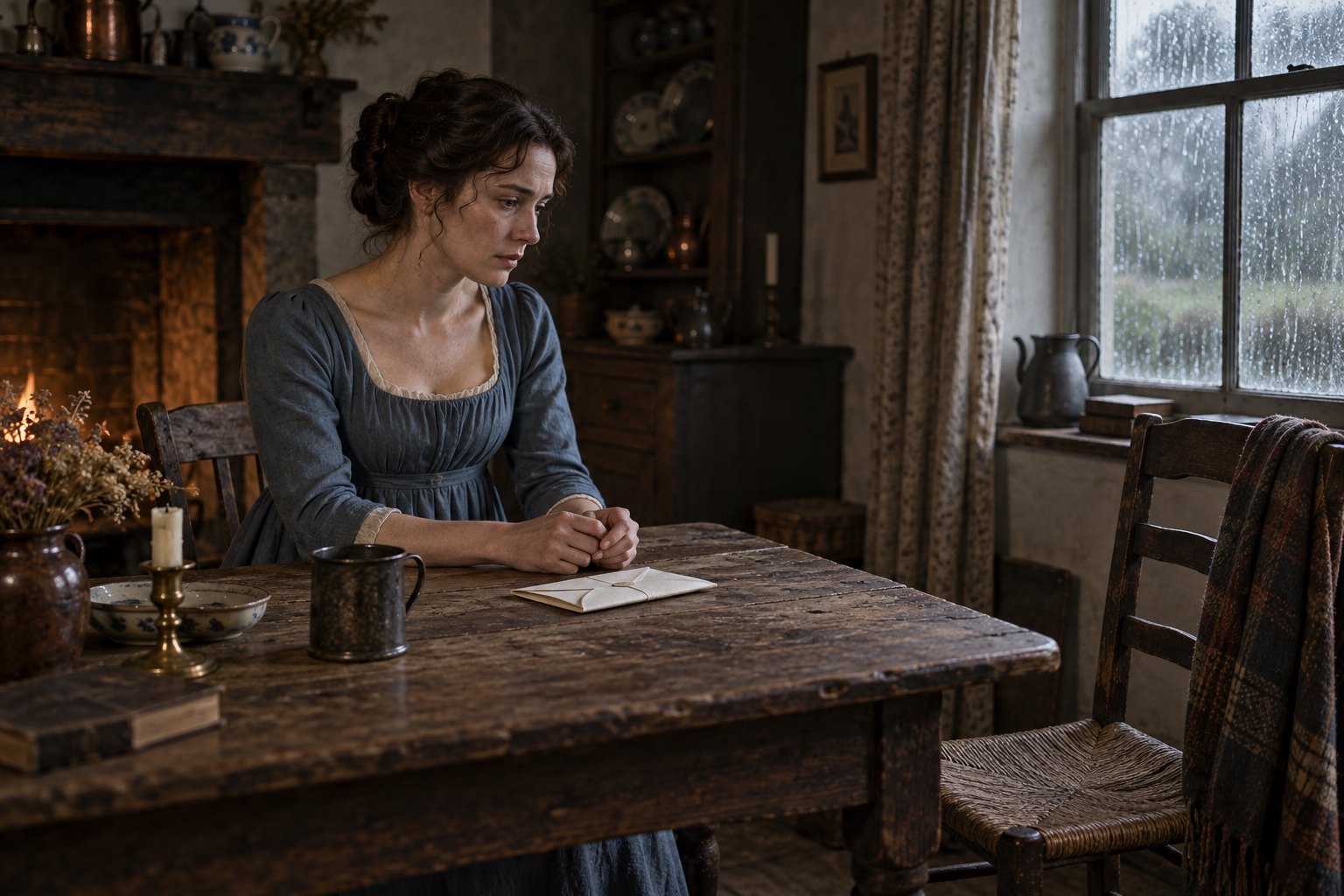
This is where a rougher visual approach could earn its place. A smaller room matters when it changes privacy. Worn clothing matters when it affects how someone enters company. Material detail becomes drama when it limits a character’s choices; weathered scenery alone cannot accomplish that.
Elinor’s composure is demanding work
Thompson’s Elinor is compelling because her restraint remains active. She continually decides what can be said, who needs reassurance, and which emotion must wait. Her apparent steadiness makes her useful to everyone around her, while making her own distress easier to overlook.
Lucy Steele’s disclosure of her secret engagement to Edward Ferrars intensifies that burden. Elinor must absorb the loss of her romantic hopes while keeping the confidence of the woman who has displaced them. Courtesy becomes an obligation to participate in her own unhappiness.
When Marianne questions her capacity for feeling, Elinor’s response cuts through the film: “What do you know of my heart?” The force comes from accumulated concealment. Her sister has mistaken the absence of a public collapse for the absence of suffering.
For any new interpretation, this is a crucial acting challenge. Elinor needs an inner life that remains legible without explaining itself constantly. A pause or an excessively careful answer can reveal what a speech would simplify. As our commentary on the acting demands of screen romance explores, apparently gentle material can require exact emotional control.
Marianne mistakes recognition for reliability
Kate Winslet’s Marianne supplies a different kind of vulnerability. She wants love to declare itself through enthusiasm, shared taste, and spontaneous understanding. Willoughby appears to offer exactly that. Their attraction matters because he seems to confirm her entire understanding of what a meaningful life should feel like.
Her mistake is understandable. Being recognized can feel like being protected. Someone who responds to the same things with the same intensity can appear trustworthy before trust has been tested.
Willoughby’s rejection exposes the distance between emotional fluency and dependable conduct. His decision to marry for money connects Marianne’s romantic injury to the financial pressures surrounding the sisters from the beginning. She has treated feeling as something that can overcome social calculation; he proves capable of making that calculation himself.
A grittier adaptation should preserve the attractiveness of Marianne’s outlook. If she seems foolish from her first entrance, her disillusionment becomes a lesson delivered from a superior position. The more searching version lets viewers understand why she believes him, then asks them to recognize what belief prevented her from seeing.
Decency needs actions as well as declarations
Edward and Colonel Brandon complicate the idea that the most persuasive lover is the best partner. Neither offers Willoughby’s effortless romantic performance. Their value emerges through decisions that may be awkward, costly, or poorly timed.
Edward’s prior commitment to Lucy prevents the easy fulfillment of his attachment to Elinor. His sense of obligation is admirable, but the situation still hurts her. The film allows decency and damage to occupy the same relationship. Good intentions do not give another person the information they need.
Brandon’s concern becomes especially revealing during Marianne’s illness. “Give me an occupation, Miss Dashwood, or I shall run mad,” he says. The line expresses feeling through a request to be useful. He wants something he can do with his fear.
That does not make care a purchase of romantic entitlement. An emotionally convincing reading must leave Marianne room to change her understanding and make her own choice. Brandon’s devotion matters because it reveals his character; her eventual affection must still belong to her.
Roughness should leave room for Austen’s humor
My reservation about “grittier” as an artistic promise is that it can suggest a narrow definition of seriousness. Sense and Sensibility needs embarrassment, social comedy, and the absurdity of people explaining their selfishness as good judgment. Those qualities make its injuries recognizable.
The opening negotiations over financial help are funny because their logic is so shameless. The laughter sharpens our understanding of the harm. Removing that comic intelligence would make the story less observant, however convincing its muddy roads might look.
Beauty also has a dramatic function. An inviting house or pleasurable gathering can show exactly what the sisters risk losing access to. As our essay on the difficult emotions beneath comforting movies argues, reassurance can coexist with painful material. Visual pleasure need not erase an audience’s awareness of insecurity.
The ending reveals what the sisters have learned to see
Elinor’s emotional release when she discovers Edward is unmarried gives the 1995 film its most satisfying reversal. The woman who has managed appearances can suddenly no longer manage her own. Her composure has never meant that she needed less love or felt less uncertainty.
The deeper achievement is the correction of the sisters’ judgments about each other. Marianne must recognize suffering that does not resemble her own. Elinor’s experience reveals the limits of making endurance look effortless. Their relationship gives the romantic resolutions their emotional weight.
For me, that is the strongest meaning of respect in adapting Austen: preserve the difficulty of understanding another person. A grittier Sense and Sensibility can make deprivation more visible, but its lasting power will depend on whether it makes hidden feeling equally visible. The sisters need a world that presses upon them—and performances that show what it costs to keep living within it.
Original content by this site's editorial team. Published: October 25, 2026 at 22:54:01 PDT (Los Angeles time)