
A Dog’s Perfect Christmas has an immediately appealing proposition: when people cannot find their way back to one another, perhaps their dogs can help. Netflix’s holiday release places a family emergency alongside bereavement, generational friction, and canine companionship. The Guardian’s opening assessment is unfavorable. But the more useful question for prospective viewers is what kind of emotional experience this story promises—and what that promise asks of its human characters.
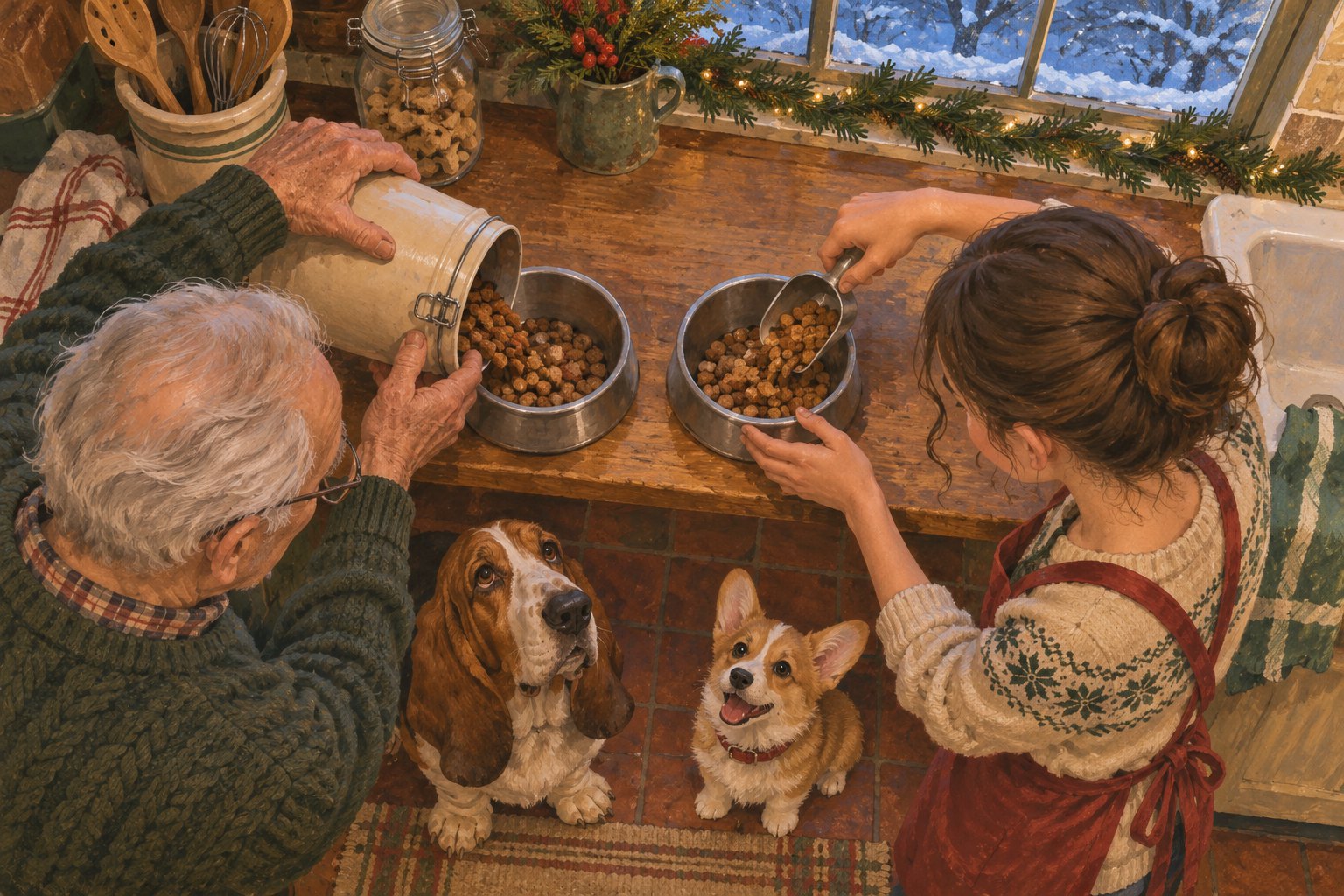
Scope and spoilers: This is a critical reading of the publicly documented premise and trailer, rather than a verdict based on a complete viewing. It discusses the family’s medical crisis and introductory character relationships without describing the ending. The illustrations are conceptual artwork, not scenes or production stills from the film.
What A Dog’s Perfect Christmas is about
Netflix lists the film’s U.S. release as November 4, 2026. Directed by Cathryn Michon and adapted from W. Bruce Cameron’s novel, it follows the Goss family through a Christmas disrupted by illness. Dennis Quaid plays grandfather Sander, Brooke Lena Johnson plays his granddaughter Ello, and Thomas Haden Church voices the basset hound Winstead.
Sander is grieving his wife and clashing with Ello. When Ello’s mother, Juliana, becomes seriously ill, their already strained household faces a more frightening uncertainty. A corgi puppy named Ruby joins the story, giving its older dog a lively counterpart and its divided humans another reason to come together.
That combination suggests a family dramedy with substantial sadness beneath the decorations. Anyone choosing it solely for playful animals should understand that illness and loss are central to the setup. The dogs offer reassurance within that distress; their presence does not make the underlying subject weightless.
Sander: affection cannot put grief on a schedule
From Sander’s perspective, Christmas carries an uncomfortable contradiction. The season asks him to participate in familiar rituals while reminding him that the person who once shared them is gone. Reading his irritability only as bad manners would miss the emotional tension built into the character.
Winstead’s connection to him makes the dog more than a seasonal accessory. A familiar animal can preserve the texture of an earlier life: the same companionship, the same dependence, the same expectation that someone will be there. In this setup, the bond offers a way to think about continuity after bereavement.
My reading is that Sander’s strongest dramatic possibility lies in learning how to remain available to other people without treating renewed affection as disloyalty to his wife. His connection with Claire, played by Mary Steenburgen, adds another relationship through which that question can be explored. Companionship becomes meaningful when it allows grief to remain part of someone’s life.
The corresponding risk is haste. A holiday story has a built-in deadline, but grief does not. Any reconciliation will carry more weight if Sander’s behavior changes through recognizable decisions rather than because Christmas has arrived and the story requires him to smile.
Ello: being young does not make the fear smaller
Ello occupies a different position inside the same household. She is navigating a relationship with an unhappy grandfather when her mother’s illness threatens the family’s stability. From her perspective, adult frustration and adult vulnerability arrive together.
That matters because teenage characters in family entertainment can become convenient shorthand for selfishness. A sharper reading asks what a teenager can reasonably understand, what adults have explained, and which responsibilities she is suddenly expected to carry. Irritation can coexist with love; a frightened person does not always express fear gracefully.
Ruby gives Ello and Sander something concrete around which to rebuild contact. Caring for an animal creates occasions for cooperation that do not require either person to begin with a perfectly articulate apology. The dramatic opportunity is modest but useful: two people who struggle to talk can still do something together.
This connects with the distinction between affection and responsibility explored in our analysis of family obligations in Club Kid and Queen at Sea. Love becomes legible through conduct, especially when family members disagree about what help should look like.
Winstead’s promise—and the limits of a dog’s perspective
The trailer gives Winstead a concise statement of purpose: “The dog’s purpose is to make people happy.” It is an appealing line because it expresses devotion without qualification. It also establishes the central problem any character-focused reading should examine: happiness is an understandable wish, but it cannot be the immediate solution to every kind of suffering.
For Winstead, bringing people together is a clear objective. For the humans, togetherness involves histories, resentments, and fears that cannot be resolved by proximity alone. The distance between those perspectives could provide both comedy and tenderness.
Animal narration works best for me when it changes what we notice. A dog’s attention can make ordinary presence feel significant: who stays nearby, who withdraws, who responds when needed. That perspective offers an alternative to the explanations people give about themselves. Actions become easier to read than excuses.
But the device has an equally clear limitation. If narration supplies every emotional conclusion, viewers have less room to interpret the humans. Winstead’s loving certainty is most interesting when it sits beside their confusion, leaving the people responsible for the choices that follow.
Juliana’s illness puts the sentiment under pressure
The medical emergency changes the meaning of the holiday. Keeping a household together becomes more urgent than arranging a satisfying celebration. It also raises a structural question: does the crisis deepen the family members’ understanding of one another, or simply provide a reason for them to reconcile?
Juliana deserves particular attention in that distinction. A sick parent can easily become the occasion for everyone else’s development. A more substantial family drama keeps the ill person’s needs visible, even when other characters occupy more of the action.
For viewers, a useful measure is whether care acquires practical consequences. Do people listen differently, accept responsibility, or adjust their expectations? Those changes matter more than a general declaration that family comes first. They make an emotional resolution credible because they show what will be different after the holiday.
How to approach the film’s early reception
An unfavorable review should help clarify expectations without automatically deciding a viewer’s response. Someone seeking canine companionship and familiar seasonal emotions may value different things from someone looking for surprising dramatic construction. Neither preference removes the need for believable characters.
Our discussion of reading movie criticism beyond the verdict offers a useful approach here: identify the qualities you want from a film, then consider whether a critic’s objections concern those qualities. A familiar premise can still be moving, but familiarity alone cannot guarantee comfort.
The deeper question inside a “perfect” Christmas
The title’s most interesting word is “perfect.” For a grieving grandfather or a daughter worried about her mother, perfection is an impossible demand. Read through those characters, the premise suggests a more humane definition: a Christmas in which distress does not leave anyone entirely alone.
Winstead’s wish to make people happy becomes more compelling when happiness includes companionship during unhappiness. A dog cannot undo bereavement or resolve a medical emergency. What canine devotion can illuminate is the value of remaining present when there is nothing clever or comforting to say.
That is the emotional standard this story invites. Its deepest potential rests in the humans learning to offer one another the patient attention they receive from their animals. The meaningful Christmas would be the one in which care continues after the reassuring moment has passed.
Original content by this site's editorial team. Published: November 4, 2026 at 18:33:20 PST (Los Angeles time)