A day at the Philadelphia Film Festival begins with a deceptively difficult choice: what deserves your attention? Choosing a movie is only part of it. You are also deciding how much room to leave for anticipation, conversation, and the stubborn scene that follows you out of the theater.
For anyone approaching the festival as a movie lover, our advice is to build the day around films you can engage with fully. A packed schedule has its pleasures, but a screening becomes more valuable when you can remember how it worked, explain why it moved you, and recognize where your first reaction might be incomplete.
This is a spoiler-free critical guide to shaping that experience, rather than an account of particular screenings or guest appearances. Its focus is the audience’s side of a festival day: choosing, watching, listening, and carrying something home.
Before the First Screening: Give the Day a Shape
Start with one film you genuinely want to see. That choice can come from a director whose work interests you, a performance you are curious about, or a premise that raises a question you cannot answer from the description. Build outward from that point instead of trying to construct the most impressive list.
For a second selection, look for a different kind of demand on your attention. A tightly plotted story and a more observational film might make a useful pairing. So might two films concerned with similar relationships but working in different genres. These are ways to make choices within the available program, not assumptions about what any particular edition includes.
The practical details deserve equal attention. Check the current program and your booking information for the venue, running time, admission instructions, accessibility provisions, and any scheduled discussion. Leave enough space for travel and food. A schedule that requires everything to run perfectly can leave you thinking about your next seat while you are still sitting in the current one.
Our preference is for a day with breathing room. Missing a possible screening can be disappointing; watching a film while too distracted to meet it halfway is a different kind of loss.
Inside the Theater: Follow What the Character Knows
The most useful starting point for close film analysis is often a character’s limited understanding. What does this person want? What do they believe is preventing them from getting it? And what can the audience see that they cannot?
Keep those questions separate. A character’s explanation of their behavior is not necessarily the film’s explanation. Someone may describe a decision as generous while their timing, gestures, or treatment of another person suggests a need for control. The interpretation becomes persuasive only when the scene provides evidence.
Watch for changes in behavior rather than waiting exclusively for declarations. Does a character answer a question they previously avoided? Do they stop looking at someone during a conversation? Does an action repeat with a different emotional meaning? Small variations can reveal an arc more precisely than a speech about personal growth.
That approach also helps when a protagonist seems frustrating. Before deciding that a choice is implausible, ask whether it follows the character’s established fears and knowledge. Then ask the harder question: has the film actually established those things, or are you supplying an explanation the storytelling has not earned?
Listen for What Dialogue Leaves Unsaid
A memorable line can become the souvenir of a screening, but its force depends on its surroundings. A pause before a sentence, an unexpectedly casual delivery, or another actor’s refusal to respond may carry as much meaning as the words themselves.
If you intend to quote dialogue in a review, verify the wording before publishing. In immediate notes, a paraphrase clearly marked as such is more useful than a polished sentence you only think you heard. Accuracy matters especially when an argument rests on one word.
Music offers another route into character. Listen for whether it shares a person’s emotional state or complicates it. A scene can show confidence while its sound suggests unease; silence can leave a gesture exposed that a score might otherwise soften. Our examination of movie soundtracks and the characters they reveal develops this way of listening through individual films.
At the Philadelphia Film Festival, this is a useful personal challenge for any screening you choose: leave able to describe one decision involving sound, not simply whether you liked the music.
Between Films: Preserve Your Reaction Before Debating It
After the credits, give yourself a moment before asking everyone else what they thought. Write three brief observations: the scene you remember most clearly, the feeling it produced, and the filmmaking choice that might explain that feeling. These notes separate evidence from response without pretending that criticism can eliminate emotion.
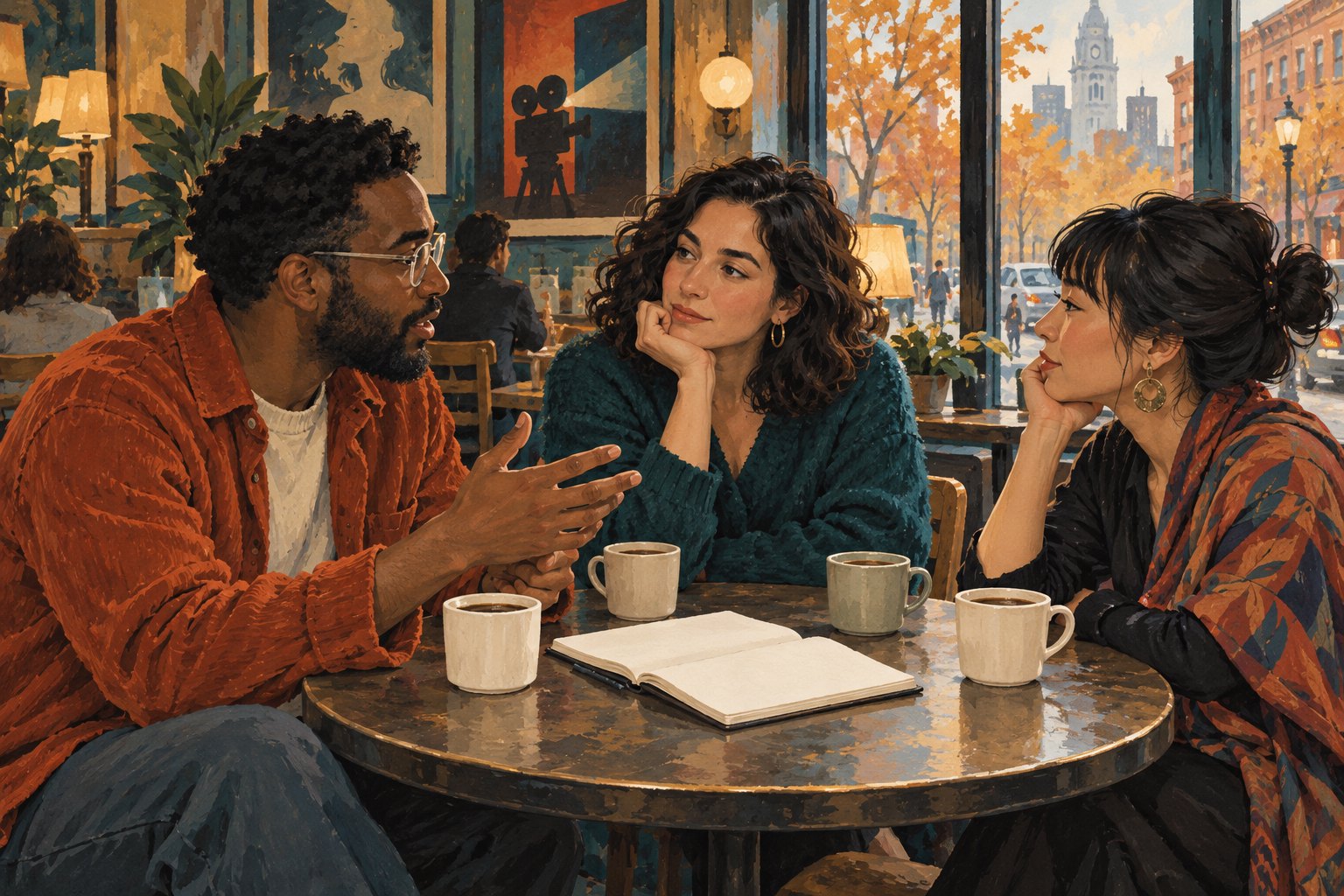
Then invite disagreement. Asking which moment changed another viewer’s understanding usually opens a richer conversation than exchanging scores. Someone else may have noticed a reaction in the background, understood a relationship differently, or found an ending unearned for reasons you had overlooked.
Disagreement does not require an immediate winner. If one viewer finds a scene restrained and another finds it emotionally distant, both can point to the same long shot or withheld close-up. The productive question is what that choice allows the film to express—and what it prevents.
Keep conversations considerate of people who have not seen the movie. Ask before discussing endings or major revelations. A festival day is more welcoming when enthusiasm does not take away someone else’s chance to encounter a story fresh.
If There Is a Q&A, Ask About a Choice
When a screening includes a filmmaker discussion, a specific question can connect the finished work to the decisions behind it. Asking why a scene stays with the listener instead of the speaker offers a concrete starting point. So does asking how a recurring sound or location developed during production.
Avoid making the filmmaker responsible for resolving every ambiguity. An explanation of intention can enrich a reading, but the film still has to communicate through what appears on screen. A moving account of production does not automatically repair an unclear relationship or an abrupt change in motivation.
Equally, an answer need not confirm your interpretation to make that interpretation worthwhile. The strongest critical response can acknowledge the filmmaker’s stated aim while explaining, with evidence, how the result landed differently.
After the Last Film: Decide What Stayed With You
At the end of the day, resist forcing every film into a single ranking. Instead, compare what each asked of you. Which one made you revise an opinion about a character? Which used uncertainty purposefully? Which offered an immediate emotional payoff but left less to consider afterward?
Keep those judgments provisional. A difficult film may become clearer after reflection; an exhilarating screening may reveal weaknesses once the excitement fades. Neither change invalidates the first response. It gives you a more complete account of the experience.
Our view is that the deeper value of a day at the Philadelphia Film Festival lies in this movement between private attention and public conversation. A movie belongs to its makers, but its meanings are tested by people who bring different memories, expectations, and sensitivities into the room. That communal dimension also informs our commentary on what a community loses when a film festival ends.
The day has done something worthwhile if you leave with a more precise question than the one you arrived with. Perhaps you understand why a character’s silence troubled you. Perhaps another viewer helped you see generosity where you first saw weakness. The screening ends; the work of paying attention can continue.
Original content by this site's editorial team. Published: October 25, 2026 at 10:46:30 PDT (Los Angeles time)