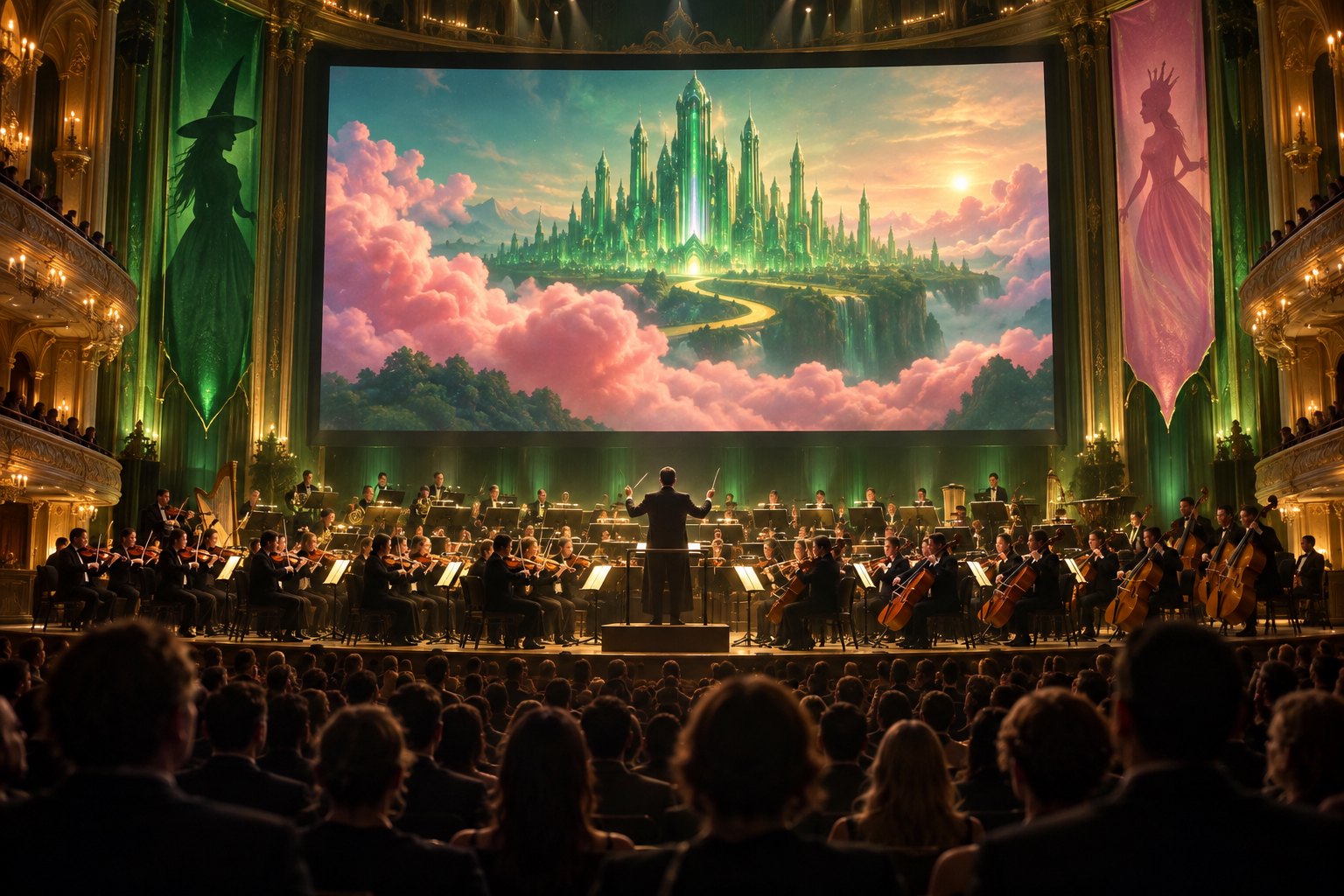
Wicked and Wicked: For Good are becoming live-to-film concert experiences, with San Francisco and New York set to open the 2027 tour, according to Deadline’s announcement. For fans, the immediate attraction is hearing this musical world in a concert setting. The more interesting critical possibility is that a different listening environment could bring Elphaba and Glinda’s emotional choices into sharper focus. The project is also confirmed in [NBCUniversal’s concert announcement](https://www.nbcuniversal.com/article/wicked-and-wicked-good-tour-globally-live-film-concert-experiences-featuring-full-symphony-orchestra).
The tour itself cannot yet receive a performance verdict. What can be examined is why these films suit the format: their music makes private desires audible, then exposes the distance between what the characters want and what they are willing to do.
Spoiler notice: The following criticism discusses the first film’s central conflict and ending, along with the political circumstances of Wicked: For Good.
What the concert announcement means for viewers
A live-to-film concert combines a movie screening with musical performance synchronized to the picture. The distinction matters when booking: a film concert should not automatically be understood as a touring stage production, a cast appearance, or a sing-along. Check the individual event description for the film being presented and the participation expected of the audience.
The two titles also deserve separate attention. An announcement covering both films does not mean every ticket includes both. Before making travel plans, confirm the particular screening, venue, start time, seating arrangement, and accessibility provisions.
As with Feid’s move into event cinema, the useful question is what gathering in a room adds to the work. Here, the strongest answer would be a clearer awareness of music as dramatic action.
Elphaba: the longing underneath the defiance
Elphaba’s story begins with exclusion, but her ambition is more complicated than proving other people wrong. She wants recognition from the very society that treats her as an embarrassment. Her hope of meeting the Wizard gives that desire a destination: perhaps someone powerful will finally recognize her worth.
That makes “The Wizard and I” essential to understanding her. Heard only as an impressive vocal showcase, it becomes an uncomplicated declaration of potential. Dramatically, it contains a vulnerability: Elphaba imagines acceptance arriving through the approval of an authority figure.
My reading is that this dependence gives her later refusal its force. She must relinquish a fantasy she has helped sustain. The moral choice is painful because the promised reward once mattered so much to her.
By the first film’s climax, her language has changed. “It’s the Wizard who should be afraid. Of me!” redirects the relationship between the isolated young woman and the institution she once admired. The line appears in the [published screenplay](https://assets.scriptslug.com/live/pdf/scripts/wicked-2024.pdf?v=1738546490), alongside the movement toward her public defiance.
For a concert audience, the listening challenge is to remember the earlier yearning when the finale arrives. The exhilaration gains depth when we hear the loss beneath it. Elphaba acquires independence at the cost of the welcome she had imagined.
Glinda: when being liked becomes a moral problem
Glinda’s opening greeting, “It’s good to see me, isn’t it?”, compresses her social worldview into a joke. She assumes that her presence is a gift. The humor works because self-absorption and genuine charm occupy the same breath.
“Popular” develops that contradiction. Glinda approaches social acceptance as something teachable: presentation can be adjusted, mannerisms improved, approval acquired. From her perspective, these skills are useful. She is offering the methods that have made her own life comfortable.
The uncomfortable implication is that this generosity comes with conditions. Helping Elphaba fit in can also mean asking her to accommodate the people who reject her. Affection does not automatically free Glinda from the values that shaped her.
That is why I find her such a productive counterpart to Elphaba. A simpler story would make popularity evidence of shallowness and alienation evidence of virtue. Their friendship demands a harder judgment: kindness can coexist with vanity, and sincere love can fail when acting on it threatens someone’s position.
For Good turns personal differences into public consequences
Wicked: For Good places the women’s divergent choices within a larger political structure. Elphaba lives in exile while fighting for Oz’s silenced Animals. Glinda becomes a reassuring public presence under Madame Morrible’s guidance. These circumstances are established in [Universal’s official film description](https://www.universalpictures.com/movies/wicked-for-good).
The contrast changes the meaning of their earlier desires. Elphaba’s wish to be accepted now collides with the demands of resistance. Glinda’s ability to make people feel comfortable becomes valuable to a government that wants reassurance to substitute for scrutiny.
In my view, this is the story’s sharpest development. A trait that looks harmless in a school setting can acquire troubling consequences when institutions put it to work. Glinda’s charm does not disappear; its usefulness changes. Elphaba’s refusal, meanwhile, carries the burden of isolation rather than the simplicity of a triumphant exit.
The relationship therefore gives both films a coherent dramatic question: what remains of friendship when public identities make honesty costly? It is a useful counterpoint to our examination of how continuing stories change the meaning of an ending. A spectacular departure can resolve one decision while leaving its consequences unsettled.
What to listen for beyond the biggest songs
The concert format’s promise should be measured by clarity. Greater volume alone would add little to a story already capable of overwhelming an audience. The more valuable experience would help listeners notice how accompaniment supports confidence, hesitation, attraction, and fear.
- Follow the changing desire. Ask what a character hopes to obtain at the beginning of a number and whether that hope survives its ending.
- Listen across scenes. Notice whether a triumphant passage changes meaning when remembered alongside an earlier moment of dependence.
- Protect the quiet moments. Dialogue and pauses carry choices that a famous musical climax can otherwise overshadow.
These are criteria for assessing the eventual performances, rather than claims about their sound balance or arrangements. The most revealing concert would make the emotional argument easier to follow while preserving the film’s dramatic pace.
The deeper question: who gets to sound good?
My strongest reading of the two-film story is that goodness involves a struggle over who receives sympathy. Glinda understands how to make people listen. Elphaba confronts what happens when telling an unwelcome truth makes a person easier to condemn.
Music complicates that struggle because beauty can carry reassurance as effectively as resistance. An audience can enjoy a dazzling number while questioning the social agreement it expresses. That tension gives these concert screenings a purpose beyond revisiting favorite songs.
The 2027 tour offers an opportunity to hear how wanting approval becomes a moral vulnerability, and how friendship challenges the roles a society assigns. Elphaba’s defiance matters because acceptance once tempted her. Glinda’s choices matter because being loved is not the same achievement as acting with courage.
Original content by this site's editorial team. Published: September 9, 2026 at 16:21:17 PDT (Los Angeles time)