Asa Germann has landed the role of Angel in an X-Men movie, according to an exclusive report from The Hollywood Reporter. The casting puts an actor’s name alongside a character with an immediately striking visual identity. For this film to make that pairing matter, though, Angel will need something more revealing than an impressive entrance.
The most interesting possibility is a performance that makes a spectacular figure feel specific: someone whose posture, reactions, and decisions remain compelling even when the camera stops admiring his wings. That is the opportunity worth watching in Germann’s reported casting.
This is a spoiler-free casting analysis, not a review of the finished movie. The casting report does not, by itself, establish Angel’s storyline, relationships, dialogue, or importance to the ensemble. The interpretations below describe creative possibilities rather than events confirmed to appear onscreen.
What the casting news actually tells us
The central reported development is straightforward: Germann has been cast as Angel. It gives audiences a concrete actor-and-character pairing to consider. It does not provide a basis for deciding whether this interpretation will be faithful, surprising, emotionally persuasive, or even especially prominent.
Those distinctions matter because superhero casting invites people to fill in a whole movie around a single announcement. A familiar character can prompt assumptions about villains, transformations, romances, and future installments. None of those follows automatically from a role being cast.
Nor does an actor’s selection establish the quality of the eventual performance. Direction, scene construction, editing, and the space afforded to a character all shape what reaches the screen. The useful question now is what the role could ask of Germann—and what the film would need to give him in return.
Angel’s visual appeal creates a dramatic challenge
A winged character offers cinema an unusually direct image of freedom. The silhouette communicates before anyone speaks. Yet that clarity can also flatten a person into an emblem: beautiful, remote, and available whenever the film needs a striking composition.
My preference would be for an Angel whose relationship with being seen is more complicated. Admiration need not feel like understanding. Someone can attract attention while remaining emotionally unreadable to the people looking at him. That tension could give a performance somewhere to go beyond alternating between confidence and distress.
The distinction would have to emerge through behavior. Does he welcome another person’s gaze, redirect it, or wait for it to pass? Does a compliment relax him or make him more guarded? These are possible acting choices, not descriptions of Germann’s scenes. Their value is that they would let the audience discover an attitude rather than receive a speech explaining it.
A successful interpretation could also allow pleasure. A character should be able to enjoy an extraordinary ability without that enjoyment canceling his other difficulties. Wonder and discomfort can coexist; giving both room would make Angel less predictable.
The performance needs a life at ground level
For Germann, one potentially rewarding part of the role is physical performance. Wings raise practical questions for screen acting: how a person occupies space, turns toward someone, settles into stillness, or keeps a distance. Those details could help the extraordinary body feel inhabited.
The important creative decision would be consistency. If the physical presence matters only during an effects sequence, the character may feel divided between an actor in conversation and an image in motion. Small, repeated choices could connect those modes without drawing attention away from the scene.
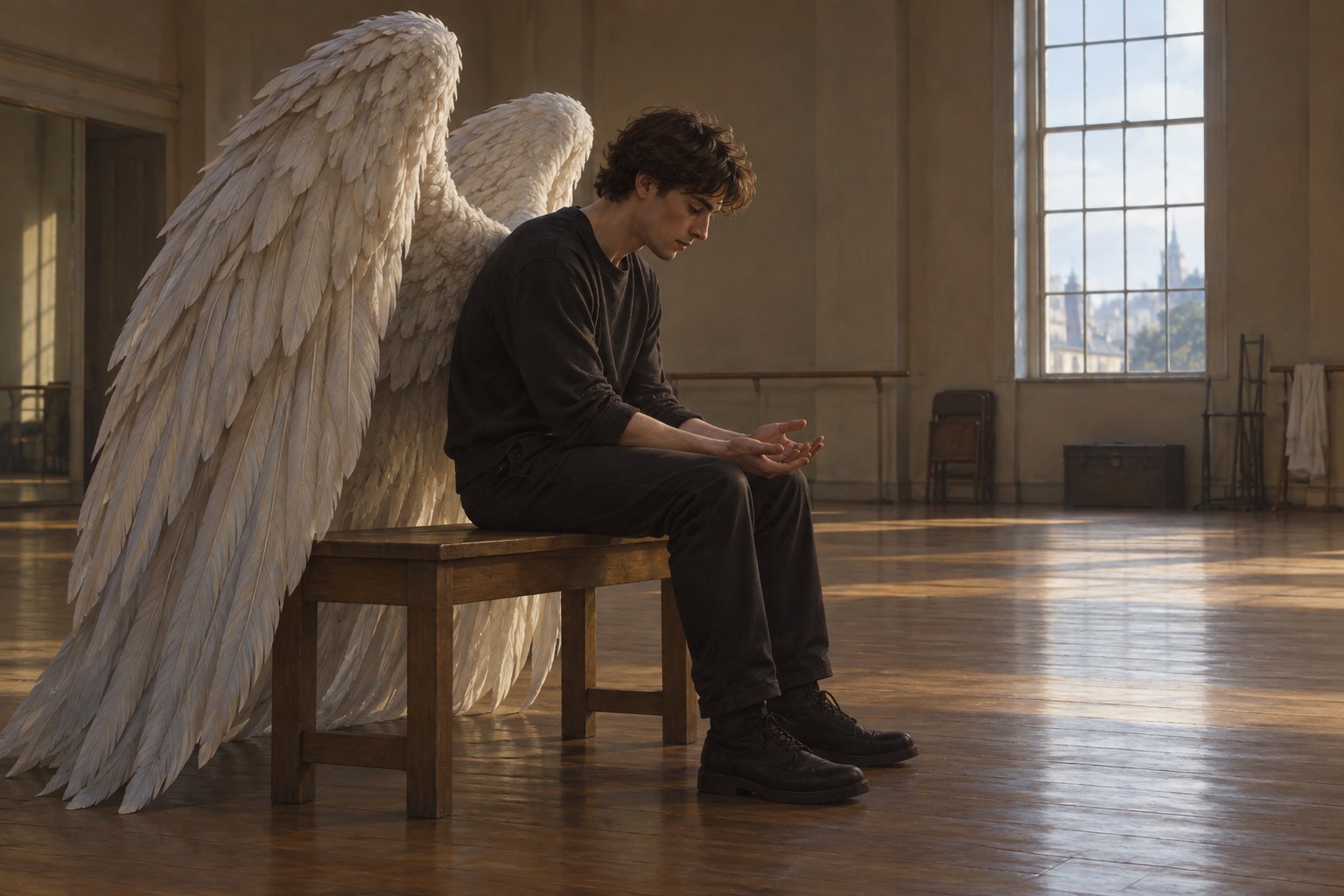
Stillness would be particularly revealing. An aerial shot can establish scale; a held reaction can establish what matters to someone. The film could give Angel emotional weight by allowing a conversation to continue long enough for his response to change our understanding of him.
That interest in the person behind an immediately recognizable premise also runs through our character-focused preview of Witch on the Holy Night. Spectacle becomes more involving when the audience understands whose experience organizes it.
An ensemble role still needs consequential choices
Angel does not need to dominate an X-Men movie to matter. He does need some influence over what happens. There is a meaningful difference between appearing in a team lineup and participating in the dramatic argument of a film.
One useful measure would be whether another character must respond to a decision he makes. A refusal, an unexpected act of trust, or a disagreement could establish agency more effectively than a lengthy introduction. These are examples of dramatic construction, not predictions about the screenplay.
Relationships would offer another measure. If everyone reacts to Angel in essentially the same way, the characterization could become repetitive. Distinct relationships allow different qualities to surface: ease with one person, impatience with another, uncertainty around someone whose opinion carries weight.
Germann’s casting is therefore only half the equation. The writing must create opportunities for him to affect a scene. Our commentary on Conor Oberst’s short film with Phoebe Bridgers considers a related principle: recognizable names invite attention, while the creative relationship determines what that attention discovers.
What would make this Angel interpretation convincing?
When there is a finished performance to assess, three questions will be more useful than whether the character resembles an imagined ideal:
- Does Angel want something specific? A clear desire gives even limited screen time direction.
- Do his choices carry consequences? Agency makes an ensemble member necessary to the story.
- Do spectacle and performance express the same person? Movement, framing, and reactions should support a coherent characterization.
Memorable dialogue would also need that foundation. A quotable line has greater force when it crystallizes a decision or exposes a contradiction. There is no verified dialogue from Germann’s Angel to assess here, so attaching familiar franchise quotations to this interpretation would create a misleading impression of its voice.
The deeper opportunity: being visible without being understood
My strongest reason for interest in this casting is the possibility of exploring the distance between visibility and recognition. Angel offers a compelling image through which to consider that difference. A person can be impossible to overlook and still struggle to have others understand what he wants.
That reading is a creative possibility, not a claim about the movie’s message. It would require the film to make room for ordinary emotional particulars alongside its extraordinary imagery: attention that becomes uncomfortable, trust that develops slowly, or confidence that depends on the company someone keeps.
Germann’s reported casting makes those possibilities newly concrete without resolving them. The most satisfying outcome would be an Angel whose wings catch the eye, then whose decisions hold it.
Original content by this site's editorial team. Published: September 10, 2026 at 12:06:26 PDT (Los Angeles time)