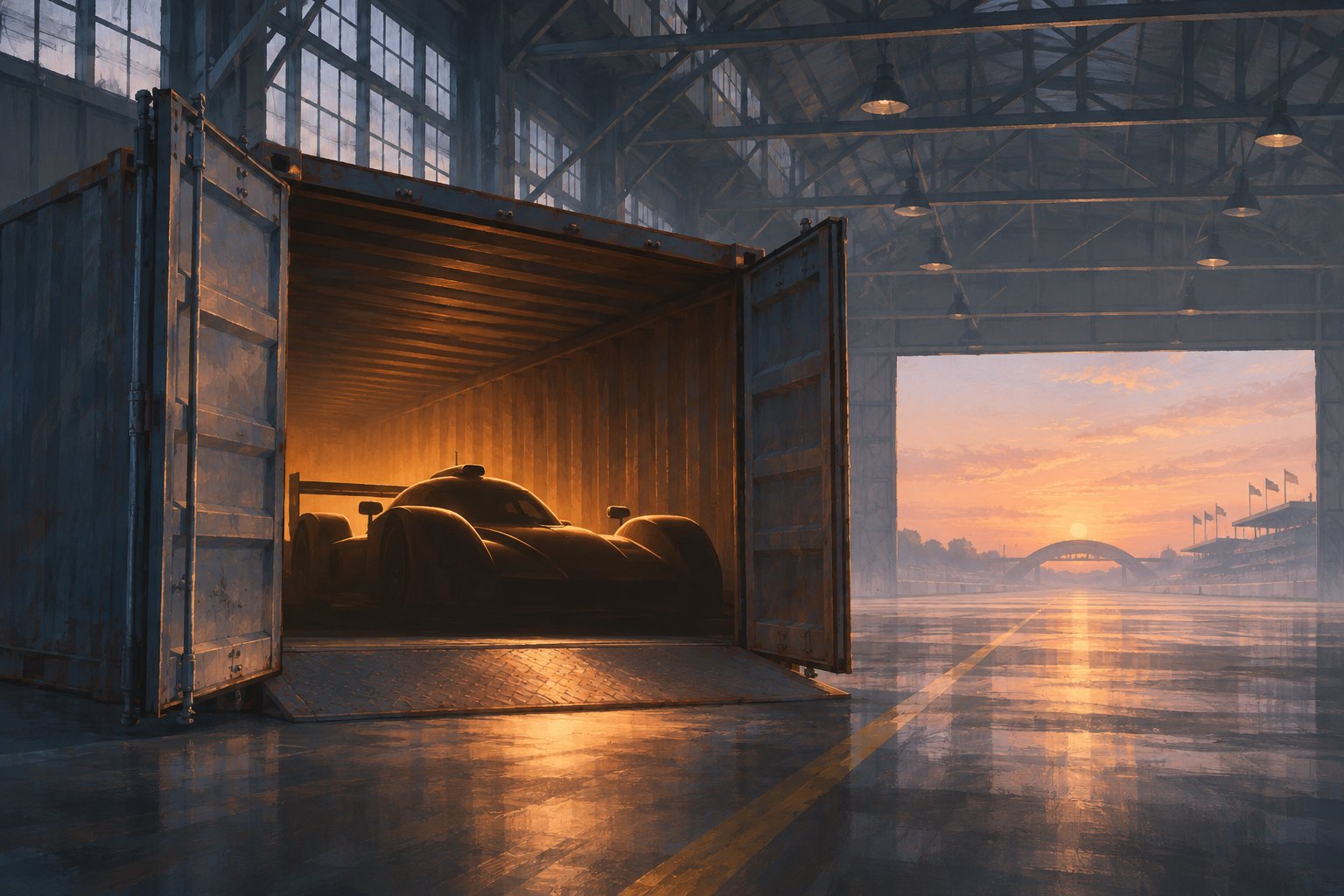
Ford Racing’s return to Le Mans gives Zack Snyder and Matt Damon an appealing storytelling problem: how do you make an audience care about a racing campaign before its competitive outcome exists? The premise of their new anthem film offers a useful answer. Make departure itself meaningful. A car traveling toward a circuit can carry anticipation, responsibility, and unfinished ambition without a checkered flag in sight.
Ford describes a Snyder-directed film with Damon providing voiceover, following its GT41 Hypercar from loading into a shipping container in the United States toward Le Mans. That journey supplies the focus here. This is an analysis of the narrative premise described by Ford, rather than a firsthand assessment of the finished film’s editing, performances, or sound. Discussion includes the announced setup and one disclosed production callback.
The car occupies the protagonist’s position
A conventional character analysis begins with desire: what does someone want, and what prevents them from getting it? A machine cannot answer those questions for itself. Yet a film can place a car in the position normally occupied by a protagonist, organizing the audience’s attention around where it goes and what its arrival means.
That distinction matters. Treating the vehicle as the center of the story does not require pretending it has a personality. Instead, the car can become the visible expression of many people’s intentions. Its movement gives a complicated undertaking a clear direction. The audience follows one object while understanding that much more than an object is being transported.
My reading of this premise is that its strongest dramatic resource is dependency. A racing machine represents extraordinary capability, but getting it to the place where that capability matters requires other people. Transportation puts that dependence into the story’s basic structure. Before the car can demonstrate what it can do, somebody must get it there.
Why departure can matter as much as arrival
Choosing a journey as the organizing idea shifts attention toward commitment. Preparation becomes consequential when it turns into action: equipment leaves a familiar environment, distance opens up behind it, and an intention acquires a destination. That is a recognizable dramatic threshold even for viewers who know little about endurance racing.
A shipping container is particularly interesting in that framework. As an ordinary object, it suggests logistics and protection. As a narrative device, it can temporarily conceal the very thing an automotive campaign wants us to admire. The resulting tension is conceptual rather than competitive: enormous potential is being held in reserve.
This is where the premise earns my interest. Speed is an obvious subject for racing imagery. Waiting, handling, and passage offer a different emotional vocabulary. They allow anticipation to emerge from the gap between what a machine was built to do and what it must undergo before doing it.
That does not establish how successfully Snyder realizes those possibilities on screen. It does explain why the announced journey offers more to discuss than a succession of attractive vehicle images. It has a beginning, a direction, and an unresolved purpose.
The people behind a collective protagonist
Looking at this story through a human perspective means asking whose effort the car represents. A team can function as a collective protagonist, but that idea becomes dramatically convincing only when individuals seem necessary to the shared goal. Otherwise, togetherness remains an assertion.
The useful viewing question is therefore simple: does human activity change what happens? Someone preparing, securing, checking, or moving an object can express responsibility through an action. A person merely standing beside it provides scale. Both may make a striking image, but they carry different amounts of narrative meaning.
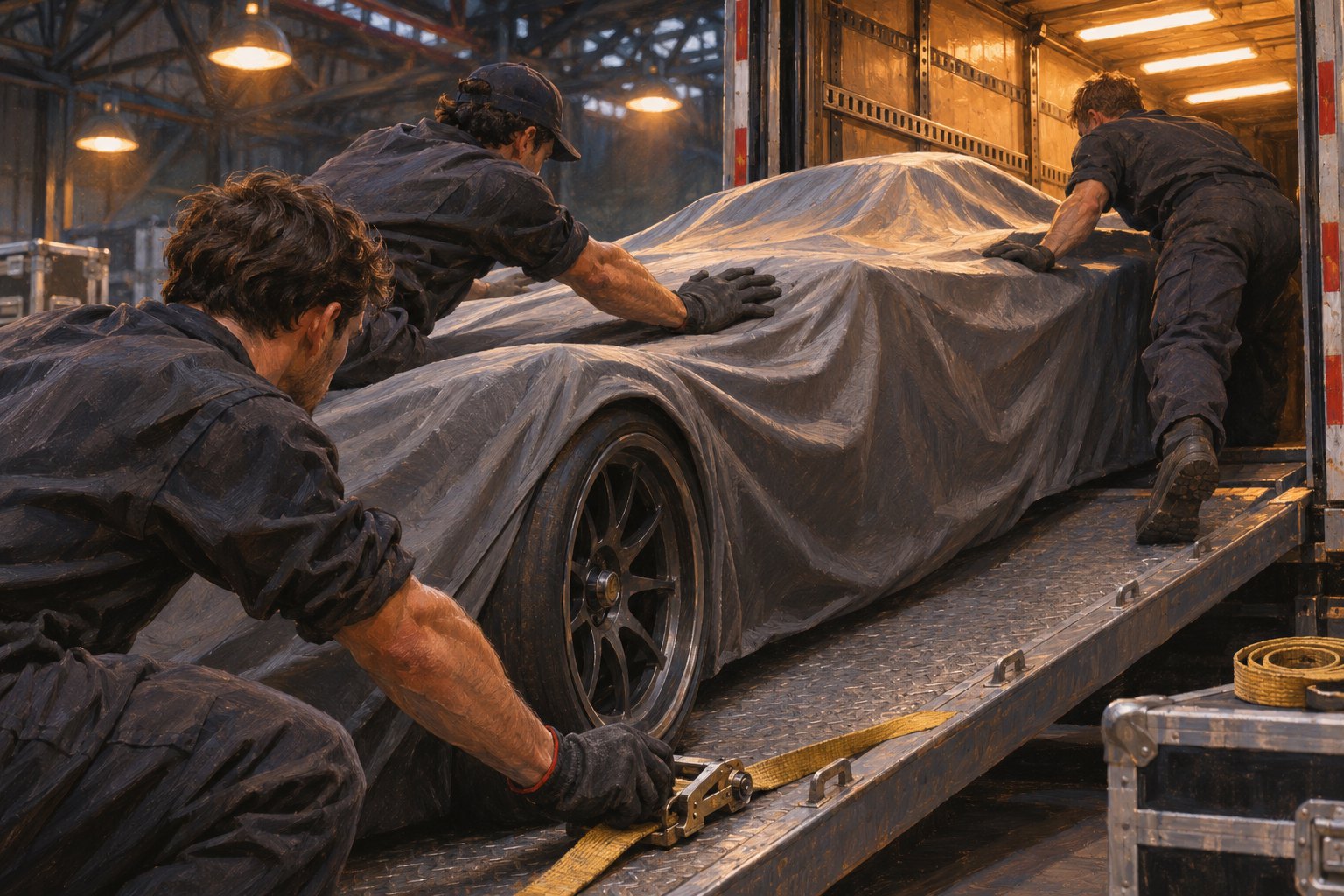
This is a question to bring to the finished film, not a claim about particular workers or gestures appearing in it. It also connects to our discussion of why supporting players matter to an ensemble: shared achievement becomes more moving when we understand how people contribute to it.
For me, the most compelling version of a team-centered racing story makes competence emotionally legible. Careful work can communicate fear of failure, respect for colleagues, or pride in a responsibility. Those feelings need neither a speech nor an invented personal tragedy.
What Damon’s voice can contribute
Ford identifies Damon as the narrator. Narration creates another possible center of attention: a voice can give a journey continuity even as places and images change. Its dramatic function depends on the relationship it establishes with the action.
When watching, listen for the position that voice seems to occupy. Does it invite the audience into a shared undertaking? Does it explain what is at stake? Does it make room for uncertainty? These distinctions affect whether an anthem feels like an invitation to care or an instruction to admire.
Our earlier commentary examined the movie associations behind Damon’s Ford Racing collaboration. Here, the more useful question is what narration contributes to the journey itself. Familiarity can draw attention, but the words still need to establish a relationship between movement and meaning.
No unverified dialogue is needed to explain that relationship. The central dramatic question already exists in the premise: what does reaching this destination demand from the people making the journey?
A return should leave room for uncertainty
The word “return” gives the project an emotional advantage. It implies that a place already matters. But it also presents a storytelling risk: familiarity can make a future challenge feel settled before it begins.
My preference is for racing stories that preserve the difference between belonging somewhere and succeeding there. A team may have powerful reasons to return; those reasons do not determine what happens next. Anticipation becomes more persuasive when confidence can coexist with vulnerability.
Viewed that way, the journey is an appropriate subject for an anthem. It can celebrate the decision to undertake a challenge without needing to manufacture its resolution. Departure is something the story can own. Victory remains something to pursue.
The workshop connection adds a quieter layer
Ford also identifies a specific production connection: the hangar used for loading the container previously appeared as the GT40 workshop in Ford v Ferrari. This is a disclosed location callback, rather than a speculative hidden reference.
Its interpretive appeal lies in the association with preparation. A workshop is where ambition encounters practical problems. Reusing that space connects the idea of going back with the work required to move forward.
That is the deeper promise of this Le Mans film’s premise. A return can mean accepting responsibility again: gathering people, preparing equipment, and committing to a destination whose outcome remains uncertain. The car gives that commitment a visible form. The human story is everything required to send it on its way.
Original content by this site's editorial team. Published: November 26, 2026 at 13:03:05 PST (Los Angeles time)