Wildwood makes the question of human creativity more interesting than a contest between handmade objects and computer-generated images. Its strongest claim on our attention is emotional: a missing brother matters to someone, loyalty requires a choice, and grief can become dangerous when it grants itself permission to hurt others. Those relationships give the fantasy a purpose beyond looking extraordinary.
That is the most useful way to approach the film amid arguments about artificial intelligence. The value of human authorship includes the decisions that make us understand another person’s fear, recognize a compromised motive, or care about a life unlike our own. A beautiful forest becomes dramatically meaningful when someone has something to lose inside it.
Spoiler note: This analysis discusses the rescue premise and central character motivations, without describing the ending. It draws on documented story details and reported dialogue rather than presenting a firsthand screening account.
Prue gives the spectacle an urgent human scale
The starting point is wonderfully direct. After crows abduct her baby brother, Prue McKeel enters the Impassable Wilderness outside Portland. Her classmate Curtis accompanies her into a forest inhabited by talking animals, bandits, and competing powers. AFI’s official synopsis identifies the widening conflict: saving her brother becomes entangled with protecting the forest’s future. [AFI’s film synopsis](https://fest.afi.com/2026/red-carpet-premieres-2026/wildwood/)
Prue’s perspective matters because she has no reason to appreciate the adventure as entertainment. For an audience, an enchanted wilderness promises discovery. For her, its distractions consume time that might be needed to recover her brother. That difference creates a productive tension between the pleasure of looking and the urgency of moving forward.
“I don’t want any part of your fairytale,” she says in dialogue documented by critic Richard Crouse. It is a sharp rejection of the role the setting seems to offer her. Prue is not asking for an extraordinary destiny; she wants an ordinary relationship restored. [Richard Crouse’s review](https://richardcrouse.ca/wildwood-4-stars-an-epic-fairy-tale-for-adults-told-on-a-grand-scale/)
My reading is that this resistance gives the story its most persuasive defense of imagination. Fantasy becomes valuable when it lets us encounter familiar obligations under unfamiliar pressure. A sister’s responsibility remains recognizable even when the world around her has abandoned everyday rules.
It also provides a useful standard for judging the filmmaking. An elaborate image should deepen our understanding of Prue’s predicament, complicate it, or briefly release its tension. Technical achievement deserves admiration, but dramatic relevance earns emotional investment.
Curtis makes loyalty a creative problem
Curtis brings a different kind of vulnerability. The official description presents him as awkward but loyal, a classmate who joins a dangerous journey that begins with someone else’s family emergency. His presence shifts the story from solitary determination toward dependence on another person.
For Prue, the reason to keep going is immediate. For Curtis, remaining involved means choosing to make another person’s crisis his concern. That distinction gives the friendship weight without requiring an invented speech or an assumption about what every gesture means.
From an animation perspective, loyalty is an especially revealing challenge. It cannot be communicated indefinitely by telling viewers that a character is loyal. It needs behavior: attention, hesitation, persistence, a willingness to remain beside someone difficult or frightened. These are criteria for assessing the performance, rather than claims about particular unverified shots.
This is where the human-creativity argument becomes concrete. Character animation involves deciding what a person understands at a given moment and how much of that understanding reaches the surface. A technically polished expression can still feel empty if it has no relationship to the character’s situation. The important question is whether Curtis registers as someone making choices.
Alexandra exposes the difference between love and possession
Alexandra, the Dowager Governess, complicates the moral picture. Published accounts identify her as a bereaved mother and a threatening power within the wilderness. Ari Chand’s discussion of the film also connects the abduction to her pursuit of power through a dark ritual. Her grief therefore sits alongside the harm she is prepared to cause. [Ari Chand’s analysis for The Conversation, republished by Evening Report](https://eveningreport.nz/2026/10/23/in-an-age-of-ai-wildwood-is-a-film-that-reminds-us-human-creativity-is-irreplaceable/)
The revealing comparison is with Prue. Both characters are defined partly by a threatened or broken family bond. That resemblance does not make their actions morally equivalent. It makes their differences worth examining. Pain can explain a desire without justifying the means used to satisfy it.
For me, this is the story’s richest interpretive opening. Prue’s effort to recover her brother invites sympathy because his safety matters. Alexandra’s position asks what happens when personal suffering becomes an entitlement to determine everyone else’s fate. The dividing line concerns what another life is allowed to mean.

This distinction also explains why darkness belongs in the discussion of the film. Emotional complexity comes from recognizing a wound while resisting the cruelty committed in its name. Readers considering the movie for younger viewers can explore our parent’s guide to Wildwood’s wonder and darker themes.
Human authorship does not require rejecting technology
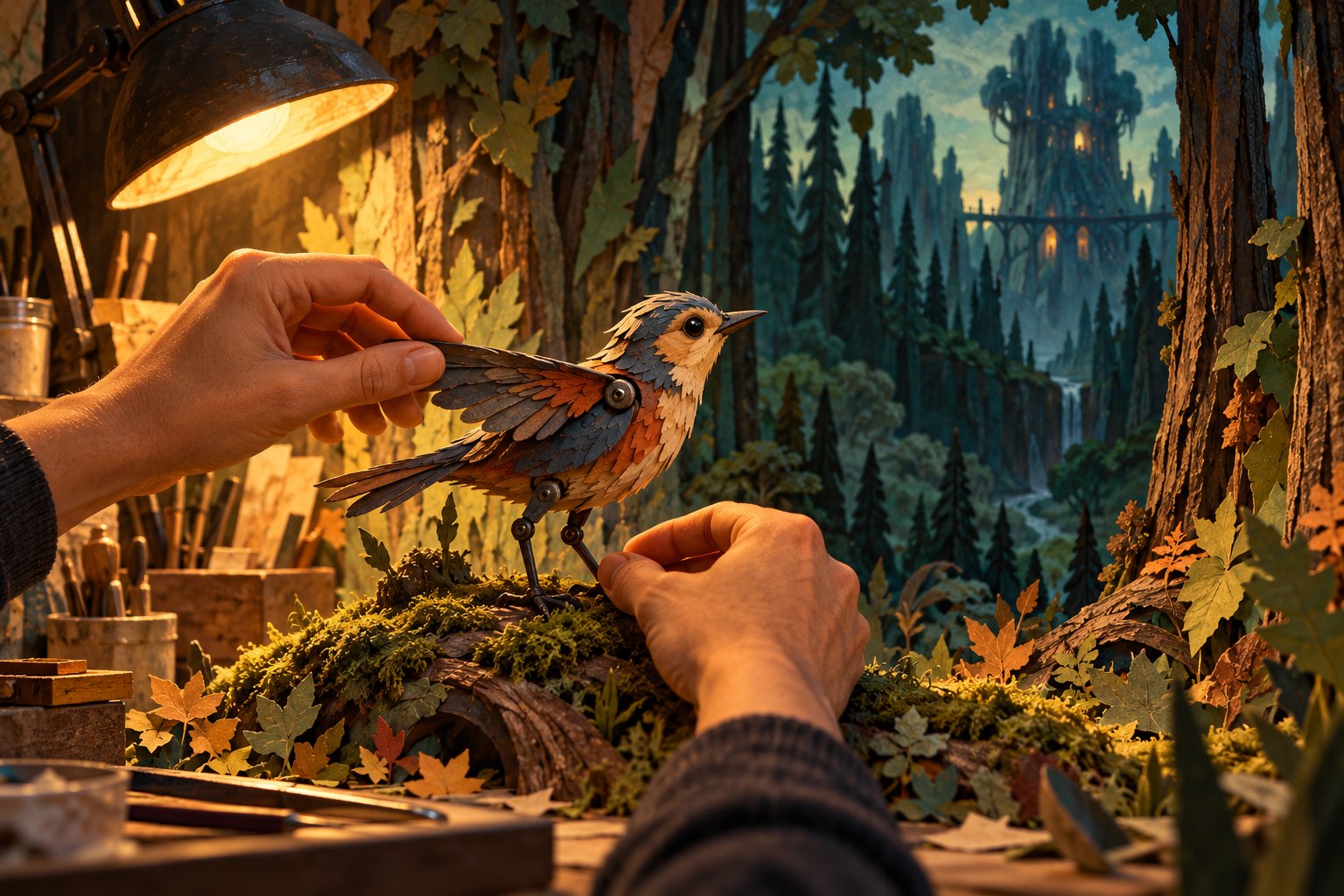
Any defense of Wildwood as human creativity should acknowledge how it was made. In an interview published by Animation World Network, director Travis Knight describes a practice combining traditional fabrication with digital tools. The production brings together stop-motion, miniatures, practical effects, and computer-generated imagery. [Travis Knight on art, craft, and technology](https://www.awn.com/animationworld/why-travis-knight-waited-16-years-make-wildwood)
The meaningful distinction concerns creative responsibility. A tool can help artists realize an expression, extend a setting, or solve a physical limitation. Authorship includes deciding why that expression belongs there and what the setting should make us feel.
Our earlier examination of Wildwood’s miniature world and its dramatic details considers the material achievement. Here, the larger issue is collaboration: different specialists contribute judgments that must eventually serve the same characters.
That is a stronger argument than declaring that painstaking labor automatically produces great cinema. It does not. A carefully built movie can still have uneven pacing or familiar storytelling. Respect for the makers should sharpen criticism by making us ask what their choices accomplish.
The deeper meaning: attention is an ethical choice
Prue’s other brief declaration, “I just want my brother,” reduces the spectacle to its essential demand. The line, also recorded in Crouse’s review, insists that a particular person cannot be replaced by the grandeur of the surrounding adventure.
That insistence offers a compelling way to interpret Wildwood in the age of AI. Human creativity matters because art carries particular commitments: whose suffering receives attention, whose motives are examined, whose life is treated as more than a means to someone else’s happiness.
The film cannot settle every argument about generative technology. Its characters offer something more useful than a universal verdict. Prue, Curtis, and Alexandra let us examine care from different directions: devotion, chosen solidarity, and the danger of possessiveness. The imaginative achievement lies in giving those differences a world where they can become visible—and asking us to care enough to tell them apart.
Original content by this site's editorial team. Published: October 24, 2026 at 01:22:33 PDT (Los Angeles time)