
Good Will Hunting gets my vote for the quintessential Boston movie because it makes belonging feel both sustaining and suffocating. Its strongest claim comes from the tension between loving the people who raised you and allowing yourself a life they cannot entirely share. The accents and familiar settings matter, but the emotional geography matters more.
That is a critical judgment, not a declaration of a contest winner. A useful answer to the Boston-movie question needs a standard: how deeply does the place shape what its characters want, fear, and misunderstand? By that measure, this intimate drama makes an unusually persuasive case.
Spoilers follow for the entire film, including its ending.
Boston is the problem Will cannot solve
Released in 1997, directed by Gus Van Sant, and written by Matt Damon and Ben Affleck, the film follows a working-class mathematical prodigy whose intelligence has outpaced his ability to trust. Damon plays Will; Robin Williams, Affleck, Minnie Driver, and Stellan Skarsgård form the principal supporting ensemble. These credits and the release year are documented in [Miramax’s film overview](https://www.miramax.com/movie/good-will-hunting/).
Will works as a janitor at MIT while living in South Boston. The distinction matters: MIT is in Cambridge, across the river. The film’s Boston identity extends beyond municipal boundaries into a region where prestigious institutions and neighborhood loyalties sit close together without offering equal access.
His secret mathematical work briefly collapses that distance. Yet being recognized creates a new problem. Once Professor Gerald Lambeau discovers his ability, Will becomes somebody other people can imagine a future for. Recognition brings opportunity, but it also brings expectations about who deserves to direct his life.
That is the film’s most productive contradiction. Will resents being dismissed and resents being claimed. His intelligence lets him enter conversations that his background supposedly excludes him from; his defensiveness makes every conversation another border to patrol.
The barroom victory reveals Will’s limits
In the Harvard-bar confrontation, Will dismantles a student who uses borrowed intellectual authority to humiliate Chuckie. His later taunt, “How do you like them apples?”, turns the encounter into a satisfying victory lap. The exchange and its aftermath appear in the [film’s dialogue transcript](https://www.moviescriptsandscreenplays.com/BenandMatt/goodwilltrans.html).
The pleasure is immediate: someone who expects social superiority to guarantee intellectual superiority discovers otherwise. But Will’s triumph still depends on beating another man at the same game. Knowledge becomes a weapon, and the audience gets the exhilaration of watching him wield it.
For me, that makes the scene more interesting than a simple celebration of self-education. Will can expose pretension instantly. He has far less practice entering a room without needing either to conquer it or escape it. His brilliance protects him from embarrassment while preserving the conditions that keep him lonely.
There is a useful comparison with Pretty Woman’s complicated fantasy of defeating class snobbery: a triumphant comeback can reverse a humiliation without changing the system that made humiliation possible. Will wins the exchange. The distance between talent and institutional permission remains.
Sean offers recognition without a career plan
Lambeau sees exceptional ability and wants it developed. Sean Maguire, the therapist Will eventually encounters, insists that ability cannot answer every question about a person. Their disagreement gives the drama its central argument: what does someone owe the world because he happens to be gifted?
Skarsgård makes Lambeau’s investment understandable. Ignoring Will’s mind would be its own failure. Yet the professor’s urgency can reduce a complicated young man to a rare resource at risk of being wasted. Sean’s approach gives Will room to become more than an outcome.
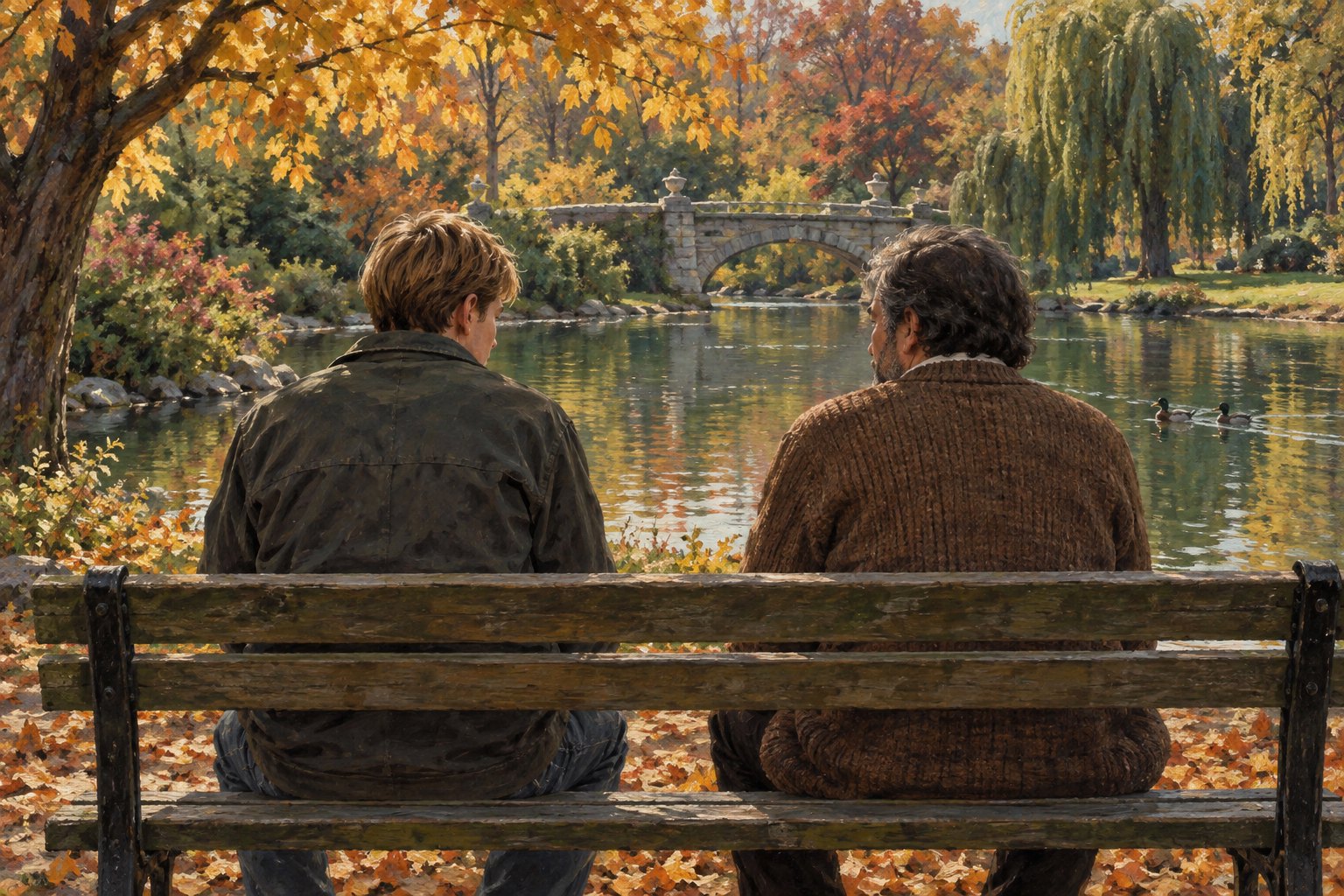
The park-bench conversation establishes the limits of Will’s command of facts. Sean draws a distinction between knowing about experience and having lived through it. Williams makes that distinction persuasive through restraint: the scene’s authority comes from someone with nothing useful to gain by winning an argument.
Later, “It’s not your fault” addresses Will’s childhood abuse. The words are deliberately simpler than the intellectual performances that usually keep him safe. Their repetition removes his usual escape routes. He cannot make the statement more sophisticated and thereby make it less personal.
I find the scene moving because Damon lets comprehension arrive unevenly. Will can accept a proposition intellectually before he can bear its emotional meaning. The film gives those two forms of understanding different rhythms.
Its limitation is dramatic compression. The breakthrough carries considerable responsibility for making the final act possible. As storytelling, that concentration is powerful; it also makes Will’s movement toward change feel tidier than the film’s earlier portrait of resistance.
Skylar exposes the cost of self-protection
Skylar’s invitation to California forces Will to consider a future he cannot control in advance. He answers the possibility of rejection by making rejection happen himself. Driver gives the confrontation emotional clarity: Skylar wants an honest relationship, while Will keeps substituting arguments about what she will eventually do.
From her perspective, his intelligence offers little protection. Being able to explain somebody’s fear does not make receiving their cruelty easier. The film becomes stronger when it allows that distinction to remain visible.
Still, Skylar receives less interior space than Will. Her ambitions and grief establish a life beyond him, but the narrative mainly uses that life to challenge his choices. Driver supplies an independence that the screenplay does not always have time to explore.
Chuckie makes leaving an act of loyalty
Chuckie provides the strongest reason to call this a Boston film. He tells Will that he hopes to arrive at his door one day and discover his friend has left. Affleck gives the speech an impatient generosity: Chuckie refuses to let familiarity become an excuse for surrender.
The scene changes what neighborhood loyalty means. Remaining physically close is no longer its highest expression. Chuckie can value their shared life and still want Will to take an opportunity that will interrupt it.
That idea also informs our discussion of why Community’s friendships need room for change. Stories about beloved groups become emotionally credible when affection can survive a different future.
Chuckie’s generosity also prevents the film from equating a conventional working life with personal failure. His judgment is more precise: Will should not pretend he lacks choices simply because exercising them frightens him. The rebuke comes from someone who understands both the comfort and the cost of staying.
The ending makes its Boston identity stronger
Will’s departure toward California leaves a crucial uncertainty intact. The film does not show a completed romantic reconciliation or a settled professional destiny. It shows a decision to approach a life whose outcome he cannot calculate.
The closing note echoes Sean’s earlier story about choosing the woman who became his wife over a baseball game. This is a deliberate callback rather than a hidden Easter egg: Will finally borrows something from Sean that can guide an action, instead of collecting another argument.
No single film can represent all of Boston, and this one offers a particularly narrow view through male friendship, class anxiety, and exceptional talent. Its genius premise also provides an escape route unavailable to most people who face similar barriers.
Yet its deeper interpretation of home remains compelling. Home gives Will language, humor, protection, and people worth loving. It becomes dangerous when he treats those gifts as proof that he must never change. My vote goes to Good Will Hunting because its most generous vision of Boston includes the possibility that the people who love you will help you leave.
Original content by this site's editorial team. Published: October 12, 2026 at 05:44:50 PDT (Los Angeles time)