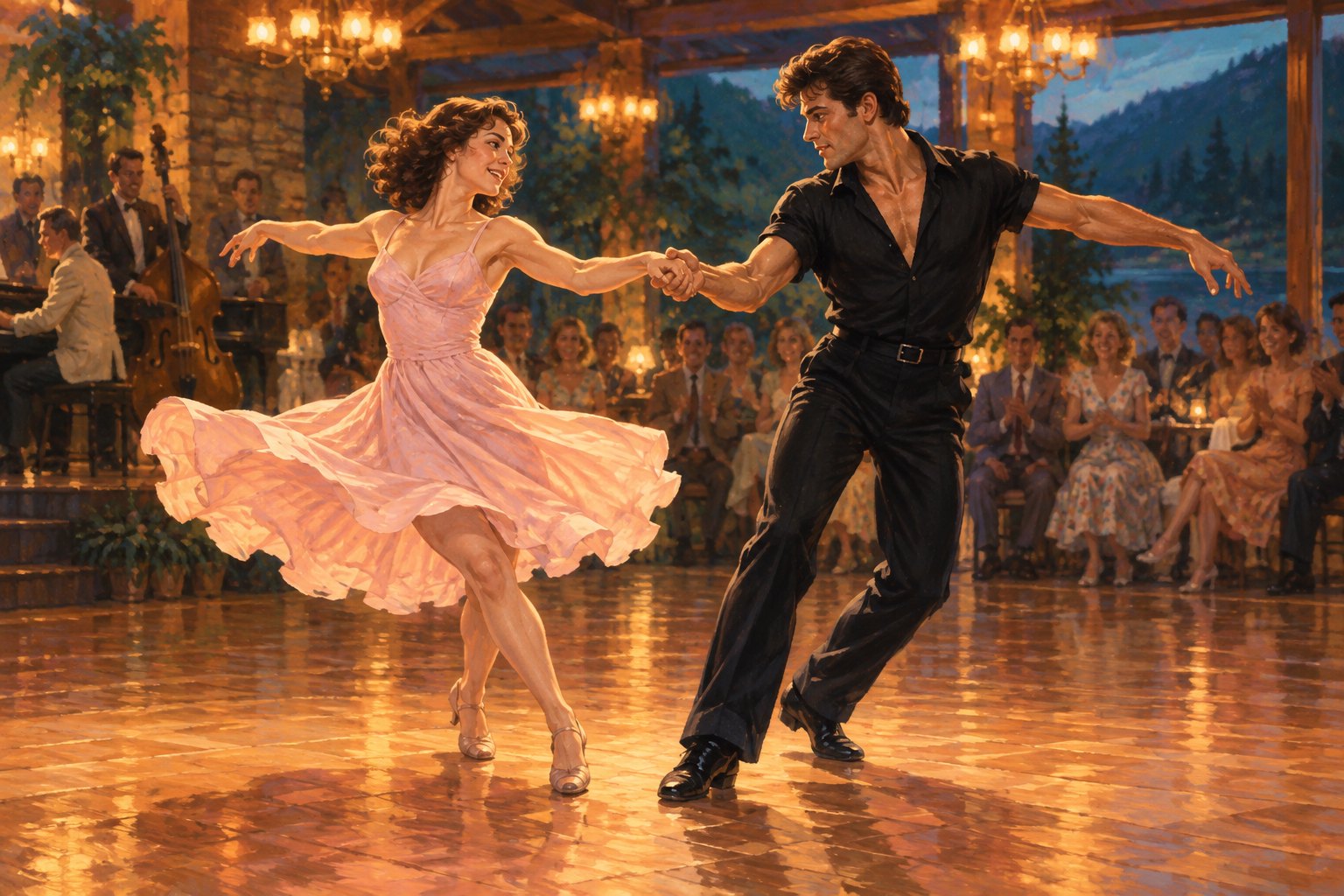
Dirty Dancing remains a satisfying feel-good movie because its happiness has something to overcome. The music and physical chemistry provide immediate pleasure, but the lasting reward comes from watching people revise their judgments. Baby learns that being good can require disappointing someone she loves. Johnny discovers that someone might defend him without wanting to own him. Their final dance makes those changes visible.
Spoiler warning: This review discusses the complete story, including Penny’s abortion and the ending.
Released in 1987, directed by Emile Ardolino, and written by Eleanor Bergstein, the film places Frances “Baby” Houseman, played by Jennifer Grey, at Kellerman’s resort during the summer of 1963. Patrick Swayze’s Johnny Castle initially seems to belong to an entirely different world. The romance works because the film gradually exposes how differently the same resort treats them.
Baby’s awkwardness is the beginning of her appeal
“I carried a watermelon.” Baby’s introduction to Johnny at the staff party is wonderfully unimpressive. She has entered a room whose rhythms she cannot yet read, and her explanation is embarrassingly literal. Grey lets the moment hang. Baby cannot turn herself into a sophisticated stranger simply because she wants to impress someone.
That awkwardness gives the character room to develop. She arrives with convictions, curiosity, and confidence in her father’s goodness, but little experience of having those beliefs tested. Helping someone sounds straightforward until it demands secrecy, money, physical effort, and the possibility of being misunderstood.
Her attraction to Johnny opens a door, but her concern for Penny gives her a reason to stay involved. That distinction matters. Baby’s growth would be much thinner if the entire summer were a makeover designed to secure a handsome man’s attention. Instead, desire and conscience develop together, sometimes awkwardly.
Grey’s performance keeps intelligence and embarrassment in the same frame. Baby can recognize unfairness before she knows how to confront it effectively. For me, that is the film’s most reassuring idea: you do not have to become effortlessly confident before your choices can matter.
Penny gives the summer romance its consequences
Penny, Johnny’s dance partner, becomes pregnant by Robbie, who refuses to help her. Baby obtains money from her father without explaining its purpose and agrees to substitute for Penny at a scheduled dance engagement. When Penny’s abortion goes badly, Baby brings her physician father to help.
The plot ties Baby’s opportunity to another woman’s vulnerability. Dancing is recreation for the resort’s guests, but it is employment for Penny and Johnny. A missed performance carries consequences beyond embarrassment. Baby enters their profession with the protection of a family holiday behind her; they cannot step out of financial uncertainty so easily.
Cynthia Rhodes gives Penny a professional composure that makes her distress particularly affecting. She deserves attention as a skilled worker whose life extends beyond the central couple. The film grants her less interior space than Baby, which remains a limitation: her crisis does considerable work for someone else’s coming-of-age story.
Even so, Penny’s presence prevents the resort from becoming an uncomplicated nostalgic playground. The eventual celebration feels stronger because the film has shown how little protection some of its workers possess. Its warmth comes partly from people helping one another when the surrounding social order fails them.
Johnny’s confidence stops at the edge of the dance floor
Swayze makes Johnny’s authority look physical before it looks verbal. His posture and movement suggest a man who knows precisely what he is doing. Away from dancing, that certainty becomes harder to maintain. He expects people with money and status to decide what he is worth.
This creates the romance’s most interesting imbalance. Johnny teaches Baby how to move, while she challenges his expectation that humiliation is inevitable. Yet her encouragement can also sound naive. Standing up to an employer is easier advice to give when losing the job will not endanger your own livelihood.
The film sharpens that conflict when Johnny objects to Baby keeping their relationship hidden. Her private belief in him has limits if she cannot acknowledge him publicly. His frustration forces her to recognize the difference between feeling fair-minded and accepting the social cost of fairness.
That is why their chemistry benefits from friction. Johnny is neither an infallible mentor nor merely a wounded man waiting to be repaired. Baby is neither a helpless beginner nor a rescuer with all the answers. Each sees something the other has difficulty admitting.
The rehearsals make trust something we can see
The practice sequences supply the film’s most persuasive argument for its romance. Attraction is immediate; coordination takes time. Bodies must learn timing, balance, distance, and attention. Repetition allows the relationship to develop through shared work rather than declarations alone.

Baby’s uncertainty also gives the later choreography a history. We remember the effort beneath the apparent ease. Grey’s hesitations make Swayze’s precision more striking, while his responsiveness keeps that precision from feeling cold. Their partnership becomes convincing through adjustment.
The soundtrack magnifies this process, moving between anticipation, playfulness, and emotional release. Songs become useful dramatic shorthand because the performances have already established what the characters risk. That relationship between music and character also informs our discussion of how romantic soundtracks make attraction audible. Here, movement gives the music an equally expressive partner.
Baby’s father must grow up a little, too
Dr. Houseman’s conflict with his daughter gives the film an emotional pressure that a simple forbidden romance would lack. He helps Penny, demonstrating real compassion, while wrongly judging Johnny. His capacity for kindness does not make his assumptions reliable.
Jerry Orbach makes the father’s disappointment hurt because affection underlies it. Baby is challenging someone whose approval has helped organize her identity. She wants him to recognize the principles behind her behavior, even as she accepts that she has deceived him.
The accusation of theft against Johnny raises the cost of that honesty. Baby supplies an alibi by revealing that she spent the night with him. Her disclosure does not secure his job: he is dismissed for the relationship. Doing the right thing fails to produce a tidy practical reward.
That setback is essential. Without it, the story could imply that courage immediately persuades authority. Instead, Baby must act before knowing whether honesty will protect anyone. Her father’s eventual admission that he misjudged Johnny offers a smaller, more credible repair: a person can recognize his error.
Why the last dance still delivers
“Nobody puts Baby in a corner.” Johnny’s famous line risks overshadowing the work Baby has already done. By the time he returns for the final performance, she has made consequential choices without his permission. His invitation gives public expression to an independence she has begun claiming herself.
The lift then turns preparation into release. Its pleasure depends on everything preceding it: effort, embarrassment, separation, and the decision to trust. The audience does not need uncertainty about the outcome to feel that release. Familiarity can intensify the anticipation.
The ending is generous, perhaps implausibly so. A shared dance cannot resolve the inequalities the story exposes, and Penny deserves a future more fully imagined than the film provides. Still, the celebration works as a temporary picture of recognition: people who have been judged, managed, or overlooked occupy the center of the room.
That pleasure connects with the attention to overlooked lives in our review of belonging and recognition in Cars. Both films make their emotional payoff depend on learning whom to notice.
The deeper meaning: approval is no longer the prize
My reading of Dirty Dancing is that its strongest fantasy is the possibility of becoming more fully yourself without becoming indifferent to other people. Baby gains independence through involvement. Johnny becomes more open without surrendering his pride. Her father preserves his dignity by accepting that he was wrong.
The final dance feels good because approval has stopped being the condition for action. Baby can move before everyone understands her. The room’s acceptance arrives afterward. Beneath the unforgettable choreography lies a durable promise: awkwardness need not be permanent, and being misunderstood need not be the end of your story.
Original content by this site's editorial team. Published: September 23, 2026 at 14:01:39 PDT (Los Angeles time)