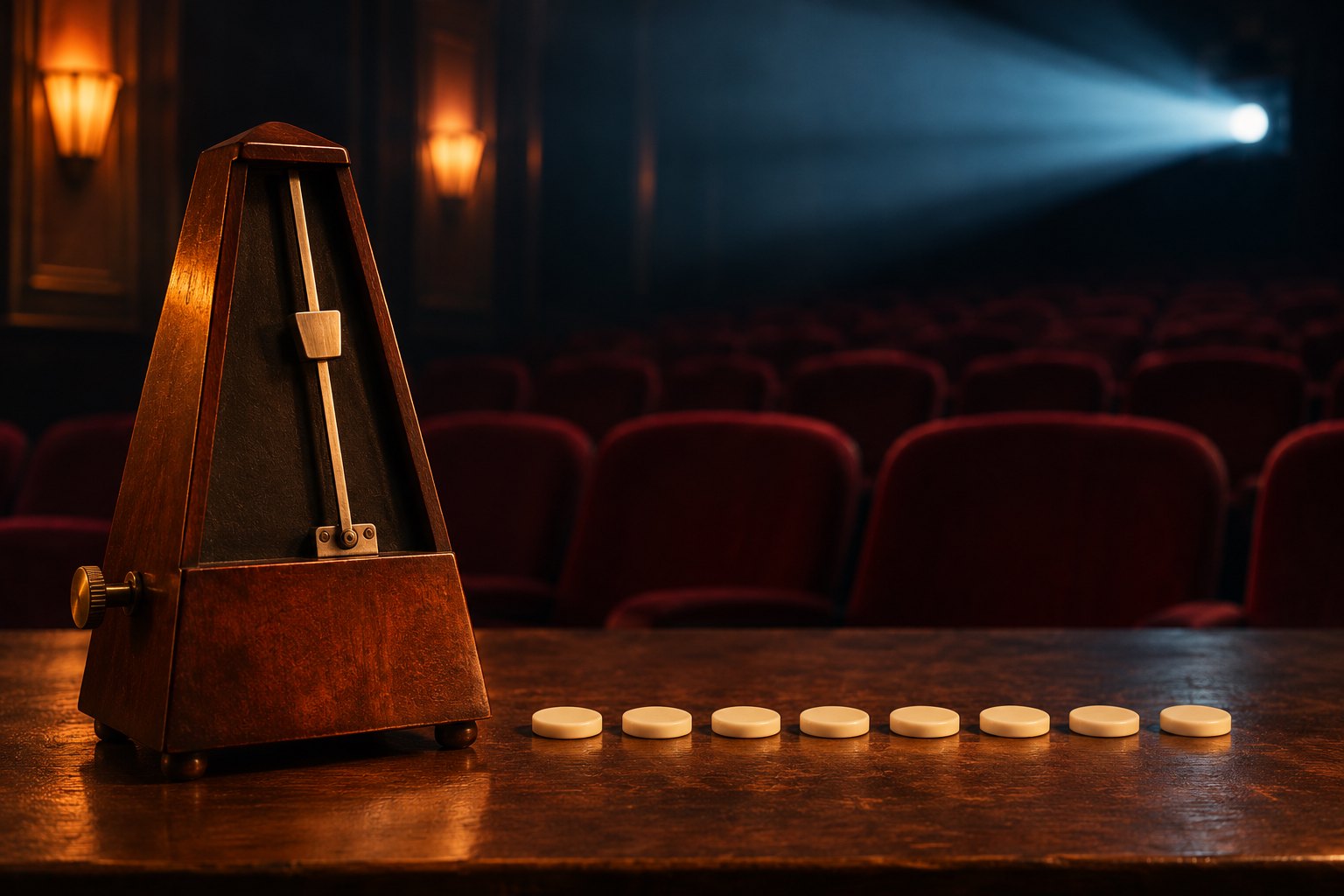
Counting in movies makes waiting tangible. A spoken number can turn an ordinary pause into a threat, give an action scene a limit, or make a musician’s next beat feel like a test of personal worth. NPR’s reflection on cinematic counting offers an especially useful way into Whiplash: a film in which knowing the count provides no guarantee of feeling safe.
Bob Mondello explored the connection between election-season waiting and screen arithmetic in an NPR commentary published in 2024. His examples included Die Hard, Clue, and Whiplash. That is an invitation to reconsider familiar scenes, rather than evidence of any current election outcome. [NPR’s counting-in-movies commentary](https://www.wypr.org/2024-11-08/while-votes-are-counted-we-look-at-how-counting-is-used-in-movies)
Spoiler warning: This review discusses Whiplash through its final performance, including Fletcher’s treatment of Andrew and the ending’s unresolved emotional stakes.
A countdown tells us who controls the next moment
In Die Hard, Hans Gruber’s warning that “There will not be a four” makes counting an assertion of authority. The frightening element is the speaker’s claimed power to decide what happens when the sequence ends. Numbers give his threat a structure the listener can understand immediately.
Musical counting ordinarily makes a different promise. It allows people to begin together, maintain a shared pulse, and coordinate something no individual could produce alone. A count-in should establish cooperation. That expectation gives Whiplash its particular sting: an activity designed to connect performers becomes a way to isolate one of them.
This is also why suspense does not require constant movement. Once we understand the consequence attached to a beat, anticipation supplies the action. The same relationship between expectation and withheld release underlies our discussion of how the timing of revelations shapes thriller suspense. The audience needs a reason to fear what comes next.
Andrew hears an opportunity; Fletcher establishes a hierarchy
Damien Chazelle’s Whiplash follows aspiring jazz drummer Andrew Neiman, played by Miles Teller, and demanding instructor Terence Fletcher, played by J.K. Simmons. Andrew wants exceptional achievement; Fletcher offers access to a prestigious ensemble and subjects him to abusive instruction. [Sony Pictures Classics’ film overview](https://www.sonyclassics.com/film/whiplash/)
From Andrew’s perspective, being noticed carries enormous emotional weight. Selection appears to confirm that the private future he imagines might become real. This makes Fletcher’s attention valuable before it becomes frightening. Andrew has already invested in the teacher’s judgment as a measure of his potential.
My reading is that the film’s central trap begins there. Andrew wants to improve, but he also wants a particular person to certify that improvement. Those desires can pull in different directions. A musician can acquire greater skill while becoming less capable of deciding what that skill is worth without someone else’s approval.
Fletcher benefits from that confusion. His authority extends beyond identifying a musical error: he can make Andrew experience an error as evidence that he does not belong. The room becomes a place where a technical correction threatens an entire imagined identity.
“Start counting”: when instruction becomes intimidation
The rehearsal confrontation crystallizes the relationship. Fletcher asks, “Were you rushing or were you dragging?” He orders Andrew to “Start counting.” Those short lines make the difference between musical knowledge and psychological security painfully audible.
The crucial distinction is that tempo is real. The scene does not require us to believe that musical standards are imaginary or that every harsh judgment is technically mistaken. Its force comes from watching a legitimate subject of instruction become inseparable from humiliation.
Fletcher throws a chair and slaps Andrew during the confrontation. Those actions change the meaning of the exercise. Andrew is no longer simply listening for the beat; he is also anticipating punishment. The film later extends that pressure into compulsive practice and damaged relationships. [AFI’s plot account](https://catalog.afi.com/Catalog/moviedetails/70240)
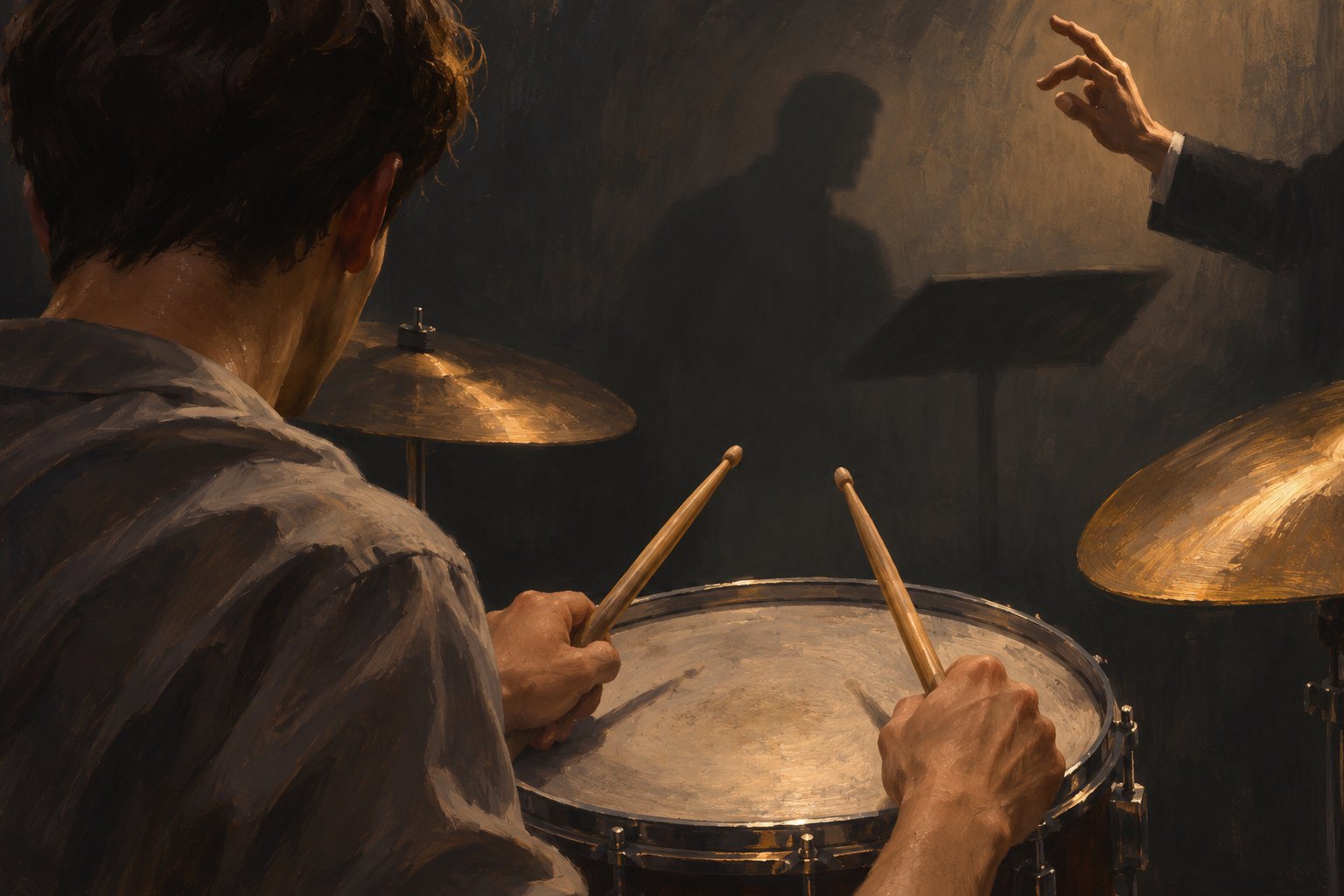
For a viewer without musical training, this is an unusually effective dramatic construction. You do not need to adjudicate every fraction of a beat. You can recognize the terror of being asked a question by someone who has made uncertainty dangerous.
Listen to the different jobs speech performs here. The question appears to request information. The command demands compliance. Andrew’s counting attempts to demonstrate competence. Each exchange narrows the distance between performing music and performing obedience.
For me, this is where Whiplash is most persuasive. It translates a specialized activity into a recognizable struggle without making that activity irrelevant. Rhythm remains the material of the conflict. Remove the need to keep time, and the scene loses its precise mechanism of pressure.
Andrew starts measuring everything against greatness
Andrew eventually breaks up with Nicole because he sees the relationship as incompatible with his ambitions. That decision reveals how thoroughly competitive thinking has entered his private life. He anticipates a future conflict and treats the person in front of him as an obstacle to be removed.
From Nicole’s position, the cruelty lies partly in the certainty. Andrew behaves as though he can already calculate what each of them will want and how the relationship will fail. He grants his projected career greater authority than their actual conversation.
This is counting’s less obvious role in the film. Beyond spoken beats, Andrew mentally assigns value to hours, opportunities, rivals, and attachments. His life becomes an exercise in eliminating whatever might reduce his chances.
The resulting character is compelling because his dedication and his arrogance cannot be neatly separated. We can admire the labor while questioning the worldview organizing it. As our guide to reading film criticism beyond a simple verdict argues, a useful review should make room for that kind of divided response.
The finale changes who sets the pace
At the final concert, Fletcher deliberately leaves Andrew unprepared for the opening number. Andrew retreats backstage, then returns and launches into “Caravan.” The performance develops into an extended solo, with Fletcher eventually participating in its execution.
Read through counting, this is a transfer of initiative. Andrew stops waiting for permission to establish what happens next. Earlier, Fletcher could interrupt and restart him; now Andrew creates a musical situation the conductor must answer.
That reversal is thrilling. It is also narrower than complete liberation. Andrew asserts himself through the very activity and standard of exceptional achievement that have bound him to Fletcher. Taking command of the performance does not automatically mean escaping the relationship.
My judgment is that the ending works because its exhilaration outruns its reassurance. We experience the pleasure of mastery before we can settle what that mastery has cost. A triumphant musical passage cannot retrospectively establish that every injury leading to it was necessary.
What the final count cannot settle
Whiplash turns counting into a question about who gets to define enough. Enough practice, enough precision, enough sacrifice: Andrew repeatedly seeks an answer from someone whose power depends on withholding satisfaction.
The deeper achievement of the ending is that musical coordination returns without resolving the moral conflict. Andrew and Fletcher can finally move together, yet agreement in tempo is not agreement about care, responsibility, or the value of a life outside performance.
That makes the film a particularly unsettling companion to NPR’s subject. A countdown often promises that uncertainty will end at a designated number. Whiplash delivers the ending of a performance while refusing that larger comfort. The playing can be extraordinary. Whether the bargain was worthwhile remains ours to judge.
Original content by this site's editorial team. Published: November 3, 2026 at 15:25:12 PST (Los Angeles time)