Weather under Fire arrives with an unusually strong expression of confidence: Yale Climate Connections has presented it as a long-awaited climate change film. That endorsement makes it a title worth examining, but it also raises a question that matters to moviegoers. What would make a climate film feel necessary as cinema, beyond the importance of its subject?
My answer starts with people. A film can make an enormous problem understandable when it lets us experience the distance between knowing something and deciding what to do about it. The promise surrounding Weather under Fire is most interesting when considered through that lens: whether an issue with planetary dimensions can become a story with recognizable human stakes.
This is a critical preview, not a review based on a screening. The film’s specific scenes, participants, dialogue, and ending have not been independently verified here. Consequently, the discussion below examines its reported reception and the storytelling expectations it creates, without assigning it invented characters or claiming that particular sequences appear in it.
What the early praise establishes—and what it leaves open
The Yale Climate Connections headline establishes an enthusiastic editorial response to Weather under Fire. It does not, by itself, establish how the film constructs its argument, whose experiences it follows, or how effectively its images and sound work together. Those distinctions matter because a recommendation and a close reading answer different questions.
A recommendation tells us that someone found a work valuable. A review should explain what the work actually does: how it introduces a person, organizes information, handles disagreement, and earns an emotional response. Repeating an endorsement without those particulars would tell readers little about the experience of watching.
For now, the useful response is to take the enthusiasm seriously while keeping the artistic verdict open. The title invites attention; the claims made on its behalf invite scrutiny. Neither requires treating advance praise as a substitute for looking carefully at the finished film.
Human perspective is the decisive test
A character-centered reading of Weather under Fire will ultimately depend on the people it actually presents. Until those details can be verified, naming a protagonist or describing a personal turning point would be speculation. Still, there is a meaningful distinction to draw between a person who inhabits a film and a person who merely illustrates its argument.
Someone becomes compelling on screen through specificity: the responsibilities they carry, the choices available to them, the things they cannot easily surrender. If a climate film gives us only a person’s most eloquent statement, we may understand their position without understanding their life. Time spent observing hesitation, routine, or competing obligations can provide something an explanatory speech cannot.
This is the standard I would bring to Weather under Fire. Does its human perspective allow for complexity? Can someone be informed yet uncertain, committed yet exhausted, frightened yet capable of humor? Those combinations create recognizable people. A succession of perfectly representative voices can create a much flatter experience, even when every contribution is sincere.
Our discussion of how documentary framing shapes a public persona considers a related problem: filmmakers influence our understanding through the perspectives they include and the space they give them. That choice deserves attention here, too, without assuming that the films use the same methods.
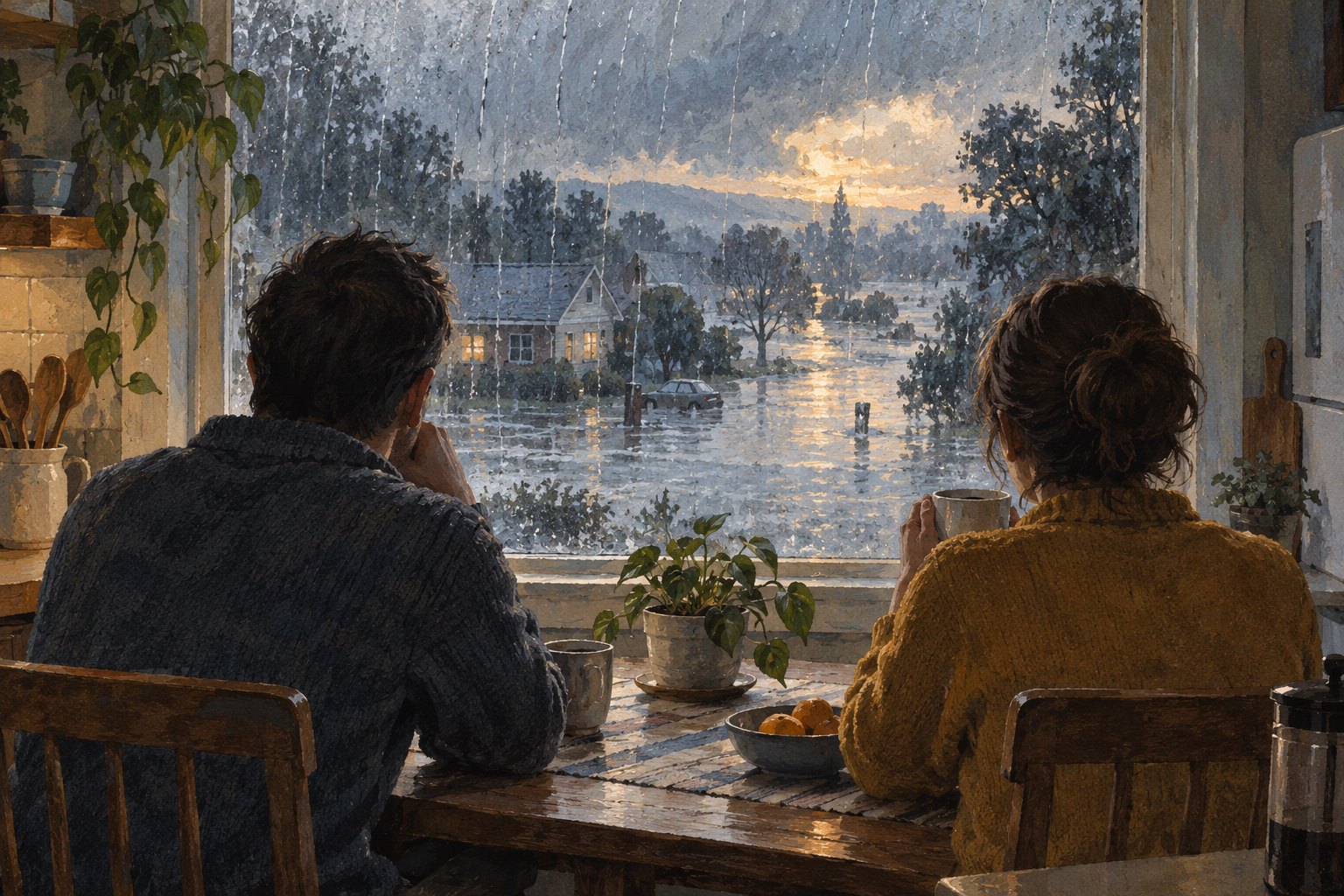
Weather imagery must do more than create alarm
The wording of Weather under Fire suggests pressure and confrontation. That is an interpretation of the title, not confirmation of any event shown in the movie. Its force nevertheless highlights an artistic challenge: how can a film make danger visible without allowing spectacle to overwhelm understanding?
Images of severe weather can command attention immediately. Their explanatory value depends on context. Where was an image recorded? What does the accompanying account establish? Why does the film place this image beside the next one? Editing can create an impression of connection before a viewer has had time to evaluate whether the connection has been demonstrated.
For this reason, a strong climate film needs more than visual intensity. It needs a clear relationship between what we see and what we are being asked to conclude. A close view of someone’s surroundings may explain a consequence more effectively than another sweeping panorama, particularly when the film has already helped us understand what that place means to them.
The issue resembles the distinction explored in what separates a sequence of highlights from a meaningful story. Accumulating powerful moments does not automatically create development. A story needs relationships between moments, and those relationships should reward attention rather than simply intensify sensation.
Listen for context, not just a memorable line
Memorable dialogue can become a film’s shorthand, but no verified dialogue from Weather under Fire is available for quotation here. The distinction is especially important in nonfiction criticism: an eloquent sentence should never be invented because it sounds like something a participant might have said.
When the film can be assessed directly, its strongest lines should be considered alongside the circumstances that give them meaning. Who is speaking? What happened before the statement? Does the camera stay with the person afterward, or does the edit immediately turn their words into a conclusion?
Those questions help distinguish testimony from a slogan. A sentence spoken after a difficult decision carries a different weight from the same sentence detached from that decision. Good criticism should preserve that difference. Otherwise, even accurately quoted words can produce a misleading account of the person who said them.
The ending will need to earn its hope
The anticipation surrounding Weather under Fire also raises expectations about how it will leave its audience. An ending can offer reassurance, discomfort, resolve, or uncertainty. None of those responses is automatically more honest than the others; what matters is whether the preceding film supports it.
My preference is for hope attached to something concrete: a meaningful decision, a relationship that changes, or a clearer understanding of what remains difficult. An uplifting final passage can feel unearned if it makes the obstacles established earlier seem suddenly weightless. Relentless despair can be equally reductive if it treats every effort as irrelevant.
A persuasive ending should let consequences persist. People do not stop having obligations when the credits begin. Whatever conclusion Weather under Fire reaches, the most revealing critical question will be whether its participants remain complicated human beings at that point or become symbols recruited to deliver a final message.
The deeper promise behind the title
Read as a title, Weather under Fire draws an ordinary subject into a language of conflict. Weather is something people notice, discuss, and arrange their days around; being under fire suggests that familiarity has become unstable. That tension gives the title interpretive potential without telling us exactly how the film realizes it.
For me, the most valuable possibility is a change in attention. Climate cinema can ask viewers to look longer at the lives inside its subject: whose choices are constrained, whose explanations receive authority, and whose experiences remain outside the frame. It can make a large issue more legible by refusing to make the people within it smaller.
The enthusiasm from Yale Climate Connections gives Weather under Fire a compelling invitation. Whether it fulfills that invitation requires the film itself. The standard is clear: an argument we can examine, people we can understand beyond their usefulness to that argument, and an emotional conclusion supported by what the camera has actually shown.
Original content by this site's editorial team. Published: October 15, 2026 at 14:56:29 PDT (Los Angeles time)