
For Virginia Feito, seeing Victorian Psycho become a movie meant encountering a place that had previously existed in her imagination. In her Vanity Fair set diary, the novelist and screenwriter describes the strange experience of entering her own invented world. Her phrase “the fictional world inside my head” captures the intimacy of that transition: something privately conceived has acquired rooms, bodies, voices, and people with their own interpretations.
That experience offers a revealing way into this particular adaptation. A story about a dangerous governess entering a carefully regulated household depends on the relationship between appearances and concealed intentions. Making the house visible is one task. Making its inhabitants’ competing perceptions intelligible is another.
Scope and spoilers: This is an analysis of Feito’s adaptation experience and the film’s officially described premise, rather than a firsthand review of the finished movie. It discusses the setup without revealing the ending.
The author’s private world becomes a shared space
There is something especially disorienting about an adaptation for its original writer. A reader supplies imaginary faces and rooms; a production makes decisions that everyone can see. The position of a doorway becomes fixed. A character takes up a particular amount of space. Another person decides how long a silence should last.
Those choices can alter meaning without changing an event. A room that feels oppressive in prose might look inviting on camera. A remark that reads as vicious can sound awkward, playful, or frightening when spoken. Adaptation therefore involves thousands of interpretations, including decisions audiences may never consciously notice.
Feito’s presence as screenwriter makes that process particularly interesting. The official Cannes credits identify Zachary Wigon as director and Feito as the writer of the screenplay. The novelist is participating in the transformation, but cinema still distributes authorship across performance, photography, design, sound, and editing.
My reading of her experience is that recognition becomes only the beginning. The deeper surprise comes when an invented person appears capable of doing something the writer did not specifically imagine—a glance, a hesitation, an unexpectedly funny delivery. That independence is part of what makes a character feel alive.
Winifred Notty’s job contains the central contradiction
The Cannes synopsis places the story in 1858. Winifred Notty arrives at Ensor House as a governess, responsible for the children’s manners and knowledge of their family history while concealing her psychopathic tendencies. Staff disappear, and the household’s owners grow suspicious.
The premise gives Winifred a particularly charged position. She is entrusted with teaching acceptable behavior while hiding impulses that violate it. Her work requires a performance of authority, yet that authority is conditional: she belongs to the household because she serves its purposes.
From her perspective, respectability can be understood as a role with rules to learn. That creates an uncomfortable possibility for the audience. Competence at performing good manners may have very little connection to goodness. Someone can understand precisely what a household expects without sharing its moral assumptions.
This is where a character-centered interpretation becomes more useful than simply describing Winifred as shocking. The interesting question is how she understands the expectations surrounding her. Does a polite gesture indicate compliance, concealment, or contempt? Those possibilities can coexist in the same action, giving an actor more to work with than a succession of sinister expressions.
Ensor House matters as a system of relationships
A gothic manor supplies atmosphere immediately, but atmosphere alone cannot explain how its occupants live. For this story, the more revealing issue is access: who enters freely, who waits, who supervises, and whose absence requires an explanation.
The official premise’s reference to disappearing staff makes the household’s attention especially important. A viewer can ask when a person becomes visible to those with power. Is it through individual attachment, or through the interruption of a service? That question offers a productive interpretive lens without assuming an answer the film has not established here.
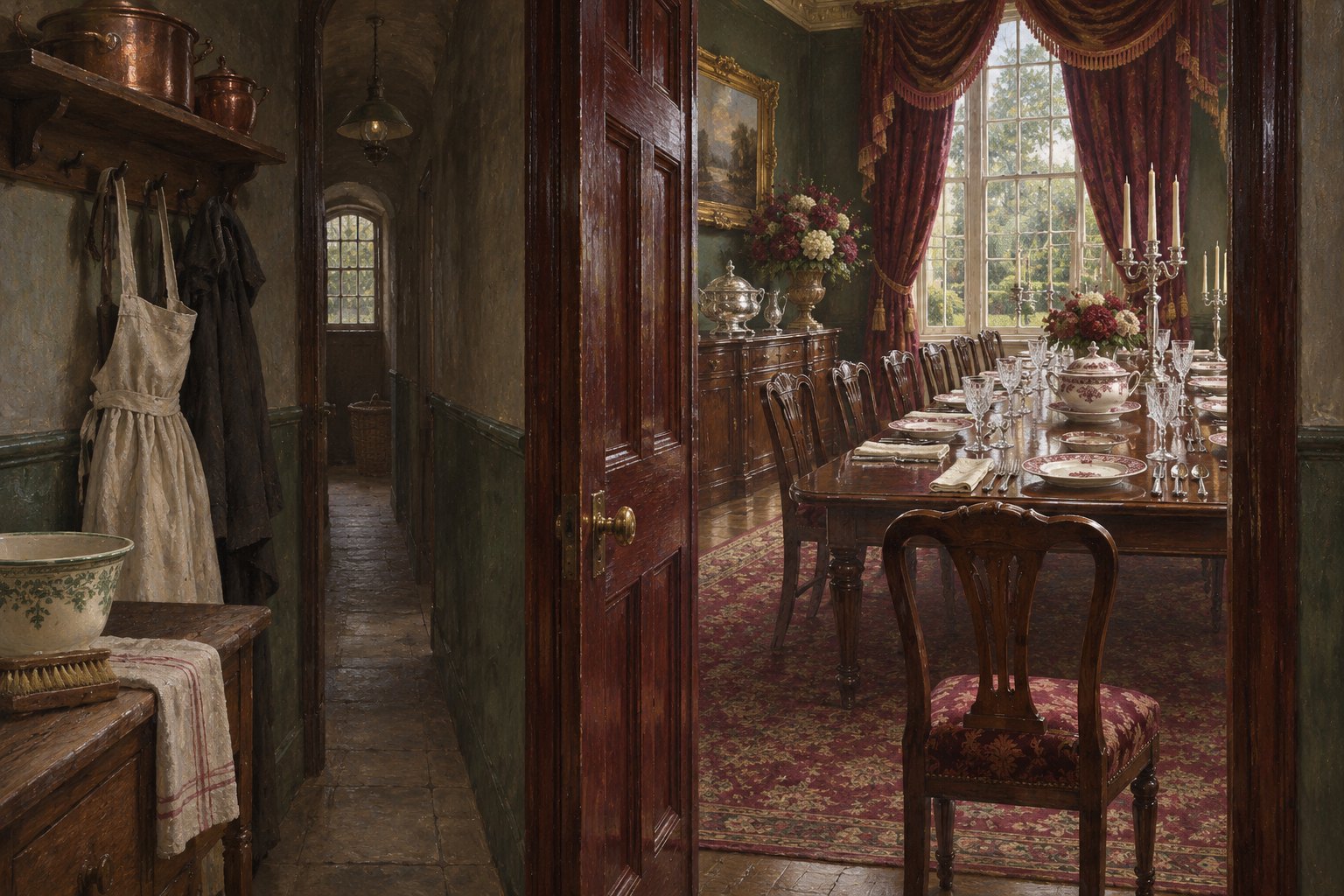
Winifred’s position also complicates any simple division between the powerful and the powerless. She works under the owners’ authority while exercising authority over children. A character can experience subordination in one relationship and wield considerable power in another.
That distinction matters morally. Social restriction may help explain a character’s anger, but explanation does not automatically make the consequences defensible. An interpretation that turns every transgression into liberation risks overlooking whoever suffers from it.
Performance must preserve the distance between manners and motive
Maika Monroe appears in the film’s officially listed cast, alongside performers including Ruth Wilson, Jason Isaacs, and Thomasin McKenzie. Cast recognition, however, tells us less about the adaptation than the relationship between performance and perspective will.
For a protagonist built around concealment, the decisive acting choices may be small. A smile can invite confidence while leaving an audience uneasy. A pause can suggest that an acceptable response is being selected rather than sincerely felt. These are possibilities inherent in the premise, not claims about particular shots or scenes.
The surrounding characters matter equally. If everyone seems immediately aware of a threat, concealment loses its dramatic function. If nobody notices anything, the household risks becoming merely foolish. The compelling territory lies between those extremes, where people interpret the same behavior differently because they have different interests.
Our discussion of how performance turns a recognizable figure into a character considers a related principle: an actor’s outward choices become meaningful through the relationships around them. In Victorian Psycho, that principle directs attention toward who believes Winifred’s social performance, and why.
Whose version of the story does the camera make persuasive?
A novelist can place a reader inside a character’s language. Film has additional ways to establish allegiance: staying close to a face, withholding another person’s reaction, or allowing a sound to dominate a scene. Each decision shapes whose experience feels immediate.
For Winifred, proximity could create understanding without requiring approval. An audience can recognize the pressure of a social role while remaining disturbed by how someone responds to it. Maintaining that distinction is central to meaningful criticism of an unsettling protagonist.
It also connects to the concern with narrative ownership explored in our analysis of Haymitch’s story in Sunrise on the Reaping: the viewpoint through which events reach us influences whom we believe and whose suffering receives attention.
The deeper transformation is from imagination to interpretation
The most compelling implication of Feito’s experience is that bringing a fictional world to life also means surrendering exclusive possession of it. Once performers inhabit the characters and audiences encounter them, the story can support responses its creator cannot fully control.
For Victorian Psycho, that makes fidelity a richer question than whether a room resembles its description. The more demanding issue is whether the adaptation preserves the tension between outward order and inward disturbance—and whether it gives people beyond its central figure enough presence to complicate her perspective.
Feito’s imagined world becoming tangible is the occasion for the story. Its larger significance lies in what happens next: a private creation becomes a public encounter, and recognition gives way to interpretation. That is where an adaptation earns a life of its own.
Original content by this site's editorial team. Published: November 19, 2026 at 02:39:54 PST (Los Angeles time)