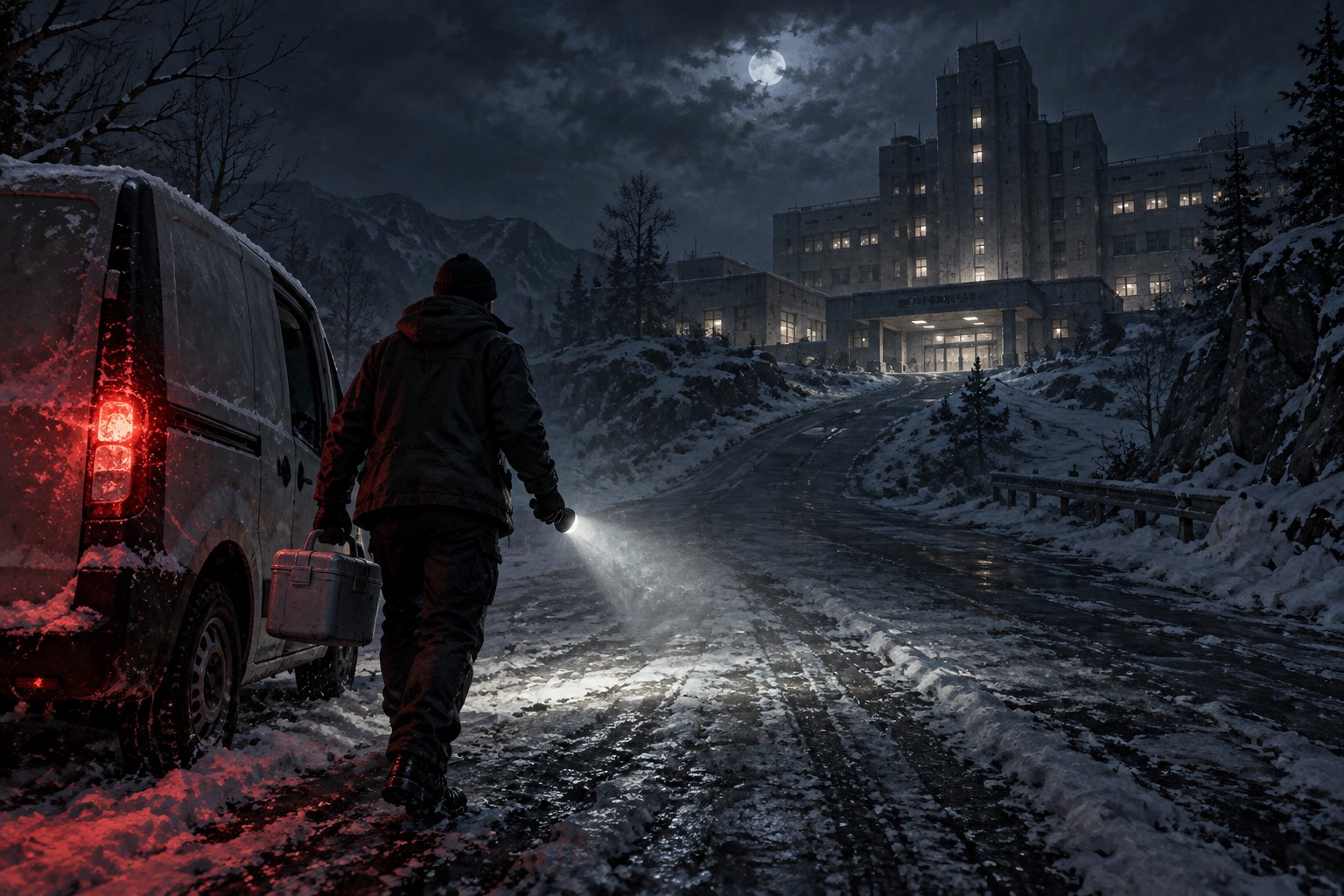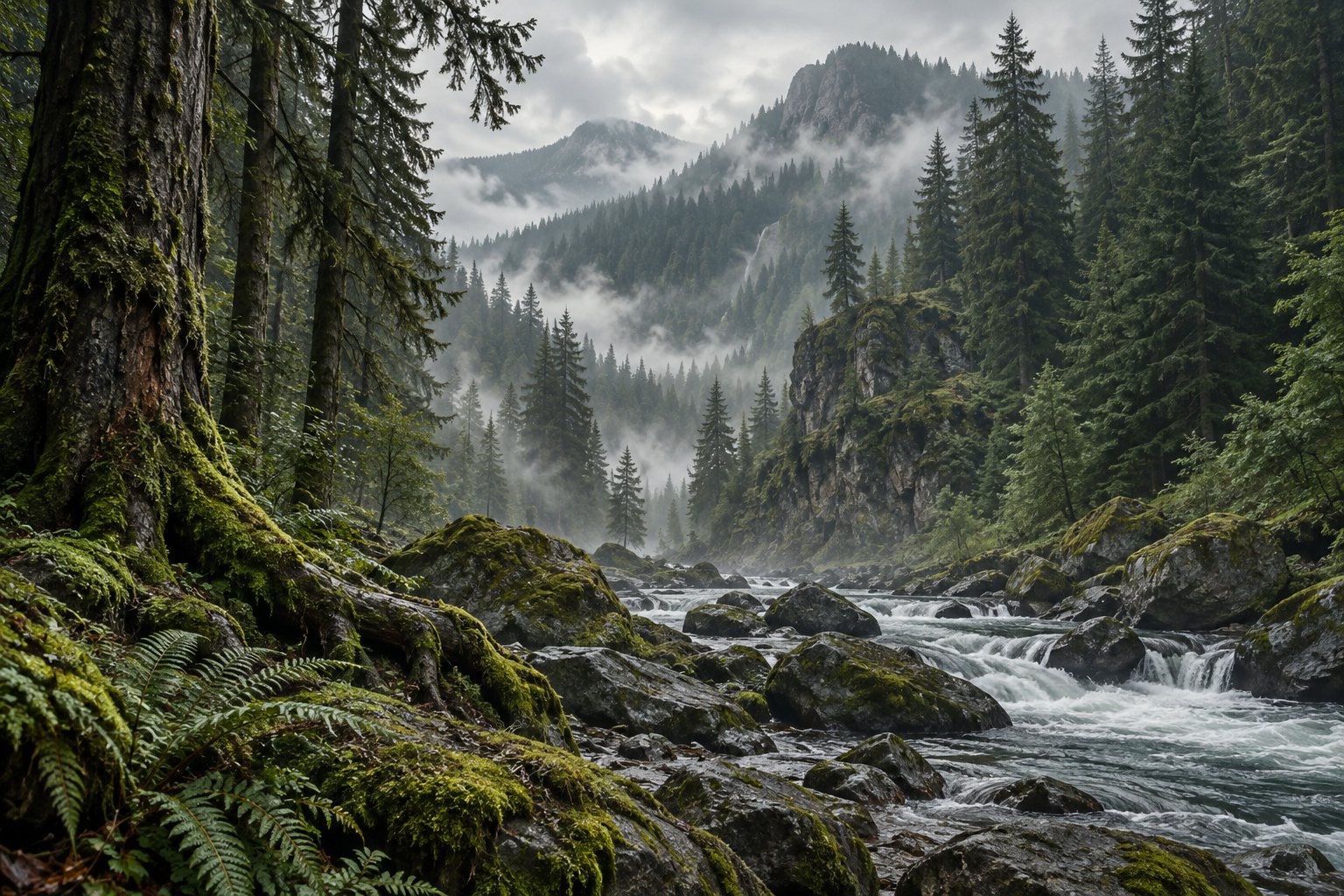
The Weight is set in Oregon, but the wilderness surrounding Ethan Hawke was filmed in southern Germany. Distributor Capelight Pictures confirms that the production shot entirely in Bavaria. That distinction answers the immediate location question while opening a more interesting one: what makes a landscape convincing when the people struggling across it belong to somewhere else?
Directed by Padraic McKinley, the film places Samuel Murphy, played by Hawke, in an adventure where distance has an emotional cost. Every obstacle separates him from his daughter. Through that perspective, the German locations become more than scenery standing in for the Pacific Northwest: they provide the physical resistance against which his determination takes shape.
Spoiler note: This analysis discusses the premise, character relationships, and selected obstacles, but does not reveal the ending. It draws on verified production information and published accounts of the film rather than a firsthand screening.
Where was The Weight filmed?
The useful distinction is straightforward: Oregon is the story’s setting; Bavaria is the filming location. The action takes place in 1933, during the Great Depression. The production’s German geography does not change the characters’ American circumstances.
It also does not, by itself, establish why the filmmakers chose Germany. Capelight identifies support from the Bavarian film funding body FFF Bayern, but that is insufficient evidence to assign the decision to a particular tax advantage, budget calculation, or rejection of Oregon. Those explanations require their own reporting.
For viewers, the more productive question concerns the landscape’s dramatic function. A forest can communicate isolation through restricted sightlines. A river can turn a short distance into an exhausting problem. A slope can make the difference between possessing valuable cargo and being capable of moving it. These are physical relationships an audience understands without recognizing the location.
The distinction between a story’s home and the place employing its production crew also connects with the questions in our analysis of who benefits from film production incentives. Here, however, the confirmed location should remain separate from assumptions about the business decision behind it.
Murphy sees the wilderness as time away from his daughter
The production company’s synopsis establishes Murphy as a widower imprisoned in a labor camp and fighting to regain custody of his daughter, Penny. Warden Clancy, played by Russell Crowe, offers early release in exchange for transporting gold through the wilderness.
That arrangement gives the adventure a pointed imbalance. Murphy supplies the effort and accepts the danger; Clancy controls the promised reward. For Murphy, the cargo matters because of what delivering it might restore. The emotional destination is a relationship.
A small exchange reported by Plugged In gives that relationship welcome everyday texture. Murphy jokes that “Pastors gotta bore the devil out of little girls.” The line matters because it preserves a father capable of teasing his child. Penny represents a shared life with habits and humor, making separation more specific than an abstract obligation to rescue someone.
My reading is that this ordinary intimacy provides the strongest foundation for the survival story. Endurance becomes meaningful when we understand what a person hopes to return to. Murphy’s competence may help him negotiate danger, but his attachment to Penny explains why he accepts the journey.
Clancy’s bargain extends the prison beyond its walls
The warden’s offer makes freedom conditional on completing a criminal undertaking. That is the central moral trap: the authority restricting Murphy’s life also presents itself as his route back to it.
Leaving the camp therefore need not mean escaping its power. The bargain travels with the prisoners. Even in open country, their choices remain organized around someone else’s demand. Seen this way, the vastness of the landscape makes their lack of freedom more disturbing. There is room to move, but little room to choose.
This is where a character-centered interpretation becomes more useful than simply cataloging hazards. A dangerous crossing tests strength and judgment. The bargain surrounding that crossing tests whether consent means much when refusal threatens a father’s reunion with his child.
Clancy’s power also complicates the usual adventure fantasy of proving oneself through hardship. Murphy has something to prove to the man controlling his release, but that man’s approval is no reliable measure of his worth.
Why the gold needs to feel heavy
Published accounts describe a precarious bridge crossing among the expedition’s major obstacles. Its dramatic logic is immediately legible: valuable cargo becomes dangerous when the structure carrying it cannot safely bear the load.
The gold’s physical properties give the title its sharpest irony. Wealth ordinarily suggests greater freedom of movement. Here, it impedes movement. The prisoners must expend strength protecting something that makes their survival harder.
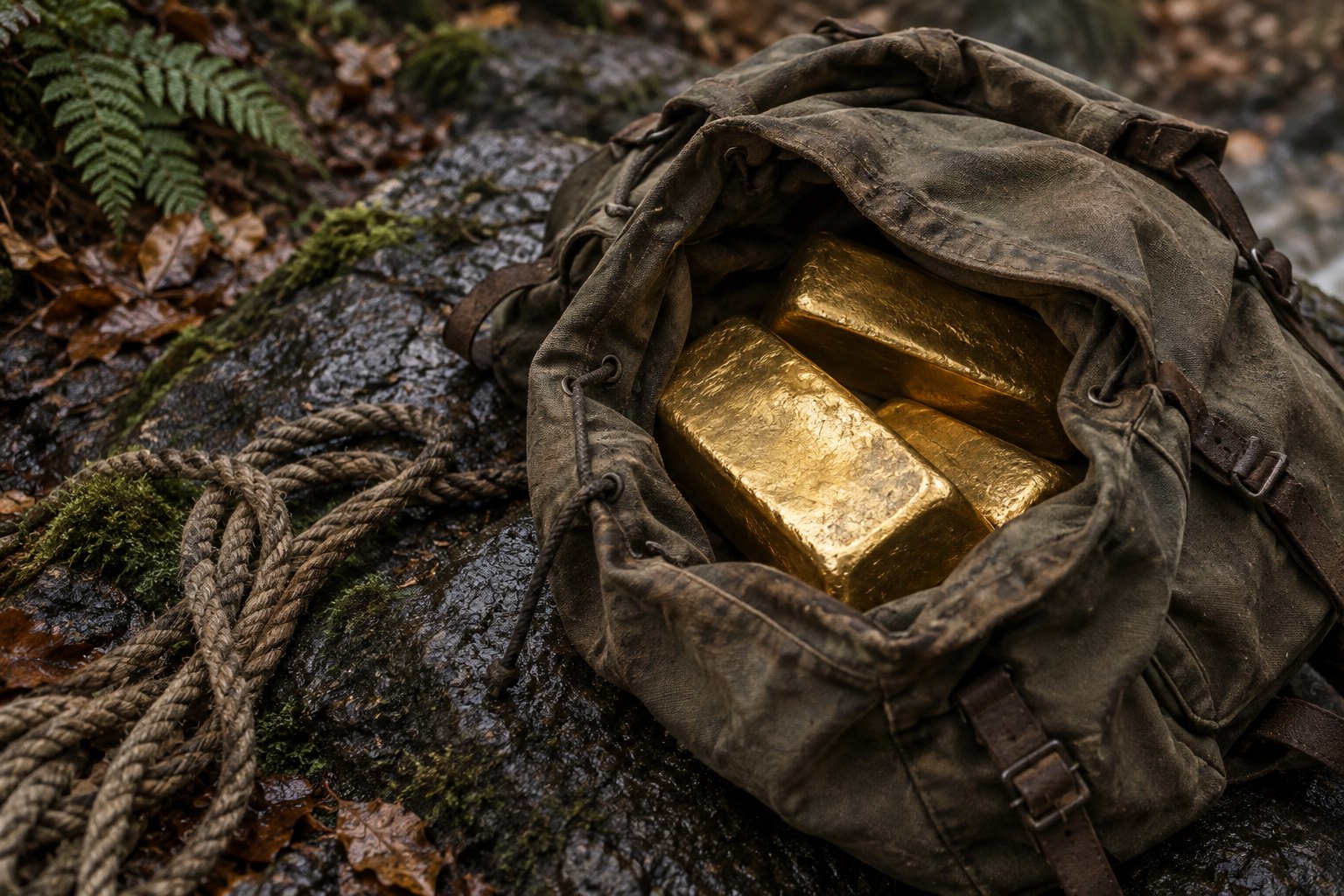
Through Murphy’s perspective, the forest becomes a series of practical questions: what can be carried, which route is possible, and whose help is necessary? This is an effective basis for suspense because the audience can understand the problem before knowing the solution.
It is also why Bavaria’s role deserves attention beyond location trivia. Whatever geographic identity the finished image assumes, the terrain must make human effort readable. A beautiful view contributes little to this story unless it also helps us understand vulnerability, distance, or strain.
Anna and the limits of self-reliance
Julia Jones plays Anna, who joins the group during its journey. Sundance’s premiere coverage describes bonds developing among people under extraordinary pressure. Her presence creates an important question for interpreting Murphy: can his determination to recover his own family coexist with responsibility toward others?
Anna’s refusal to be intimidated comes through in another line recorded by Plugged In: “I think men who talk big, usually ain’t big.” The retort challenges a version of masculinity built on threatening speech. It provides a useful counterpoint to the practical demands of surviving together.
My interpretation is that Murphy’s mission becomes richer whenever it requires dependence rather than solitary mastery. Accepting help means acknowledging that determination has limits. Offering help means recognizing that his own emergency does not cancel anyone else’s humanity.
That emphasis on people under pressure also informs our discussion of how character gives survival spectacle meaning. The circumstances differ, but the critical test remains useful: do the dangers reveal relationships, or merely interrupt them?
The deeper meaning of the borrowed landscape
Sundance identifies Jeremiah Johnson and Sorcerer as creative reference points for the filmmakers. Those documented influences offer context for the outdoor adventure approach; they should not automatically be treated as hidden Easter eggs.
The most compelling reading of The Weight lies in the unequal distribution of its burdens. Murphy carries the immediate physical risk, the separation from Penny, and the uncertainty of a bargain he cannot enforce. Clancy holds the authority to assign that work. The gold concentrates value while the people transporting it absorb the cost.
Oregon supplies the story’s historical setting, and Bavaria supplies its filmed terrain. The character drama connects them through an experience that needs no geographic disguise: the fear that getting home may require surrendering too much of yourself. That is the question worth carrying beyond the location reveal—whether Murphy can recover his place as a father while preserving the qualities that make that reunion matter.
Original content by this site's editorial team. Published: September 19, 2026 at 01:54:06 PDT (Los Angeles time)