The Mummy Theme Park gives MST3K an irresistible collision: ancient bodies treated as modern entertainment equipment. The show’s encounter with the film brings an obscure horror attraction into renewed view. [A.V. Club’s episode coverage](https://avclub.com/mst3k-rifftrax-experiments-recap-the-mummy-theme-park) establishes that pairing; the more interesting critical question is what survives beneath the invitation to laugh.
My reading is that the film’s strongest idea concerns ownership. A businessman believes he can own the past, a photographer arrives to package it as an image, and the dead resist becoming somebody else’s product. That does not automatically make the movie successful horror. It does give its absurdity a shape worth examining.
Spoiler warning: This analysis discusses the attraction’s breakdown, the characters’ escape, and the ending. The accompanying images are conceptual illustrations, not film stills.
A tourist attraction built on a category mistake
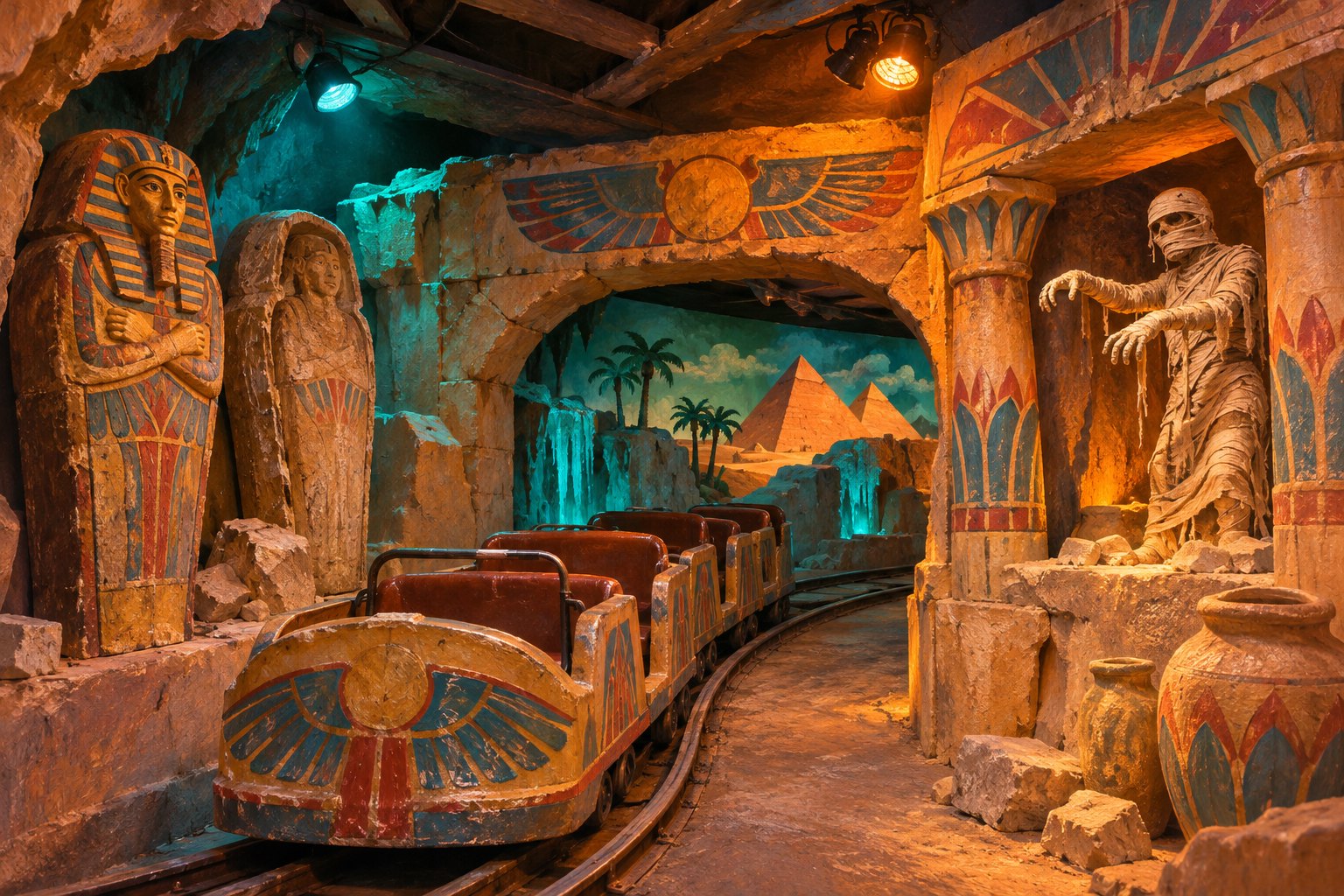
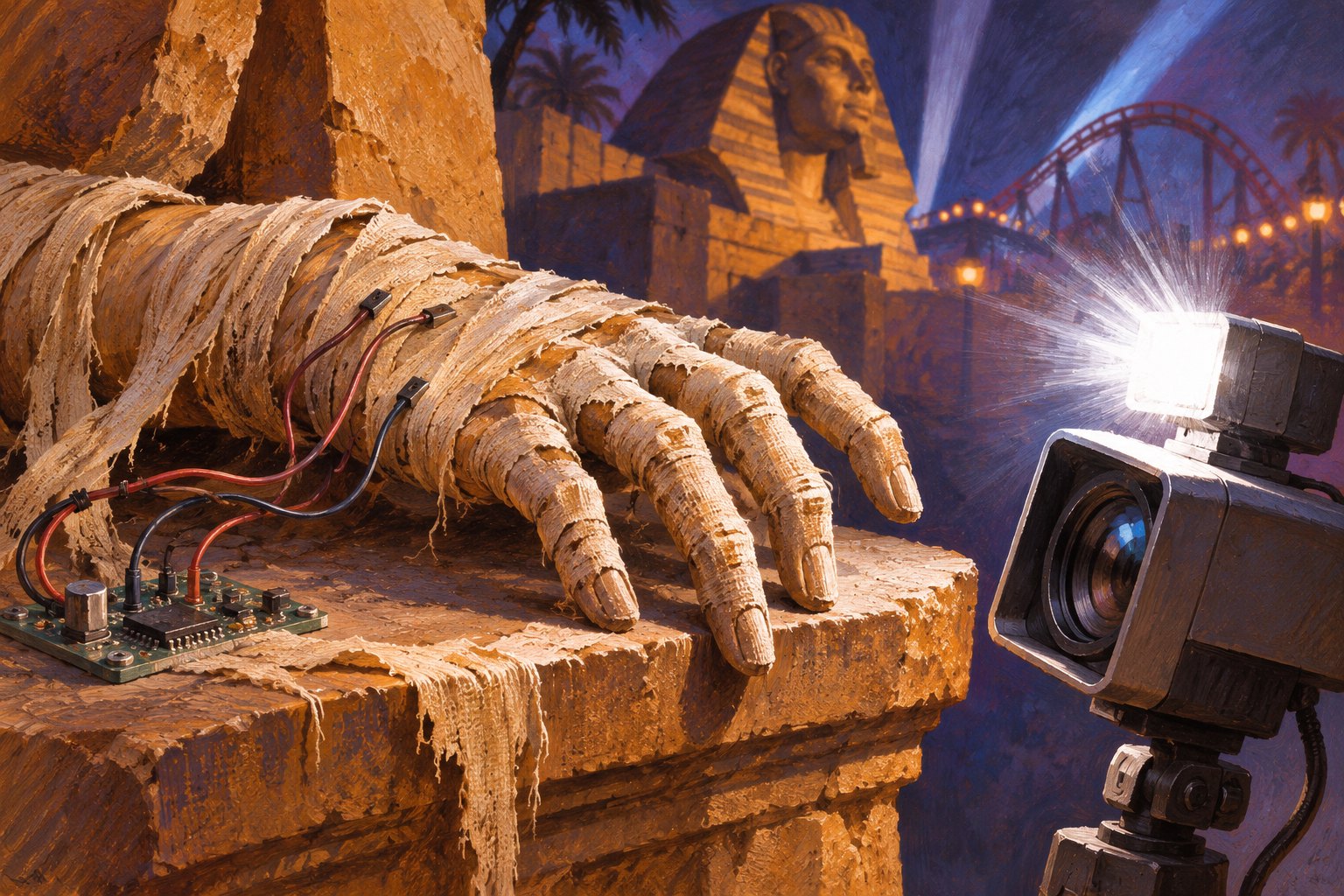
Directed by Alvaro Passeri, the 2000 Italian film follows American photographer Daniel Flynn and his colleague Julie into an underground attraction developed by Sheik El Sahid. Its exhibits incorporate ancient mummies fitted with technological controls. Daniel’s camera flash disrupts a mummy’s microchip, turning the promotional assignment into a fight for survival. Those central plot elements are documented in the film’s [plot and credits overview](https://en.wikipedia.org/wiki/The_Mummy_Theme_Park).
The premise contains a useful distinction. An artificial monster can malfunction; a dead person can be violated. By treating its mummies as both bodies and machinery, the movie introduces an ethical problem that its technical explanations cannot resolve. Installing controls does not settle whether anyone should have built the attraction.
This is where the title earns its bluntness. A theme park promises that danger has been organized for your enjoyment. You follow a route, encounter a spectacle, and expect to leave. A tomb makes a different demand: recognize that the place exists for someone other than you. Putting the two together creates a conflict before the first pursuit begins.
El Sahid mistakes possession for mastery
El Sahid’s operational philosophy finds a compact expression in his explanation, “We replace any crumbling bones with steel pins.” Michael Delahoyde’s [scene-by-scene film notes](https://michaeldelahoyde.org/monsters/mummytp/) record the line during the park tour. As exposition, it explains the attraction’s hybrid construction. As characterization, it reduces a human body to a maintenance problem.
That reduction is more revealing than a generic declaration of greed. From the proprietor’s perspective, deterioration is an inconvenience that engineering can overcome. The question of respect barely fits inside that worldview. If the exhibit stands, moves, and performs, the business model appears vindicated.
My objection to that logic is also what makes it productive horror material: the owner confuses the ability to manipulate something with an entitlement to do so. A control room can monitor an attraction without understanding it. The more confidently a character describes the safeguards, the more attention a viewer should pay to the assumptions those safeguards leave untouched.
Daniel’s camera becomes part of the danger
Daniel is an unusually appropriate protagonist for this setting because his job involves making things visible. He enters as someone expected to create desirable images, yet the instrument of that work helps turn the attraction against him.
The camera-flash trigger is an eccentric mechanical explanation, but it creates a strong dramatic reversal. The photographer cannot remain a neutral observer. His ordinary professional behavior changes the situation he is documenting. An assignment built around looking becomes a lesson in the consequences of looking without understanding.
There is an appealing interpretation here even if one finds the surrounding storytelling unconvincing: publicity is not outside the machinery of exploitation. It helps that machinery function. Daniel’s occupation makes him a participant in selling the park before it makes him a potential witness against it.
This is also why effects deserve evaluation in relation to character. As our discussion of what makes a major visual-effects shot matter argues, spectacle becomes meaningful through its consequences. Here, the useful question is whether an effect changes Daniel’s relationship to what he has been hired to photograph.
Julie exposes the film’s uneven idea of competence
Julie offers a less comfortable case. The plot makes her sexuality part of a distraction during a mummy attack, but later gives her technical agency: she uses her laptop to help engineer the escape. The first development treats her body as a solution; the second lets her knowledge become one.
Her declaration, “I screwed them with my laptop!”, recorded in Delahoyde’s film notes, compresses that contradiction into a joke. The wording preserves the movie’s sexual register even when she is accomplishing something practical. A moment that could establish competence still insists on presenting it as innuendo. [Delahoyde’s film notes](https://michaeldelahoyde.org/monsters/mummytp/)
My criticism is not that an adventure character must be solemn to be capable. It is that capability becomes less satisfying when the story treats it as a convenient surprise. A stronger character arc would make us anticipate Julie’s resourcefulness, then enjoy seeing it tested. Nevertheless, her role in the escape matters: reading her only as someone waiting to be rescued would miss an important part of the actual story.
What MST3K’s framing adds—and what it cannot fix
A film like this offers two distinct pleasures to a riffing audience. One is recognition: noticing the gap between an ambitious explanation and the fragile logic supporting it. The other is discovery: encountering a creative decision too peculiar to have predicted.
Those pleasures should not be confused with a claim that every weak scene becomes good when someone jokes over it. Comedy can make a viewing experience more rewarding without repairing characterization, pacing, or a confused account of how the monsters work. That distinction allows affection and criticism to coexist.
The social dimension matters, too. Our commentary on why shared moviegoing changes the experience considers how an audience creates value beyond the screen. Riffing makes that response part of the presentation itself. An awkward explanation becomes a shared point of attention rather than a private test of patience.
The ending turns ownership against the owner
In the climax, Nekhebet calls for the attraction’s destruction, Daniel and Julie escape by train, and El Sahid is wrapped alive. The proprietor becomes a mummy himself. The reversal completes the film’s underlying ownership problem with unusual directness: the person who organized bodies as attractions becomes another body that can be contained. [Film plot overview](https://en.wikipedia.org/wiki/The_Mummy_Theme_Park)
I find that reversal more compelling than the broad proposition that ancient curses punish greed. It makes his failure specific. El Sahid’s mistake is imagining that he occupies a permanent position outside the system he controls. The ending removes that privilege.
That is the richest reason to revisit The Mummy Theme Park through MST3K. Beneath the opportunities for jokes sits a story about people confusing access with understanding. The photographer, the technician, and the proprietor all approach the attraction through different kinds of control. Its dead inhabitants expose the limits of those approaches. The film may invite laughter at its explanations, but the question underneath them remains sturdy: when entertainment depends on turning someone else’s past into your property, who gets the final say?
Original content by this site's editorial team. Published: November 8, 2026 at 19:53:11 PST (Los Angeles time)