Ken Russell’s The Devils has acquired the cultural standing that once seemed impossible for a film associated with censorship, sexual provocation, and religious outrage. Yet approaching this 1971 drama as a respectable period piece risks missing its continuing force. Beneath the spectacle is a precise and frightening question: what happens when powerful people discover that someone else’s private suffering can serve their public ambitions?
The occasion for revisiting it is concrete. The British Film Institute announced a definitive 4K restoration, with a one-week U.S. engagement beginning October 16, 2026, followed by a UK and Ireland cinema release on October 30. Those dates establish the new release context; the interpretation below concerns the film’s characters and dramatic construction. [BFI restoration announcement](https://www.bfi.org.uk/news/ken-russells-devils-definitive-4k-restoration-launch-ahead-major-bfi-retrospective)
Spoilers follow, including the ending. The film contains graphic violence, sexual imagery, and scenes of religious persecution.
Grandier’s real offense is becoming inconvenient
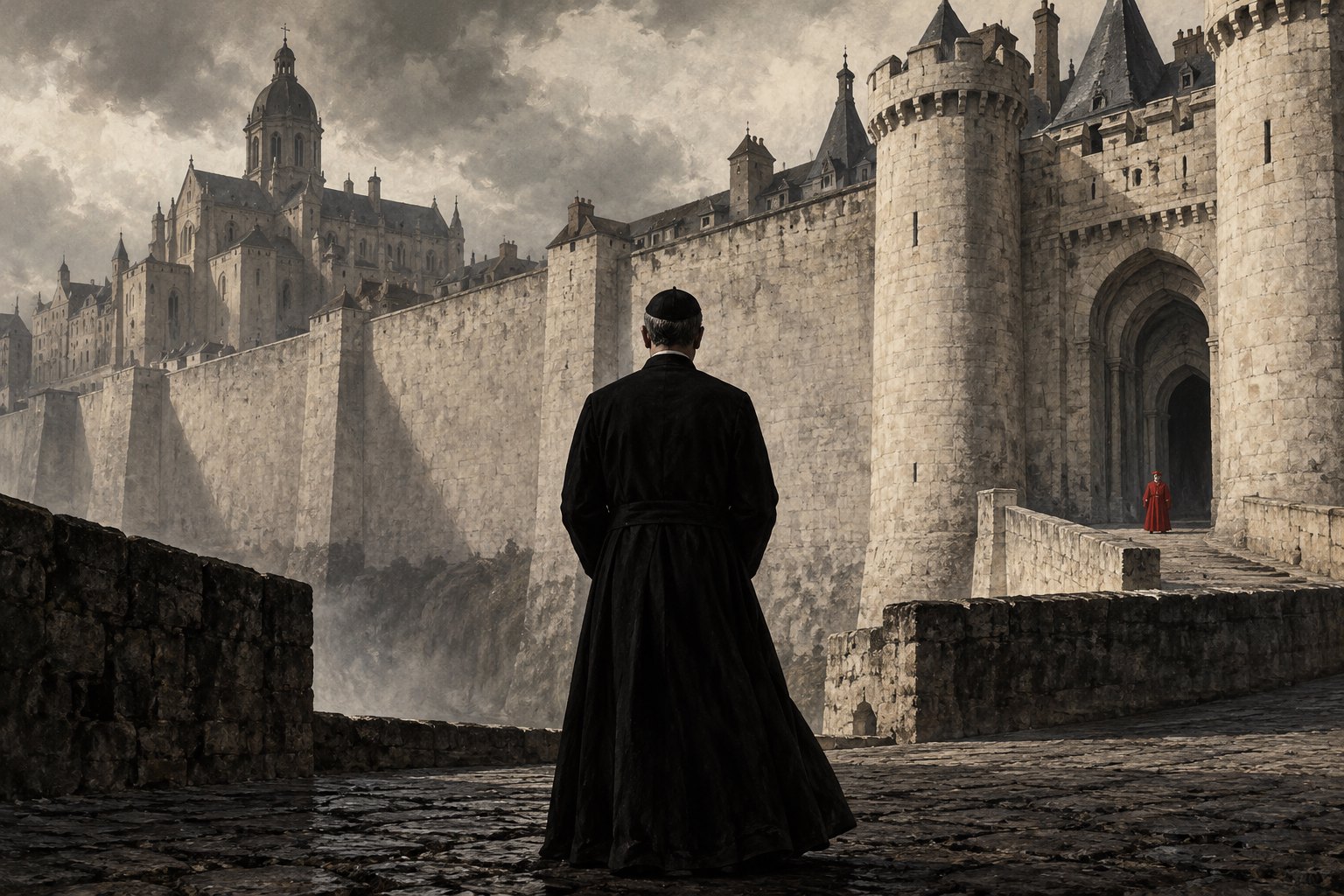
Set in seventeenth-century France, the story places Father Urbain Grandier, played by Oliver Reed, between the fortified town of Loudun and authorities determined to bring it under tighter control. Cardinal Richelieu’s interest in dismantling its defenses gives the religious accusations their political purpose. Russell himself described the film as an examination of state domination in a retrospective interview. [Ken Russell’s account of the film](https://www.bfi.org.uk/sight-and-sound/interviews/my-one-political-film-ken-russell-devils)
Grandier makes a compelling protagonist because he offers so little assistance to anyone seeking a spotless martyr. His sexual conduct and pride complicate his priestly authority. Reed gives him the bearing of a man accustomed to commanding attention, someone who can mistake personal magnetism for protection.
My reading is that his confidence initially limits his understanding of danger. He behaves as though an argument can still be won by the person capable of making it most forcefully. That assumption becomes disastrous when his opponents control what counts as evidence.
His declaration, “But Satan’s boy I could never be!” preserves a flash of that arrogance. The distinction matters: acknowledging moral failure does not require accepting an invented criminal identity. The film asks whether we can defend someone’s innocence without first making him admirable. That separation gives Grandier’s ordeal its ethical weight.
Readers interested in flawed protectors may recognize a related concern in our analysis of Bruce Wayne’s changing responsibility toward Gotham: a commanding presence means little unless it becomes useful to the people who depend on it.
Sister Jeanne’s desire becomes somebody else’s evidence
Vanessa Redgrave’s Sister Jeanne makes the film harder to reduce to a straightforward confrontation between innocence and villainy. Her fixation on Grandier mixes desire, spiritual imagery, humiliation, and an imagined intimacy. She wants a relationship with a man whose significance in her inner life far exceeds their actual acquaintance.
The performance’s strength lies in that imbalance. Grandier can move through public space with apparent ease. Jeanne’s existence is constrained, and her fantasies offer an intensity unavailable to her ordinary life. Her longing is comprehensible even when its consequences become appalling.
Russell’s treatment also deserves scrutiny. The emphasis on Jeanne’s physical difference can encourage viewers to associate bodily difference with psychological disturbance. Redgrave gives the character emotional specificity, but that does not make every visual choice equally persuasive. The film can expose cruelty while participating in an unkind way of looking.
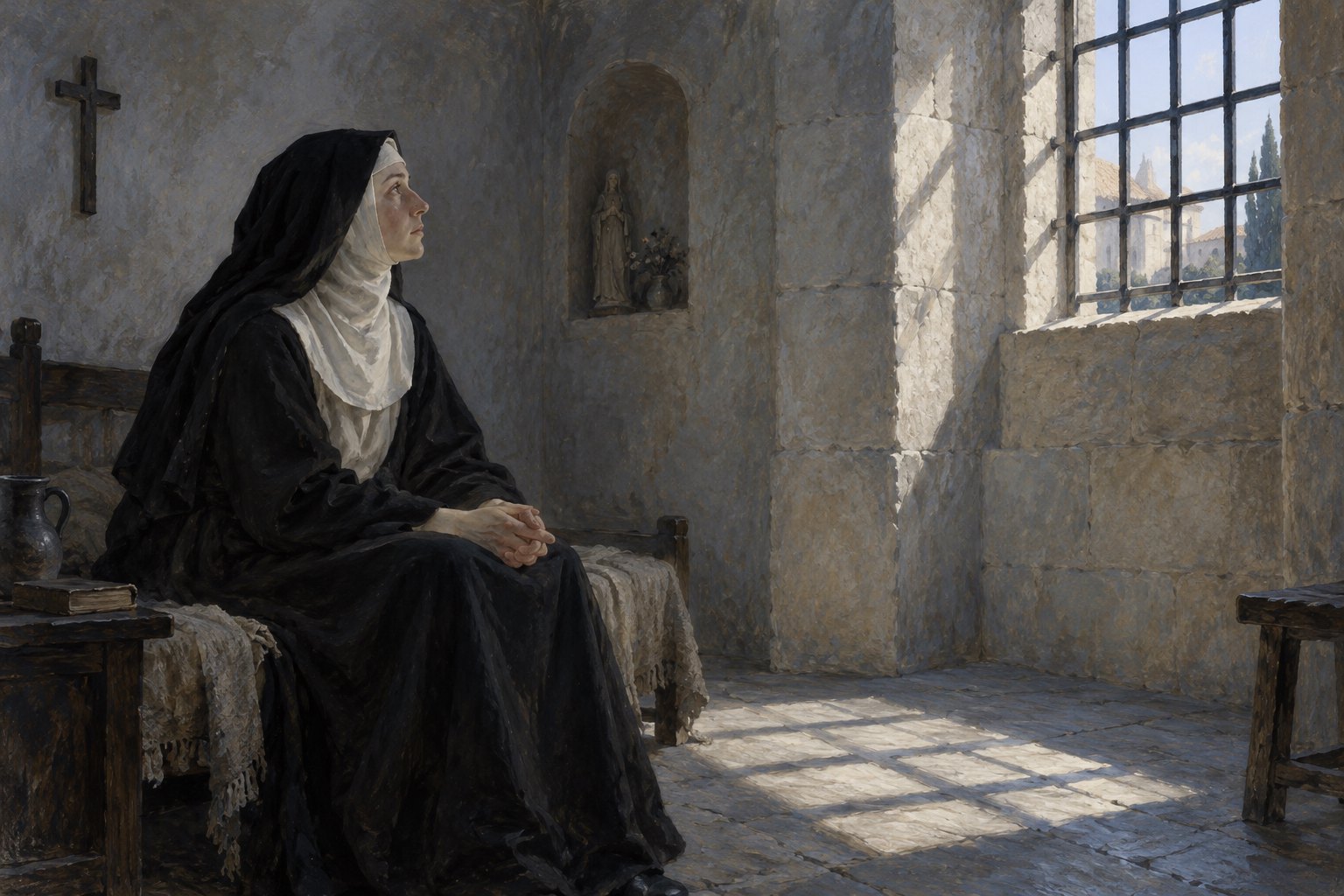
The decisive development is the conversion of Jeanne’s distress into a prosecutable story. Once her words become useful to Grandier’s enemies, their meaning is no longer hers to determine. Religious authority gives her extraordinary attention while narrowing what she is permitted to say.
This is where the film’s psychological drama meets its politics. Being listened to is not necessarily the same as being understood. An institution can amplify a person’s testimony precisely because it has no interest in the whole person.
There is a distant, revealing connection to our discussion of public fantasy and private identity in Notting Hill. Both films invite scrutiny of the person an observer invents. Russell follows that process toward accusation rather than romance.
The exorcism turns certainty into entertainment
Father Barre, played by Michael Gothard, makes the investigation feel like a performance that requires escalating effects. The public exorcisms offer spectacle where careful inquiry should be. Once the display has begun, uncertainty becomes an obstacle to the people directing it.
The empty reliquary episode condenses that problem. The nuns respond to an allegedly sacred object before its container is revealed to hold nothing. Exposure does not bring the proceedings to a meaningful halt. The spectacle survives the collapse of its explanation.
For me, this is more disturbing than any suggestion of supernatural possession. A mistaken belief might be corrected. A performance that rewards its participants can continue after correction, because its usefulness has become independent of its truth.
Russell’s excess serves that argument, although it also tests the viewer’s stamina. The frenzy can become so visually insistent that individual suffering disappears into the crowd. That tension is part of the film’s difficulty: its attack on public spectacle is itself spectacular.
Madeleine gives the tragedy a quieter scale
Madeleine, played by Gemma Jones, offers a different relationship to Grandier. Their secret marriage places personal commitment alongside his public persona. She matters because the film needs someone for whom his destruction is an intimate loss, beyond its value as a religious or political event.
Her comparative quietness can make her seem secondary beside Reed and Redgrave. I find that restraint essential. Without it, the film might become an uninterrupted competition among imposing personalities. Madeleine gives the viewer somewhere to register what all the shouting costs.
The ending brings Grandier’s execution together with the destruction of Loudun’s walls, then leaves Madeleine to walk away through the ruined defenses. The accusations have achieved a material objective. A man is dead, and the town has lost its protection. [Plot and cast reference](https://en.wikipedia.org/wiki/The_Devils_(film))
What survives after the scandal
Near his death, Grandier asks, “Give me the kiss of peace and let me die.” Set beside his earlier defiance, the request marks a profound contraction of scale: the commanding man now asks for one human gesture. Both lines appear in the film’s transcribed dialogue. [Dialogue reference](https://www.subtitlecat.com/subs/543/The.Devils.1971.DVDRip.x264-angrybunny-%20CG-English.html)
The request also makes the surrounding religious language answerable to an immediate action. Compassion is easy to proclaim in the abstract. Here, it would require recognizing the humanity of someone the proceedings have defined as monstrous.
That is why The Devils remains an exceptional, uneven, exhausting film. Its grotesquerie sometimes overwhelms its people, but its central moral distinction stays sharp: a compromised person can still be the victim of an intolerable injustice.
The deeper horror is that the authorities do not need to make everyone believe forever. They need belief to last long enough to accomplish something irreversible. Grandier’s death and the fallen walls give that idea physical form. Historical distance may make the costumes easier to admire. It offers no comfortable distance from the behavior.
Original content by this site's editorial team. Published: October 16, 2026 at 09:32:56 PDT (Los Angeles time)