Rumba Royale has been selected by Congo for the Best International Feature Film Oscar race, according to Deadline. The announcement brings renewed attention to a historical thriller whose most intriguing element is its perspective: a photographer watching a nightclub community as the political world around it changes. National selection should not be confused with an Academy Award nomination.
Directed by Hamed Mobasser and Yohane Dean Lengol, the film stars Fally Ipupa as Daniel, a photographer in 1959 Léopoldville. Film at Lincoln Center’s festival description places him inside the orbit of the Rumba Royale nightclub, where he grows close to Olive, a waitress with ambitions beyond her job. That combination of looking, longing and unequal opportunity offers a compelling starting point for understanding the film. [Film at Lincoln Center’s festival synopsis](https://www.filmlinc.org/films/rumba-royale/).
Scope and spoilers: This is an analysis of the verified premise and its dramatic implications, rather than a firsthand assessment of the complete film. It discusses an inciting incident disclosed in public screening materials, but does not reveal an ending. Dialogue is not quoted because no authenticated transcript was available.
What the Oscar selection brings into focus
A national submission gives audiences a reason to investigate a film they may otherwise have missed. It does not settle questions about the quality of its performances, its storytelling or its chances with voters. For Rumba Royale, the useful next step is to move from the awards announcement toward the particular people and tensions within its story.
The title points to a place of entertainment, but the central character makes observation equally important. Daniel earns our attention because his relationship to the club involves recording it. Olive offers another entry into the same environment: she works there and imagines a life beyond it. Their positions suggest different experiences of a room that other people enter for pleasure.
My interest lies in that difference. A historical thriller can become more revealing when large changes are experienced through small, unequal freedoms: who can linger, who must serve, and who can leave. Those are useful questions to bring to this film without treating its awards status as a critical verdict.
Daniel: the distance between seeing and understanding
A photographer makes an especially suggestive protagonist for a mystery. Photography preserves appearances, while a mystery asks viewers to question them. Daniel’s profession therefore creates a potential tension before any revelation arrives: he can record what is visible without necessarily understanding the relationships behind it.
This is an interpretation of the premise, not a claim about a particular photograph becoming evidence. The distinction matters. It would be easy to invent a familiar thriller mechanism in which a background detail exposes a crime. The more interesting question is whether Daniel’s habit of looking helps him understand people—or encourages confidence that his emotional involvement cannot justify.
His growing closeness to Olive sharpens that question. Attraction changes attention. Someone who begins as an observer may become selective, protective or vulnerable once another person matters to him. The dramatic possibility is that Daniel’s camera and his feelings offer competing versions of the same world.
That tension connects with our discussion of how perspective determines whose story reaches the viewer. Access to a person’s image does not automatically provide access to their experience. A character-centered reading of Rumba Royale should keep that gap open.
Olive: a future beyond the dance floor
The festival synopsis gives Olive a crucial attribute: ambition. She has desires that extend beyond the nightclub. That detail deserves attention because it establishes a possible life trajectory independent of Daniel’s fascination with her.
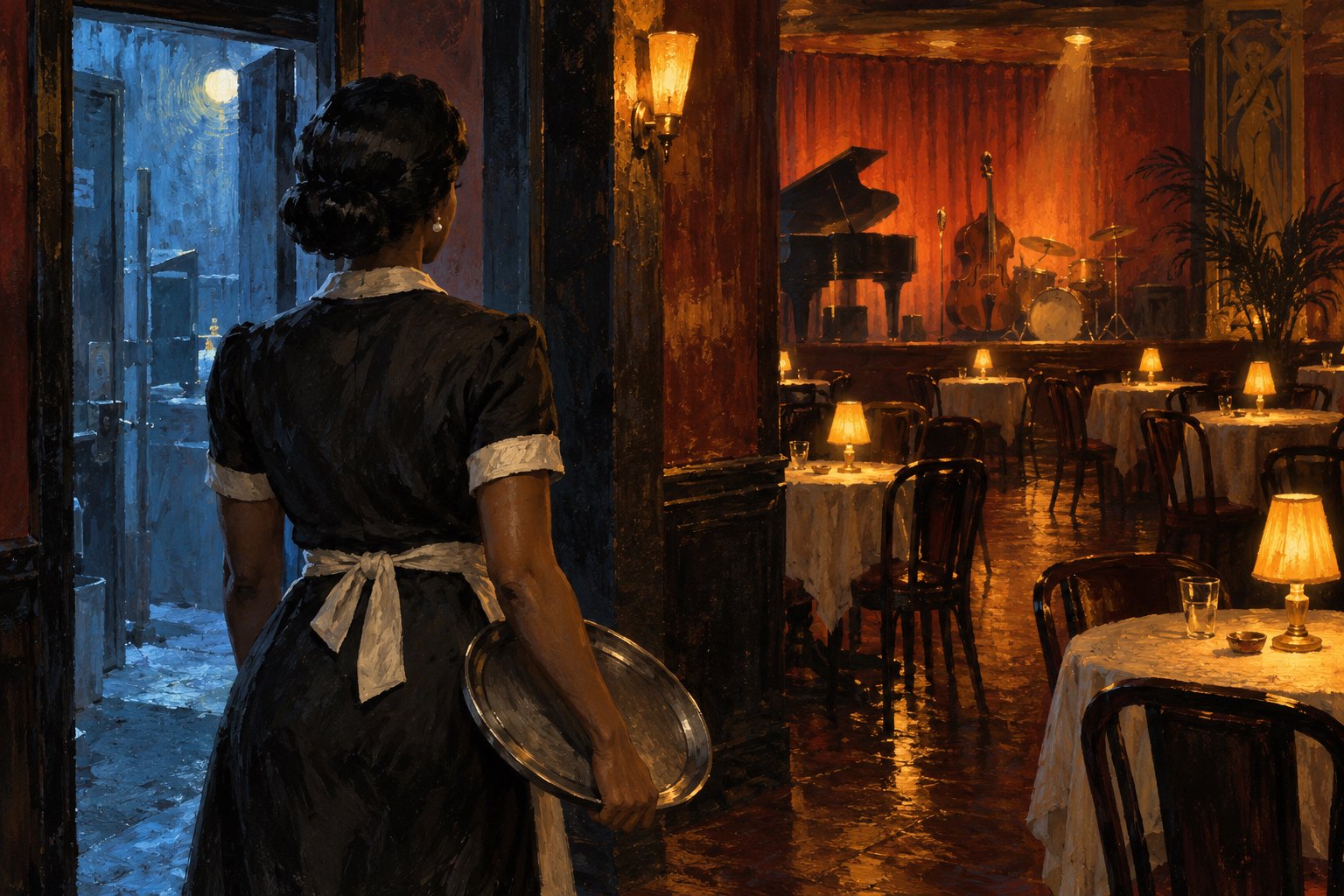
From her position, the club can be understood as a workplace as well as a social destination. The difference changes the meaning of its pleasures. A guest can experience an evening as escape; an employee must also navigate expectations, obligations and the practical limits of the job. This is a way to read Olive’s circumstances, rather than a description of unverified scenes.
The strongest question to carry into a viewing is whether her ambitions become specific. What does she want to change, and what would that change cost? A character gains depth when aspiration produces choices, especially choices another character struggles to understand. Simply being the object of someone’s affection would provide a narrower dramatic role.
Questions of belonging and dependence also shape our analysis of conditional access and character agency in The Guest. Here, Olive’s stated desire for something beyond the club makes the possibility of departure especially meaningful. Belonging to a place and wanting to remain there are separate experiences.
When the nightclub becomes a mystery
The French Institute in Kinshasa’s screening description supplies the darker turn: the woman Daniel loves is found dead. It places that death within a nightclub frequented by Congolese and European patrons as independence approaches. The description establishes a collision between intimate loss and a changing political environment without explaining the mystery’s resolution. [French Institute screening description](https://www.ifrdc.org/evenements/cinema-rumba-royal).
That premise raises a demanding storytelling question. Will the death illuminate a person’s life, or chiefly motivate someone else’s search? A satisfying mystery needs more than a solution. Its revelations should change our understanding of the relationships that made the crime possible and of the person whose absence drives the narrative.
For Daniel, grief potentially makes observation urgent and unreliable at once. For viewers, it changes how the nightclub can be approached. Familiar gestures may acquire new meanings; sociability may conceal conflicting interests. These are possibilities inherent in the setup, not confirmed accounts of how the film stages its suspense.
Music, pleasure and unequal freedom
A nightclub is a particularly useful setting for examining hierarchy because proximity can look like equality. People may occupy the same room and share its entertainment while possessing very different degrees of security or authority. The analytical mistake would be to assume that a shared rhythm dissolves those differences.
Equally, pleasure should not be dismissed as decorative. Characters can seek enjoyment while living through political uncertainty. Their music, friendships and attractions can matter in themselves, rather than existing only to foreshadow danger. A thoughtful viewing should ask whether the film allows those ordinary desires enough space to feel lived.
That is where Rumba Royale seems most promising to me at the level of premise: its setting brings public history into contact with private hopes. The meaningful measure will be how precisely the completed film connects those scales through action, performance and consequence.
A deeper reading: who gets to imagine what comes next?
The most productive interpretation begins with the characters’ different relationships to possibility. Daniel records a world; Olive imagines moving beyond her place within it. The approaching political transformation gives those personal orientations a wider resonance without making either character a simple symbol of a nation.
Read this way, the nightclub becomes a place where different futures temporarily meet. Some people may find continuity desirable; others may need change to make their ambitions possible. The mystery adds another question: who has the power to make a version of events believable?
Congo’s selection gives Rumba Royale an international spotlight. Its lasting interest will depend on what that light reveals about individual lives: what Daniel understands, how fully Olive’s wishes register, and whether the people inside this crowded social world remain more complicated than the roles assigned to them.
Original content by this site's editorial team. Published: October 9, 2026 at 17:06:29 PDT (Los Angeles time)