Sylvester Stallone turned the experience of rejection into something more durable than a revenge fantasy. In Rocky, the overlooked man does not prove that everyone else is worthless. He struggles to believe that he has worth himself. That distinction makes the 1976 film unusually moving: its hero needs an opportunity, but he also needs a way to stop measuring his entire existence by other people’s indifference.
The connection between Stallone’s career struggles and his fictional boxer is central to renewed discussion of the film’s origins. BBC reporting describes how frustration with limited opportunities helped push Stallone toward writing his own material. The essential parallel is compelling without embellishment: an actor seeking recognition created a fighter who fears he will never receive it. [BBC reporting republished by MyJoyOnline](https://www.myjoyonline.com/it-was-a-total-miracle-how-rejection-led-sylvester-stallone-to-create-films-ultimate-underdog-rocky/)
Spoiler warning: This review discusses the original film’s relationships and ending.
Stallone’s rejection becomes Rocky’s emotional language
Written by Stallone and directed by John G. Avildsen, Rocky emerged from a struggle over who would embody its protagonist. The American Film Institute’s production history documents Stallone’s insistence on playing the lead despite interest in casting an established star. That history supports the connection between author and character without requiring every colorful anecdote surrounding the production to be accepted as fact. [AFI’s production history](https://catalog.afi.com/Catalog/MovieDetails/53862)
On screen, rejection has already become part of Rocky Balboa’s routine. He boxes in small venues and collects debts for a loan shark. His physical strength gives him a function in the neighborhood, but little sense of direction. Stallone plays him with a revealing mismatch between appearance and behavior: the imposing body belongs to a man who talks as though silence might end the conversation permanently.
His reluctance to injure a debtor is particularly useful character work. Rocky earns money through intimidation, yet hesitates at the cruelty his job demands. The contradiction prevents his decency from becoming an uncomplicated halo. He participates in an ugly arrangement while struggling against its expectations.
My reading is that his deepest fear precedes Apollo Creed’s challenge. He worries that the roles available to him have already explained everything he can become. Stallone’s performance makes that fear visible in conversational detours, awkward jokes, and the persistent effort to keep another person listening.
Adrian gives the story a life outside the ring
Rocky’s relationship with Adrian, played by Talia Shire, establishes a different kind of recognition. She is not a crowd waiting to be impressed. Her reserve requires him to negotiate the uncertainty of another person rather than deliver a performance guaranteed to earn applause.
When he explains their attraction through the phrase “Together, we fill gaps,” the language is plain enough to sound discovered rather than composed. It suggests companionship between incomplete people. Rocky does not possess a polished account of love; he has noticed that being with Adrian changes the experience of being himself. [Dialogue reference](https://www.imdb.com/title/tt0075148/quotes/)
Shire’s restraint matters. Adrian’s early quietness can look passive, but her increasing willingness to speak exposes how much of her life has been organized around her brother Paulie’s demands. Burt Young makes Paulie’s dependence inseparable from resentment. He wants access to other people’s possibilities while treating those people as if they owe him their lives.
The romance nevertheless deserves scrutiny. In Rocky’s apartment, his persistence and control of the doorway make the courtship uncomfortable. The scene’s movement toward tenderness does not erase that pressure. For me, the relationship becomes persuasive through Adrian’s developing voice, rather than through the assumption that his confidence should automatically overcome her hesitation.
That distinction connects with our discussion of clarity and emotional availability in The Dating Project: mutual understanding requires room for both people to express what they want. Adrian matters most when the film allows her to become more than evidence of Rocky’s goodness.
Mickey’s late arrival makes encouragement complicated
Mickey, played by Burgess Meredith, offers another version of conditional recognition. His treatment of Rocky at the gym makes the fighter feel replaceable. Once the championship opportunity appears, Mickey wants to help manage it. From Rocky’s perspective, the timing raises an obvious question: why did he become worth helping only when somebody powerful noticed him?
Their confrontation gives rejection a history. Rocky’s anger is bigger than the immediate disagreement because he has accumulated years of feeling dismissed. Mickey, meanwhile, carries the frustration of an older man whose experience has not brought him the standing he wanted.
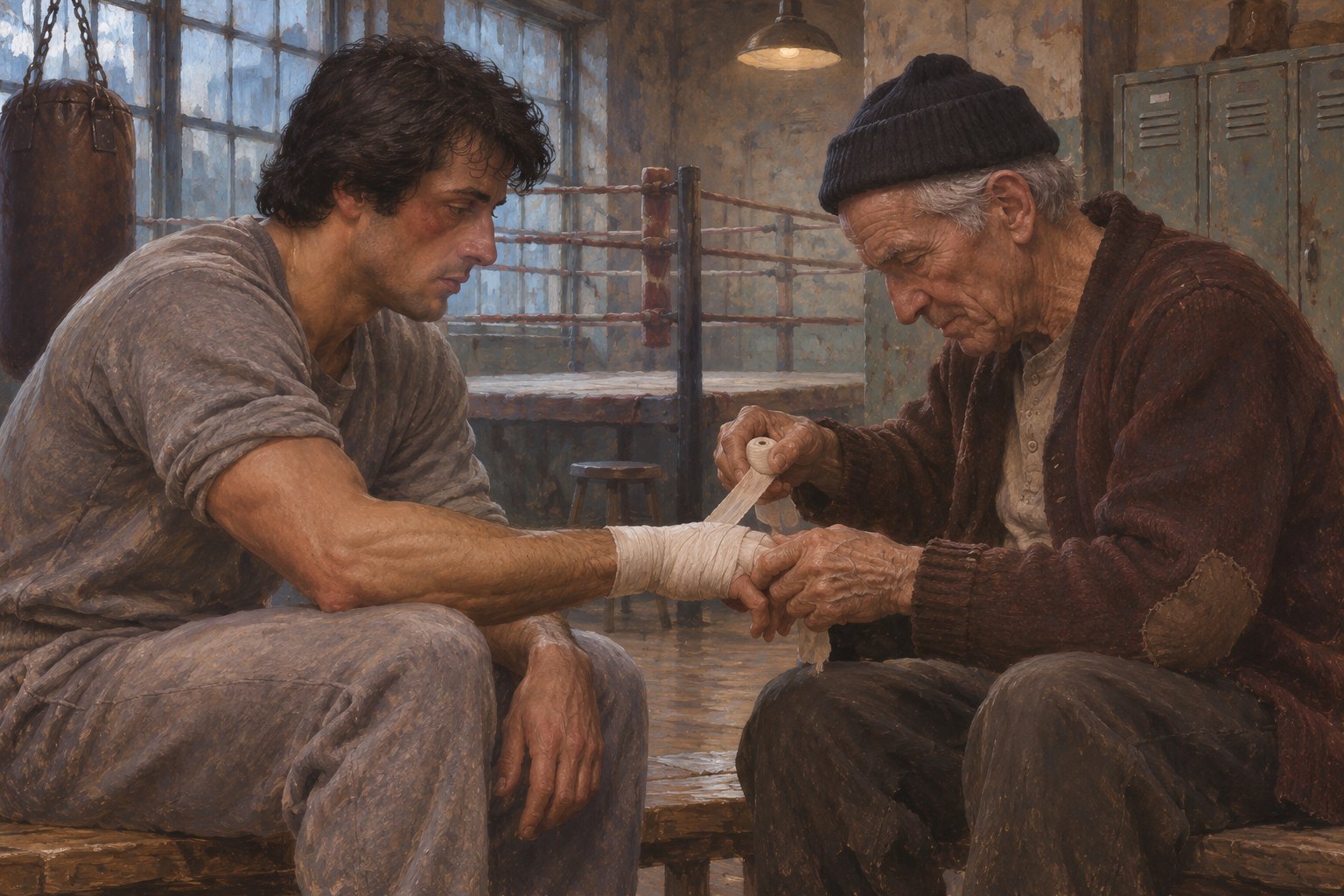
Neither man can offer the other a clean beginning. Their eventual cooperation is moving precisely because resentment remains part of what they must overcome. Rocky needs knowledge; Mickey needs his knowledge to matter. The film allows practical dependence to become the beginning of affection.
This also complicates the familiar idea of the solitary underdog. Rocky can train alone in the early morning, but his preparation depends on relationships. His determination becomes useful when somebody helps give it structure.
Apollo offers opportunity on his own terms
Apollo Creed, played by Carl Weathers, understands the championship bout as both competition and entertainment. Choosing an unknown challenger after his scheduled opponent becomes unavailable gives him a marketable story. Rocky’s opportunity is real, but its initial purpose is to serve the champion’s spectacle.
Weathers gives Apollo the confidence of someone accustomed to controlling a room. The contrast with Stallone is sharp: Apollo presents a finished public identity, while Rocky struggles to articulate even his private ambitions.
Calling Apollo merely arrogant would flatten the conflict. He is an accomplished champion who understands promotion. His mistake is assuming that the man selected to complete the event’s narrative will remain inside that supporting role. Rocky’s resistance forces him into a contest more demanding than the occasion he planned.
That tension keeps the film’s optimism from becoming entirely innocent. An institution can open a door while still expecting very little of the person invited through it. Rocky cannot determine why he receives his chance. He can determine how seriously he takes it.
The training montage earns its exhilaration
The running, gym work, and ascent of the Philadelphia steps give physical form to an internal change. Rocky begins organizing his days around a purpose. Repetition becomes progress because the film has first established the repetitive life from which he is trying to escape.
Avildsen’s patience with ordinary encounters is therefore essential. The quieter scenes supply the emotional weight that the athletic passages release. Remove the loneliness, awkward conversation, and bruised pride, and the training becomes an attractive exercise sequence.
Returning to the original also rewards the openness discussed in our reflection on rediscovering surprise in familiar movies. The famous images can obscure how much uncertainty surrounds them. Rocky’s improved condition does not eliminate his fear.
Why losing makes the ending more powerful
Before the fight, Rocky admits that he does not believe he can beat Apollo. His ambition becomes to “go the distance.” That modest phrase changes the dramatic question. The contest will test whether he can endure something he considers beyond him, even if the official result belongs to somebody else.
Rocky lasts the full fifteen rounds, and Apollo wins by split decision. Yet the ending directs its emotional attention toward Rocky calling for Adrian. Public judgment continues around them while the film moves toward a private acknowledgment.
To me, this is the original’s most generous idea. Rejection does not secretly guarantee greatness, and persistence does not make every desired outcome inevitable. Rocky gains something narrower and more believable: an experience that challenges his contempt for himself, and a relationship in which he can be recognized beyond his usefulness.
Stallone’s struggle to bring the character to the screen gives that ending additional resonance. But the film survives independently of its creation story because it understands the difference between receiving a chance and learning what that chance means. Rocky enters the ring hoping to establish that his life counts. By the final embrace, the scorecards have become an inadequate way to answer him.
Original content by this site's editorial team. Published: November 7, 2026 at 15:49:25 PST (Los Angeles time)