Obsession has a sequel idea, according to the Los Angeles Times. Its ending makes Nikki’s future the most compelling reason to continue. Before wondering what another wish could unleash, consider what the first film leaves behind: a woman who finally belongs to herself again, surrounded by consequences she never chose.
Major spoilers follow for Obsession, including its ending. Discussion includes coercion, violence, and suicide.
Writer-director Curry Barker’s horror story follows Bear, played by Michael Johnston, whose wish forces his friend Nikki, played by Inde Navarrette, into overwhelming devotion. The central critical question is whether we understand the catastrophe primarily as his romantic fantasy turning against him or as her life being stolen. My reading is that the ending decisively shifts the emphasis toward Nikki—and any continuation should take that shift seriously.
Bear wants an answer without asking the question
Bear’s initial difficulty is painfully recognizable: he cannot comfortably tell Nikki how he feels. A supernatural shortcut removes the possibility of rejection. It also removes the possibility of a freely given answer.
That distinction matters more than whether his wish could have been worded better. Relationships require another person to remain capable of disappointing us. Someone who cannot withdraw affection cannot meaningfully offer it either. Bear obtains certainty by eliminating the independence that would make Nikki’s affection valuable.
The restaurant exchange exposes his willingness to accept that arrangement. Nikki asks, “Why does it matter?” Bear answers, “It doesn’t matter to me.” In context, the exchange concerns the authenticity of her feelings. Those few words locate the horror inside his priorities: the result satisfies him, so its origin becomes negotiable.
Johnston’s character is therefore more interesting than an innocent fool who accidentally opens the wrong box. His embarrassment invites recognition; his decisions demand judgment. The audience can understand his loneliness without treating loneliness as permission.
This is also why the distinction between love and control, explored from another perspective in our analysis of love, responsibility, and freedom in Hexed, becomes so severe here. Caring about someone involves accepting a life that does not revolve around your needs.
Nikki’s interruptions are the heart of the horror
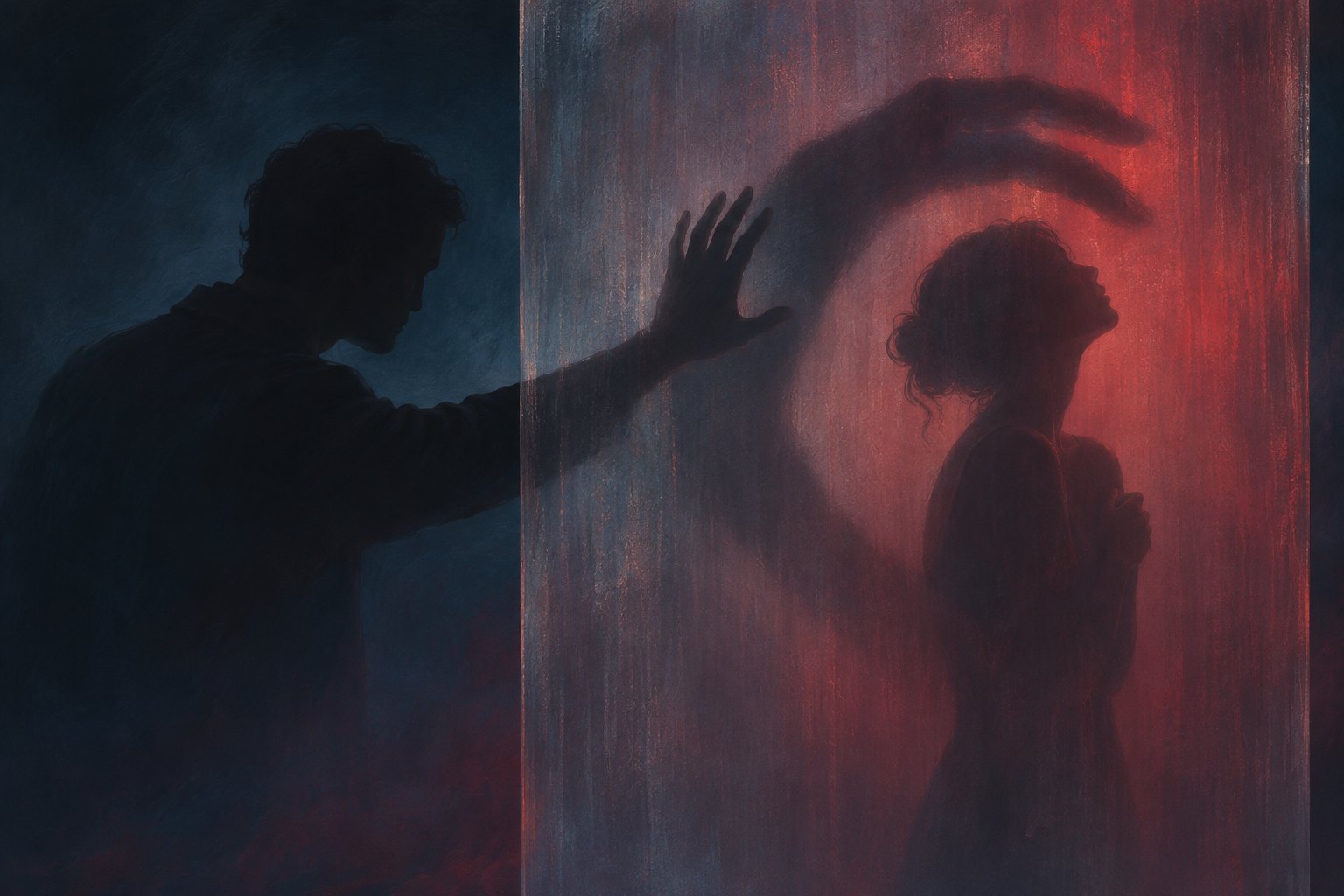
The One Wish Willow produces a version of Nikki whose devotion grows frightening and violent. Yet the film also gives us interruptions in that behavior: signs that the person Bear knows has not simply embraced an extreme romance.
“It’s not me!” is the crucial protest. It asks the viewer to separate Nikki from the behavior being imposed through her. Without that separation, the story risks becoming a familiar warning about an excessively demanding girlfriend. With it, the same scenes describe an assault on identity.
For me, this divided role supplies the film’s strongest dramatic idea. A face usually helps us locate a person’s intentions. Here, the visible person and the intention controlling her no longer reliably match. Expressions of affection become frightening because they conceal the absence of choice.
Bear’s perspective can initially dominate because he is the one reacting to the escalating danger. But being frightened does not make him the story’s only victim, or erase his role in creating its conditions. Nikki’s predicament requires the viewer to imagine an experience that his immediate panic keeps pushing aside.
That is the film’s most productive discomfort: we follow someone whose understanding of the crisis is narrower than the crisis itself. The challenge is to notice when his question—how can I escape this?—fails to include hers.
What happens in the ending?
After his attempts to reverse the wish fail, Bear takes pills intending to end his life, then tries to undo that decision. Meanwhile, Nikki uses another One Wish Willow. The ending indicates that she has wished for his love in return, although the precise wording is not presented as a complete explanation of the magic.
Bear returns to embrace her, then dies. His death ends the original wish’s hold on Nikki. She survives, regains awareness, and confronts the devastation around her.
The final embrace is therefore a terrible imitation of romantic completion. Both characters appear devoted, but mutual compulsion is still compulsion. Making the arrangement symmetrical cannot make it consensual.
Nor should Bear’s death automatically be treated as a clean redemption. His reversal complicates that interpretation. The ending does not give us a simple progression from selfishness to decisive sacrifice; it preserves the fear and instability of a person confronting consequences he cannot comfortably accept.
Why Nikki surviving changes the meaning

Nikki’s survival prevents the ending from closing neatly around Bear. His story reaches an endpoint. Hers suddenly becomes imaginable beyond the relationship that consumed it.
That does not make the conclusion reassuring. Freedom arrives without restoration. Regaining control cannot return lost relationships or make the experience comprehensible. The horror shifts from what her body might do next to what she must now live with.
This is where I find the ending most effective. It refuses the comforting assumption that removing an immediate threat repairs its damage. A supernatural rule can stop operating in an instant; a person’s relationship with herself cannot necessarily recover at the same speed.
Our discussion of privacy and belonging in All for Christmas considers how romance makes room for a person’s independent life. Obsession presents that question in its bleakest form: what remains when a relationship has forcibly occupied that space?
What a sequel would need to earn
A sequel idea is not a finished film. Its existence cannot tell us which characters will return, what the story will prioritize, or whether its emotional choices will justify revisiting this ending.
My strongest preference would be for a continuation that treats Nikki as someone with decisions to make. Simply placing her under another spell could reproduce the premise while surrendering the development that makes the final scene matter.
A story about her future would have harder questions available. What would trust require after her own expressions and actions became unreliable evidence of her wishes? How could she describe an experience that other people might understand only through its visible consequences? These are possible directions for criticism and speculation, not announced plot details.
The sequel would also need to resist making recovery a reward for further suffering. Nikki does not have to prove that she deserves autonomy. It was hers before Bear interfered.
The ending’s deeper warning
Obsession works best as a rejection of the fantasy that perfect devotion can substitute for knowing another person. Bear wants Nikki’s feelings to settle his uncertainty. The wish makes her entire existence answer that demand.
The final scene breaks that arrangement, but leaves its human cost intact. Nikki’s freedom matters even when it brings no immediate happiness. That is the distinction a sequel should preserve: a person’s right to herself does not depend on whether the resulting story is comforting, romantic, or easy to finish.
Original content by this site's editorial team. Published: November 25, 2026 at 21:22:51 PST (Los Angeles time)