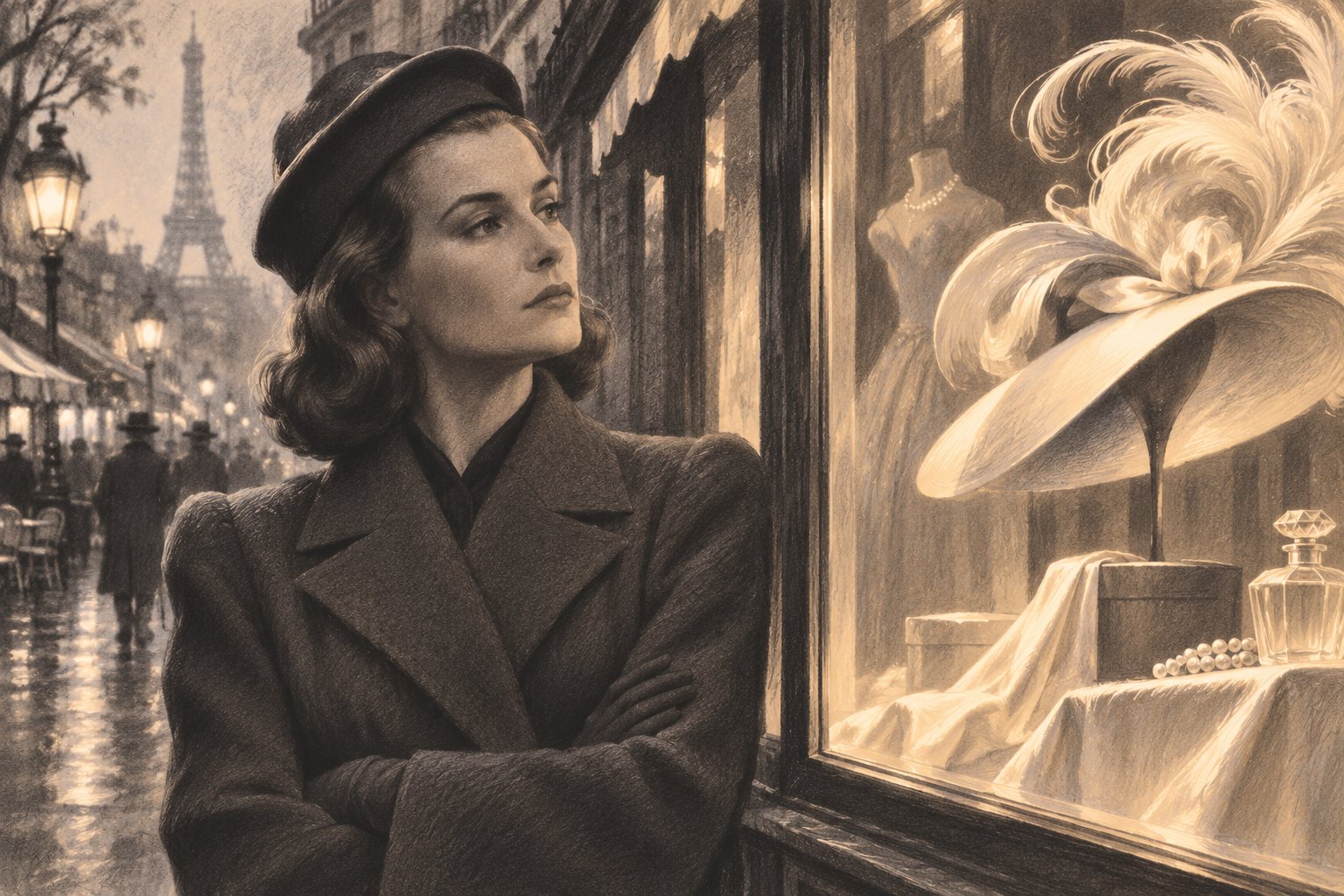
Ninotchka makes an excellent movie-night choice because its romantic pleasures come with something to argue about afterward. Ernst Lubitsch’s 1939 comedy gives Greta Garbo a woman whose convictions organize every encounter—until pleasure becomes an experience she cannot comfortably explain. The jokes remain wonderfully pointed, but the real attraction is watching her discover that being consistent and being fully alive may demand different things.
My verdict: this is an exceptionally funny romance with a more interesting heroine than its apparent conversion story suggests. Its political contrasts can be blunt, and its ending smooths over difficult questions. Garbo’s performance supplies the hesitation, pride, and vulnerability that keep those simplifications from defining the film.
Spoilers follow, including the separation and ending.
Ninotchka arrives with a job, not a romantic vacancy
Three Soviet representatives—Iranoff, Buljanoff, and Kopalski—have come to Paris to sell jewels confiscated from Grand Duchess Swana. Their mission becomes entangled in luxury and a disputed claim to ownership. Ninotchka arrives to restore discipline and complete the business. Meanwhile, Swana’s lover, Count Leon d’Algout, has been helping obstruct the sale.
That setup matters because Ninotchka is competent before she is charming. Her colleagues have allowed their appetites to complicate their responsibilities; she recognizes the problem immediately. Garbo makes her directness feel like an intellectual habit rather than a collection of comic tics. Ninotchka expects words to convey useful information. Everyone around her keeps using them to decorate motives.
Her objection to an expensive hotel suite is especially revealing. She translates its cost into cows the money could purchase for her country. The calculation is funny because it violates the hotel’s entire atmosphere, but the moral question survives the joke: why should one official enjoy comfort at everyone else’s expense?
Lubitsch lets us appreciate that question while showing the frightening limits of her reasoning. Her reference to “fewer but better Russians” turns state violence into an efficiency report. The chill comes from Garbo’s composure. A person capable of noticing waste has learned to overlook suffering when official language makes it sound productive.
Leon must become more than a persuasive man
Melvyn Douglas plays Leon as someone accustomed to having charm accepted as sufficient justification. Ninotchka’s first responses deny him that convenience. “Must you flirt?” she asks. Her follow-up, “Suppress it,” treats his romantic manner as an unnecessary interruption.
The exchange works because both performers protect their characters’ intelligence. Douglas does not behave as though Leon has encountered a dull woman. He becomes fascinated by someone who refuses his usual conversational rules. Garbo, meanwhile, allows curiosity into Ninotchka’s scrutiny without immediately softening her delivery.
Her assessment that his “general appearance is not distasteful” makes attraction sound like a satisfactory inspection. Yet the comedy contains an admission: she has been looking. Desire is already present; what she lacks is a vocabulary that permits her to enjoy it without defending its usefulness.
Leon’s connection to Swana also means that his appeal cannot establish his trustworthiness. Ninotchka has professional reasons to resist him. As in our discussion of how Home Alone builds character through judgments about trust, the crucial movement involves revising an assessment of another person. Attraction starts that process here, but embarrassment makes it convincing.
Why the café laughter changes their relationship
Leon tries to make Ninotchka laugh through deliberate comic performance. His jokes fail. Then he falls, and she breaks into laughter. The distinction is essential: his polished attempt to produce an effect gets nowhere; the collapse of his dignity reaches her immediately.
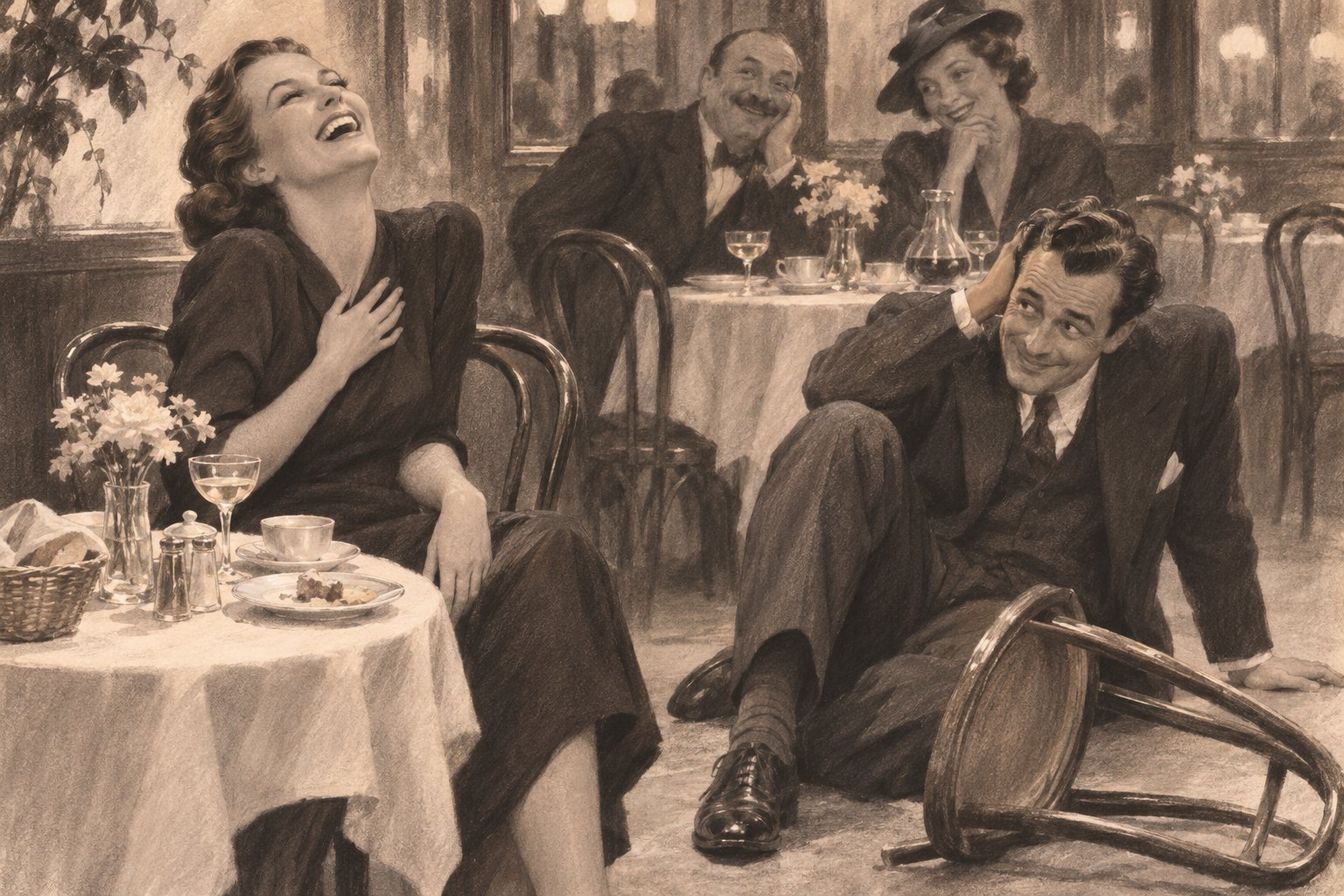
I read this as the film’s most persuasive romantic moment. Leon briefly loses control over how he appears, then joins the laughter at his own expense. He becomes easier to like because he can survive being ridiculous. Ninotchka discovers an experience that arrives before she can judge whether it is appropriate.
Garbo’s stillness before the outburst gives the release its force. Her face has not been empty; it has been guarded. The laughter feels expansive because the performance has established how carefully Ninotchka ordinarily regulates herself. Lubitsch allows physical comedy to accomplish what a speech about freedom would make painfully obvious.
The hat gives desire a visible shape
The extravagant hat Ninotchka initially condemns becomes a compact expression of her changing relationship with pleasure. When she later wears it, the object has not become more practical. Her willingness to want it has changed.
That is both delightful and open to criticism. The film associates liberation with fashionable consumption, and a modern viewer can reasonably resist the suggestion that an austere woman needs better clothes to become complete. Its romantic fantasy makes Parisian luxury unusually available while leaving the labor supporting that luxury mostly in the background.
Still, Garbo gives the hat more emotional specificity than a simple makeover would allow. Ninotchka must encounter herself as someone capable of an unnecessary preference. The scene invites a question more intimate than whether capitalism has won: can she choose something without presenting a public-interest argument for it?
The three envoys offer a broader comic version of that dilemma. They repeatedly find ways to accommodate comfort within their professed beliefs. Ninotchka is more affecting because accommodation costs her something. She cannot simply wink at her own contradictions.
Swana understands where Ninotchka is vulnerable
Ina Claire’s Swana sharpens the romance by refusing to become merely an obstacle with elegant clothes. She understands the power of possession: jewels, social standing, and access to Leon all belong within her sense of what can be defended or recovered.
After the jewels are stolen from Ninotchka’s unlocked safe and reach Swana, the duchess offers their return on the condition that Ninotchka leave for Russia without seeing Leon again. The bargain exploits precisely the responsibility that Paris supposedly dissolved. Ninotchka accepts because her mission still matters.
This is the film’s strongest answer to a shallow reading of her transformation. Enjoying romance has not erased her concern for others. Swana wins the immediate contest by recognizing that Ninotchka will sacrifice private happiness to fulfill a public obligation.
It also complicates the film’s geography of freedom. Paris provides laughter and beauty, but a wealthy rival can still manipulate someone else’s choices. Pleasure alone does not make a society generous.
The ending offers escape, with a final complication
Back in Moscow, Ninotchka experiences separation under conditions that make even communication difficult. Leon’s censored letters turn an intimate relationship into something subject to official permission. The comedy’s earlier disputes over language now have an emotional cost: words cannot connect people when authority removes their meaning.
The reunion comes through another assignment involving the three envoys, this time in Constantinople. Leon has arranged a route back to her. Unlike the romantic faith explored in our analysis of Serendipity’s reliance on fate, this happy ending depends on deliberate maneuvering. Love needs practical assistance.
The restaurant coda, with Kopalski protesting his treatment by his fellow former envoys, prevents the destination from becoming entirely innocent. Changing economic roles has not eliminated conflict. The men who wanted freedom from one system can reproduce unequal relationships in another.
For me, that lingering joke strengthens the film’s deeper meaning. Ninotchka is most valuable when it asks how much of a person must be suppressed to maintain a perfectly orderly worldview. Its heroine does not become lovable only when she laughs; her seriousness made her worth watching all along. Laughter gives her another way to exist. The lasting pleasure is seeing Garbo make room for both.
Original content by this site's editorial team. Published: November 21, 2026 at 02:14:43 PST (Los Angeles time)