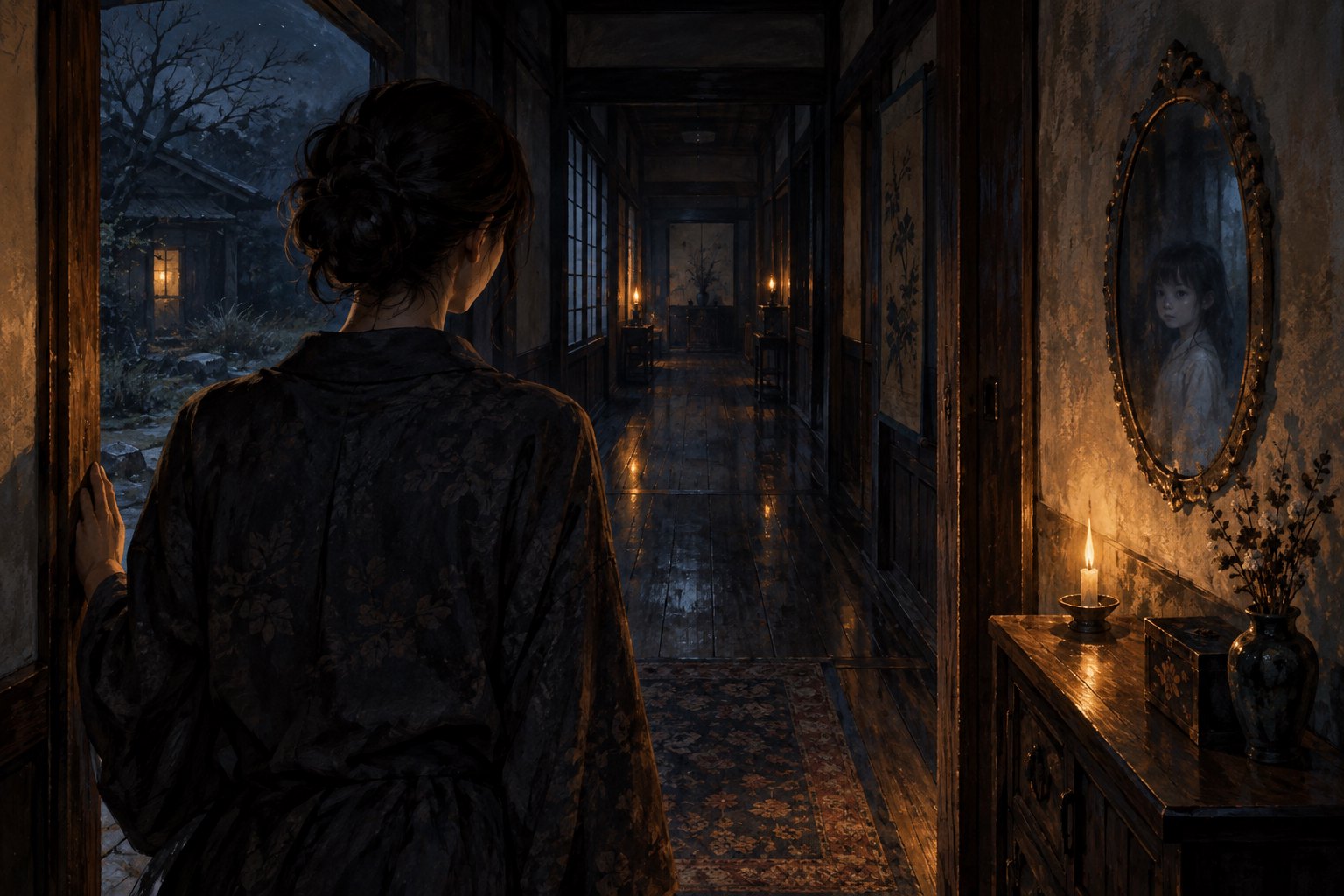
Never After Dark gives its heroine an unusually uncomfortable problem: she knows how to help the dead move on, but her closest companion is someone who has stayed. American writer-director Dave Boyle’s Japanese horror film centers on Airi, a traveling medium played by Moeka Hoshi, and Miku, her deceased sister, played by Kurumi Inagaki. Their partnership makes an apparently straightforward exorcism story emotionally complicated before its mystery begins to turn.
The film’s strongest idea is that expertise and vulnerability can occupy the same person. Airi understands ghosts well enough to earn a living dealing with them. Understanding what keeps people attached to one another proves harder. For me, that contradiction is a more persuasive reason to engage with Boyle’s film than the novelty of an American filmmaker working in Japanese horror.
Spoiler notice: This review discusses the sisters’ relationship, the exorcism ritual, and the central shift toward human danger. It does not describe the final confrontation.
Airi Treats the Impossible as a Working Day
Airi arrives at an isolated country house after its owner, Teiko, seeks help with an apparition. Teiko’s son Gunji questions whether the medium can be trusted. The assignment becomes increasingly dangerous as Airi discovers that the presence exceeds her experience and that the living pose their own threat. These are the essential stakes established in Magnolia Pictures’ official synopsis. [Film synopsis and credits](https://www.magpictures.com/neverafterdark/)
The choice to begin with a professional changes the audience’s relationship to the haunting. We do not have to wait for someone to accept that ghosts exist. Instead, we watch a specialist decide which disturbances deserve attention. Her confidence establishes a baseline; once she has difficulty interpreting what happens, the problem feels larger than an ordinary frightened visitor’s confusion.
One of Airi’s explanations supplies a compact statement of the film’s emotional problem: “If you die clinging to worldly things, you can’t move on.” The line, reproduced in Simon Abrams’s review, sounds like useful information for a client. Applied to Airi’s own relationship with Miku, it becomes considerably less comfortable. [Dialogue and character context](https://www.rogerebert.com/reviews/never-after-dark-horror-film-review-2026)
Who gets to decide when attachment becomes unhealthy? Someone who helps strangers separate from their dead might still want an exception for herself. That tension makes Airi worth following even when the immediate business involves familiar haunted-house mechanics.
Miku Makes the Ghost Story a Family Story
Miku communicates with Airi through mirrors and reflections. Fantasia’s official description establishes that she died when the sisters were children and continues to accompany Airi. The supernatural is therefore part of their everyday intimacy, not simply an invading force. [Festival synopsis](https://fantasiafestival.com/en/film/never-after-dark)
This arrangement gives reflective surfaces two incompatible meanings. A mirror can reveal something frightening, but it can also provide access to someone loved. The same object offers both exposure and reassurance. That ambiguity matters more than treating every reflection as a place to hide a jump scare.
Miku’s warnings also complicate the idea that the professional always knows best. Airi can possess practical knowledge while remaining resistant to advice from someone close to her. Sibling familiarity makes it easy to discount a warning because one recognizes the speaker’s habits, even when the warning itself deserves consideration.
My reading is that their relationship tests the difference between companionship and listening. Keeping someone near does not guarantee that you take them seriously. Airi’s work brings her into contact with other people’s unfinished business while allowing her own unresolved relationship to remain an ordinary part of the job.
Teiko and Gunji Want Different Things From the Same Visit
Teiko and Gunji create a useful disagreement around Airi’s authority. Teiko’s interest in the afterlife extends beyond wanting an unpleasant visitor removed; she is a widow whose curiosity carries personal stakes. Gunji worries that his mother is being deceived. His skepticism coexists with an attraction to Airi that makes his position less detached than he might prefer. [Character background](https://reactormag.com/movie-review-never-after-dark/)
From Teiko’s perspective, confirmation that spirits exist might be reassuring even when a particular spirit is terrifying. From Gunji’s perspective, questioning the medium can feel like protecting his family. Both responses are understandable. Neither necessarily helps Airi assess the situation clearly.
The resulting conflict gives belief a practical consequence. These people are negotiating access, privacy, responsibility, and trust inside a house whose rules they do not understand. Whether someone believes in ghosts becomes only one part of whether that person behaves sensibly around danger.
The Ritual Gives Fear a Physical Procedure
Airi’s ritual uses tangible objects: a candle, scissors, hair, and a spinning device built around a mirror. She enters the spirits’ realm while her body remains behind. During the investigation, a concealed box of teeth connects the haunting to acts of violence. The discovery makes the house’s secret distressingly material. [Ritual and investigation details](https://www.reelingreviews.com/reviews/never-after-dark/)
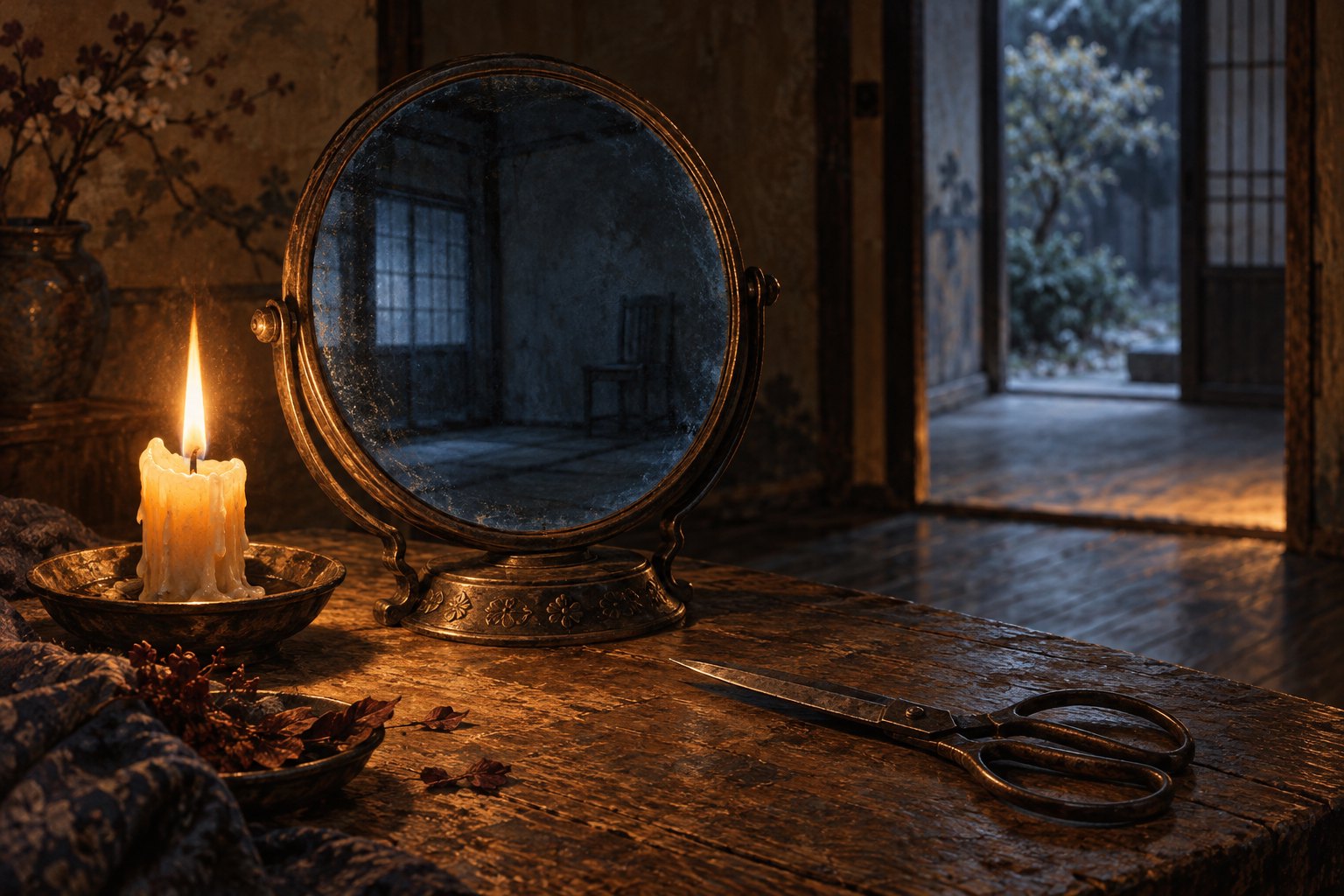
There is a strong dramatic advantage to making supernatural work procedural. Objects give the audience something concrete to understand: a sequence begins, an action changes the situation, and a return must remain possible. Airi’s expertise becomes visible through what she does.
Her bodily vulnerability also complicates her apparent freedom. Crossing a boundary does not mean escaping all the dangers on the side she leaves behind. The ritual asks us to think about divided attention: while Airi investigates one kind of threat, what has she stopped watching?
That is the distinction between merely recognizing a device and making it function within a character’s predicament. Our guide to familiar horror movie clichés explores the same question: an old mechanism can still generate tension when the person using it has something specific to lose.
The House Disrupts More Than the Boundary Between Life and Death
“That clock only tells time when it wants,” Teiko observes. The line becomes significant as the building’s chronology grows unstable. Its haunting involves a disturbing relationship between what has happened and what may still happen, complicating the assumption that a ghost must represent a safely completed past. [Dialogue and chronology](https://projectedfigures.com/2026/03/14/never-after-dark-2026/)
The conceptual shift puts pressure on Airi’s original task. Helping a trapped spirit and protecting people from an active human threat require different judgments. Compassion remains valuable, but it cannot substitute for recognizing someone’s capacity to cause harm.
There is a potential limitation here. Viewers who want every supernatural mechanism explained may find that the mystery’s movement demands more interpretive flexibility than they enjoy. The most rewarding approach is to follow how each discovery changes Airi’s decisions, rather than expecting the film to become a comprehensive handbook of its afterlife.
What the Haunting Means
The most compelling interpretation of Never After Dark concerns the limits of emotional access. Airi can communicate with a dead loved one, yet that extraordinary privilege does not remove disagreement, guilt, or the difficulty of making choices. The fantasy of one more conversation becomes an ongoing relationship with all its familiar complications.
That makes the film a useful companion to our examination of whether understanding a horror character strengthens the fear. Here, character knowledge gives danger a sharper personal meaning. We can understand why Airi trusts her routine and why she wants Miku close without assuming those desires will protect her.
Boyle’s central achievement lies in that uncomfortable overlap. The dead can be beloved; the living can be dangerous; an experienced guide can still misread a situation. Airi’s gift brings her closer to people who are gone, but it never grants her complete knowledge of the people standing beside her.
Original content by this site's editorial team. Published: October 13, 2026 at 18:31:41 PDT (Los Angeles time)