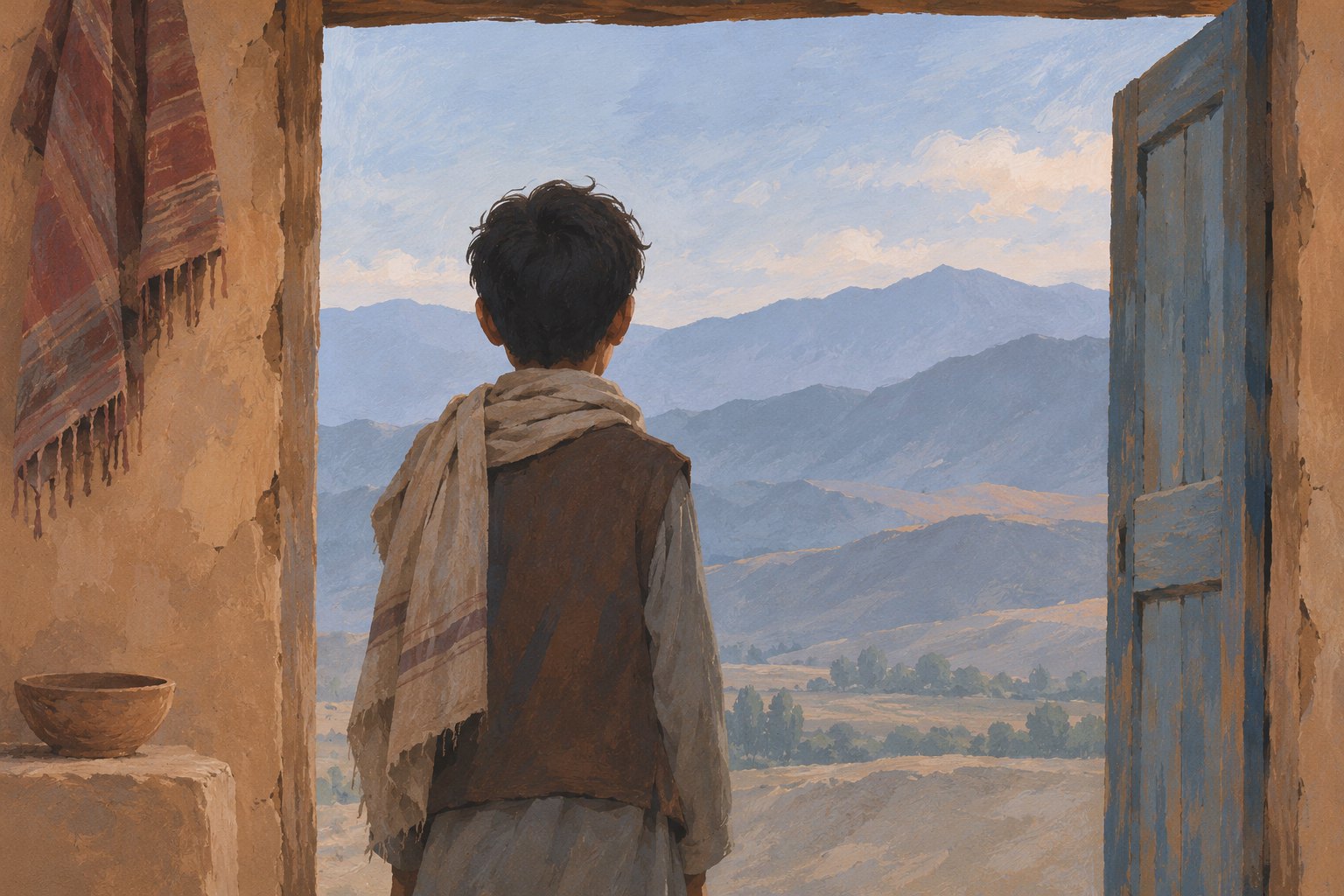
Mohabat follows a 12-year-old Afghan boy after a U.S. drone strike kills his father, according to Democracy Now!’s description. That premise places a child’s continuing life at the center of a story about military violence. The death matters as an event with political responsibility; it also matters as the loss of a particular relationship that no account of the strike alone can explain.
For viewers seeking to understand the film, that distinction offers a useful starting point. What does it mean to follow the person who must live with the aftermath? How can a movie give a bereaved child room to exist beyond the circumstances that brought him to the camera?
Scope: This is a spoiler-free critical discussion of the reported premise, not a review based on a complete screening. It does not assess unverified scenes, performances, dialogue, or the ending.
A child’s perspective changes the central question
A military account might organize a story around an operation: its objective, its execution, and its stated outcome. A film following a child after his father’s death invites another structure. The central question becomes what living through the consequences involves. The event has happened, but the experience of its consequences has no equally clear endpoint.
That shift matters because a child is not simply a smaller version of an adult witness. At 12, dependence and growing independence can coexist. A young person may understand that something irreversible has happened while still needing others to explain its circumstances. These are possibilities to keep in mind when approaching Mohabat’s story, not conclusions about his private thoughts.
My view is that the strongest character-centered criticism starts with that restraint. It asks what a person actually expresses before assigning emotions to a face or turning silence into a statement. Sadness, anger, confusion, and composure cannot be reliably inferred from the premise alone. Mohabat deserves the same interpretive patience audiences routinely extend to more familiar screen subjects.
His father’s death is also the loss of a relationship
The word “father” carries a different kind of information from a casualty description. It identifies a relationship. It asks us to consider someone whose importance to the boy cannot be measured solely by the circumstances of his death.
There is an ethical distinction here between acknowledging that relationship and inventing its particulars. We cannot assume what the two talked about, which routines they shared, or how the father behaved at home. Yet those unknowns matter. They remind us that a brief description of a death leaves most of a life outside the frame.
For a viewer, a productive question is whether the film makes space for that missing fullness. Does the father emerge through what others actually remember? Does the boy have opportunities to describe what matters to him? These are standards for attentive viewing, rather than claims about how particular sequences unfold.

Following a boy should mean more than observing suffering
A story introduced through bereavement creates an understandable expectation of sorrow. That expectation can also narrow our attention. If we watch only for evidence of damage, we risk treating every gesture as a symptom and overlooking whatever else the person chooses to show us.
Character depth depends on allowing more than one emotional register. Ordinary interests, impatience, humor, or moments of distraction need not undermine the seriousness of grief. If such moments appear, they deserve attention on their own terms. They should not automatically become evidence that a child has recovered or proof of an uplifting lesson.
This concern also informs our discussion of how screen portrayals can narrow a person into a label. The circumstances differ, but the viewing responsibility carries over: a compelling organizing idea should not become the only way we understand someone.
For Mohabat, the risk is being reduced to the bereaved Afghan child. The premise establishes his loss and nationality; neither tells us everything about his personality. A thoughtful audience should remain open to details that complicate the first description.
Political responsibility and personal attention belong together
The reported involvement of a U.S. drone strike is integral to this story. Removing it would strip the father’s death of its stated cause. At the same time, focusing exclusively on the military technology could push the boy to the margins of a film introduced through his experience.
The useful balance is to retain both levels of attention. We can ask who caused a death while also recognizing that a child’s account of its consequences has value beyond its usefulness in a policy argument. Personal testimony need not settle every historical question to deserve serious consideration.
For American audiences, this distinction is particularly relevant. The mention of a U.S. strike can prompt immediate debate about justification, strategy, or national identity. Those questions should not make the Afghan person at the center disappear. Listening requires noticing when our own argument starts taking up more space than the life being described.
What to watch for in the film’s treatment of its subject
Three questions can guide a close viewing without prescribing the answers. First, how much space does Mohabat have to express his own priorities? Second, how does the film distinguish what he knows firsthand from what other people tell him? Third, does its emotional structure allow uncertainty, or encourage viewers to feel they have fully understood him?
These questions concern form as much as subject matter. Editing can make a reaction seem definitive. Music can suggest an emotion before a person has articulated it. A sustained observation can offer time to notice complexity, although duration alone guarantees nothing. Without a complete screening, judgments about those choices would be premature.
Our commentary on childhood experience and the storyteller behind Hello Maggie! considers a related responsibility: attending to the person whose life gives a film its significance. Here, that means resisting the temptation to substitute a ready-made narrative of innocence, devastation, or resilience for what Mohabat actually communicates.
The deeper question: who gets to define the aftermath?
The most compelling implication of Mohabat’s premise is its attention to what continues. An account of a strike can end when the action ends. A child’s life cannot be organized so neatly around that stopping point. The aftermath belongs to the people who keep living it.
That does not establish the film’s artistic success. A serious subject still requires careful filmmaking, and an honest verdict must rest on the work itself. It does establish why this story warrants attention: the distance between describing a death and understanding what that death takes from another person.
My reading of the premise is that its deepest challenge lies in asking audiences to remain attentive after the immediate shock. Mohabat’s loss deserves recognition. His continuing life deserves curiosity, patience, and the possibility of being understood as more than the consequence of someone else’s violence.
Original content by this site's editorial team. Published: November 15, 2026 at 05:06:45 PST (Los Angeles time)