Malliotakis has introduced legislation aimed at helping American film and television production, according to an announcement from her congressional office. For viewers, the immediate significance is the proposed attention to how screen entertainment gets made. The announcement establishes an intention to support production; it does not, by itself, establish that assistance has become law or that particular movies will benefit.
The useful question is what that support should achieve. More filming activity could be welcome, but a persuasive case needs to explain who gains access to work, which projects become possible, and how any public commitment will be evaluated. From a film criticism perspective, there is another consideration: whether stronger production conditions give filmmakers more room to create believable people and distinctive worlds.
What the announcement establishes—and what remains open
The confirmed core of this story is narrow: Malliotakis has introduced legislation with the stated goal of helping American film and television production. Specific eligibility rules, financial mechanisms, costs, implementation dates, and legislative prospects are not established here. Assigning the proposal a tax-credit percentage or promising a particular employment outcome would go beyond that foundation.
That distinction matters because a goal and a mechanism answer different questions. Supporting production describes an ambition. A policy’s actual design determines whether assistance reaches a small independent feature, a television series, a major studio project, or some combination of them.
The analysis that follows offers criteria for judging the initiative, rather than a verdict on provisions that have not been verified. It is industry commentary, not a review of a finished movie. There is no film attached to this announcement whose plot, dialogue, or performances could responsibly be assessed.
Why production conditions belong in a conversation about movies
Audiences encounter the finished scene: a person hesitating before answering, a room that reveals an unhappy marriage, a street that feels like somewhere a character actually lives. The labor behind those impressions usually stays outside the frame. Yet character development depends partly on decisions made by people who never appear on a poster.
A costume can suggest that someone dresses for the life they want rather than the one they have. A carefully arranged apartment can expose financial strain without explanatory dialogue. Clear production sound can preserve the distinction between a whispered confession and an ordinary line delivered quietly. These are examples of filmmaking craft, not claims about projects covered by Malliotakis’s proposal.
Resources cannot guarantee that those choices will be intelligent. Additional time and skilled collaborators can, however, create opportunities to refine them. That is the strongest artistic reason to take production policy seriously: the conditions surrounding a performance can influence how fully an audience understands it.
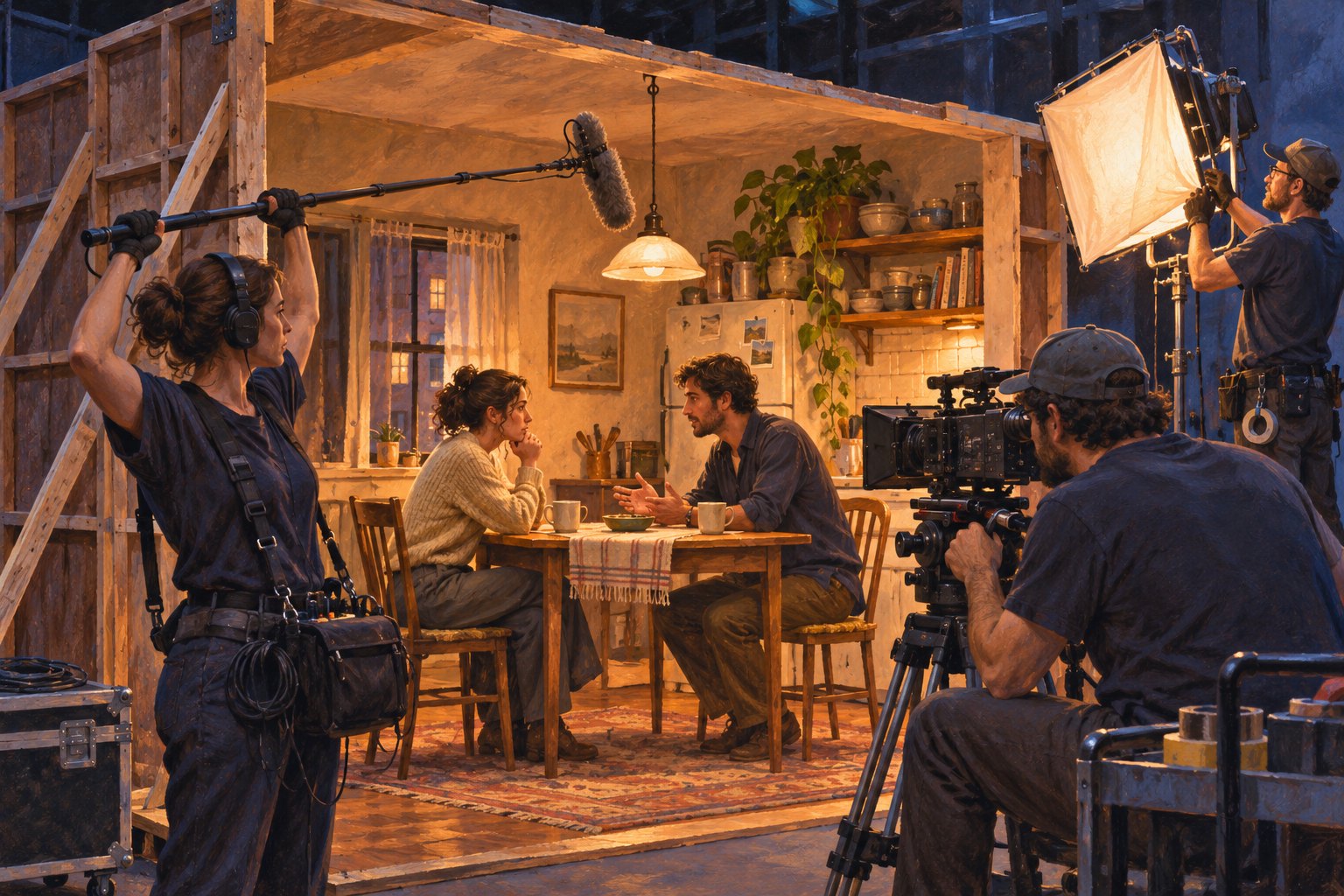
Put the working crew at the center of the discussion
One useful way to evaluate the Malliotakis initiative is to shift attention from the celebrity at the premiere to the people preparing the set. For a crew member, meaningful support would ideally translate into accessible work, dependable scheduling, safe conditions, and opportunities to build a sustainable career. Those are standards to investigate, not benefits that can already be credited to this legislation.
Employment totals alone would tell only part of the story. A short engagement and months of continuous work can both contribute to a headline number while offering very different levels of stability. Similarly, a production’s arrival in a community does not automatically explain how much of its spending reaches local workers or businesses.
Training deserves attention alongside immediate hiring. Our coverage of Eckerd College students participating in a feature-film shoot considers the value of learning through actual production work. The relevant policy question is whether support helps newcomers develop skills under experienced supervision, with a plausible route toward future employment.
Would smaller productions have a practical way in?
A production-support measure should also be examined from the perspective of a filmmaker with limited administrative and financial resources. Formal eligibility would be only the first hurdle. Application demands, timing, and the ability to plan around assistance could determine whether participation is realistic.
Consider a hypothetical independent drama built around a few locations and an unfamiliar cast. Its producers might need certainty before committing to a shooting schedule. Assistance available only after substantial spending could present a different challenge from support that can be accounted for earlier. This example illustrates a design question; it does not describe how Malliotakis’s legislation operates.
For viewers, access matters because different production scales can support different kinds of storytelling. An intimate family drama and an effects-heavy adventure make different demands on their crews and budgets. A healthy production environment should leave space for both, without assuming that either scale automatically produces better art.
Local filming can enrich a story, but geography is no guarantee
The American-production goal invites a cultural question as well as an economic one: what can a location contribute to a character’s world? Architecture, room sizes, neighborhood rhythms, and the distance between home and work can all help establish how a person lives. When filmmakers pay attention to those details, setting becomes part of the drama.
Still, a domestic filming location does not automatically make a story perceptive or authentic. A place can be photographed beautifully and understood poorly. Conversely, an invented set can express a character’s circumstances with remarkable precision. The artistic test remains what the filmmakers notice and how they use it.
The same distinction applies to local participation. Our guide to evaluating a background acting opportunity in Summit County emphasizes practical questions about the work itself. That perspective belongs in this debate: enthusiasm about a nearby production should lead to clear information about actual opportunities.
Four questions that would make the proposal easier to judge
As verified details become available, readers can assess the initiative through four concrete questions:
- Who qualifies? Look for clear definitions of eligible productions, spending, and recipients, including whether smaller projects can realistically participate.
- What activity would the support change? A persuasive evaluation should distinguish newly enabled work from activity that would have occurred anyway.
- Who experiences the benefit? Examine opportunities for crew members, emerging workers, and participating businesses alongside benefits to production companies.
- How would results be demonstrated? Clear reporting should make it possible to compare stated objectives with outcomes and identify shortcomings.
These questions do not require predicting whether the bill will advance. They provide a way to move beyond its broadly appealing goal. They also leave room for disagreement about costs and priorities without reducing the discussion to whether someone supports movies.
The deeper issue: preserving the ability to make something distinctive
Our editorial view is that the strongest case for supporting production rests on sustaining skilled work and expanding practical opportunities to tell stories. A busy soundstage is valuable to the people working there. Its artistic value emerges later, through the choices that turn equipment, labor, and performances into a convincing film.
Malliotakis’s announcement deserves attention on those terms. Its stated ambition addresses the machinery behind the entertainment audiences watch; its merits will depend on verified design and demonstrated results. For movie lovers, the most meaningful outcome would be a production environment where experienced crews can keep working, new filmmakers can find a foothold, and characters have the time and craft behind them to feel fully alive.
Original content by this site's editorial team. Published: November 13, 2026 at 10:17:40 PST (Los Angeles time)