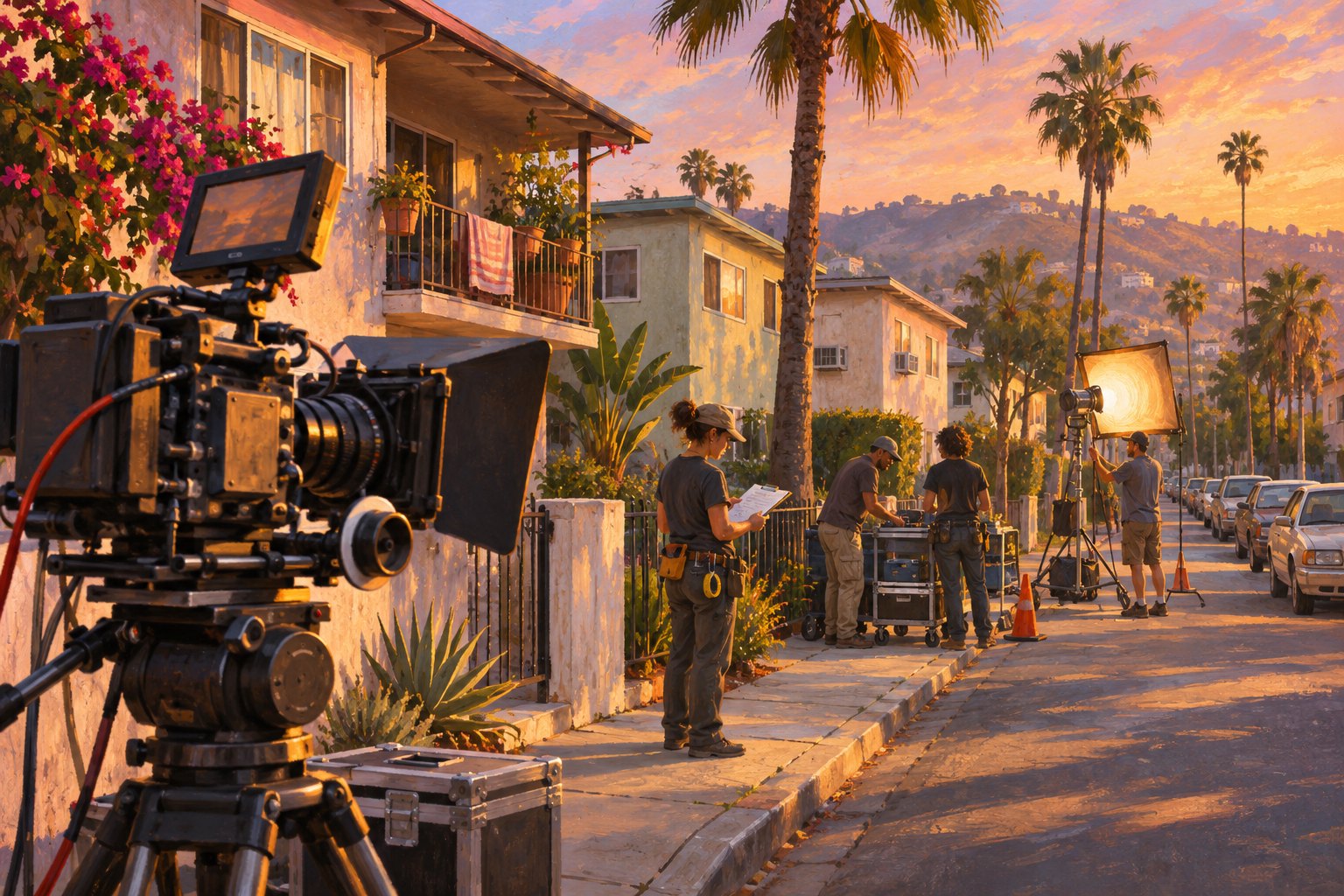
Los Angeles County is backing a federal film tax credit, according to NBC Los Angeles. That is a statement of support, not evidence that a new credit is available or that a particular production will return. For moviegoers, however, the development invites a question beyond the financing: could support for production help preserve the particular places, working relationships, and physical details that make a film feel alive?
The distinction matters because keeping filmmaking in a region and keeping that region recognizable on screen are different achievements. A production can employ local crews while telling a story set somewhere else. It can also announce a Los Angeles setting while showing little of the city beyond a few familiar views. Neither choice determines quality. But the relationship between a story and its surroundings deserves a place in this debate.
What the endorsement tells us—and what it cannot
The confirmed development is the county’s support for a federal film tax credit. That statement alone does not establish the terms of an eventual benefit, its availability to individual projects, or its effects on employment and production decisions. Those questions require evidence beyond an endorsement.
Our earlier examination of the county’s support and the stakes for film workers addresses the policy debate. Here, the focus is narrower: the creative consequences of where and how movies get made.
My view is that the strongest cultural argument for supporting production concerns the range of choices available to filmmakers. Financial breathing room could make a demanding location practical, preserve time for rehearsal, or allow a carefully designed interior to survive a budget revision. Those are possible uses of resources, not outcomes that this county action has demonstrated.
A location should change how a character behaves
A useful way to evaluate a movie’s setting is to ask what the protagonist can do there. Can someone cross the room without interrupting a conversation? Can they leave an argument without asking for a ride? Is their workplace visible from their apartment window? Physical arrangements become dramatic information when they create opportunities or restrictions.
Consider a hypothetical scene in which a character needs to apologize. A crowded kitchen forces the apology into other people’s hearing. A parked car creates privacy but gives the driver control over when the encounter ends. A long walk allows silence to occupy the space between sentences. The dialogue could remain identical while the balance of power changes completely.
This is where production choices meet character analysis. An environment is doing meaningful work when it helps explain a decision that might otherwise seem arbitrary. The location becomes part of the performance: a doorway offers escape, a narrow passage prevents it, and a window makes an apparently private moment feel exposed.
For a film associated with Los Angeles, geographic specificity can also give distance dramatic weight. The important question is not whether the audience recognizes an intersection. It is whether the movie makes travel, separation, access, and belonging feel consequential to the people in the story.
Authenticity takes more than shooting locally
There is a tempting shortcut in discussions of production incentives: assume that filming in the place a story depicts automatically produces greater authenticity. It does not. A camera can turn a real neighborhood into a generic backdrop through selective framing, hurried coverage, or indifference to the people who inhabit it.
The opposite is also possible. A constructed room can convey a remarkably precise life. Furniture placement, worn surfaces, practical lighting, and the objects a character keeps within reach can establish habits before anyone speaks. What matters is the attention behind those choices, not simply the address where the camera stands.
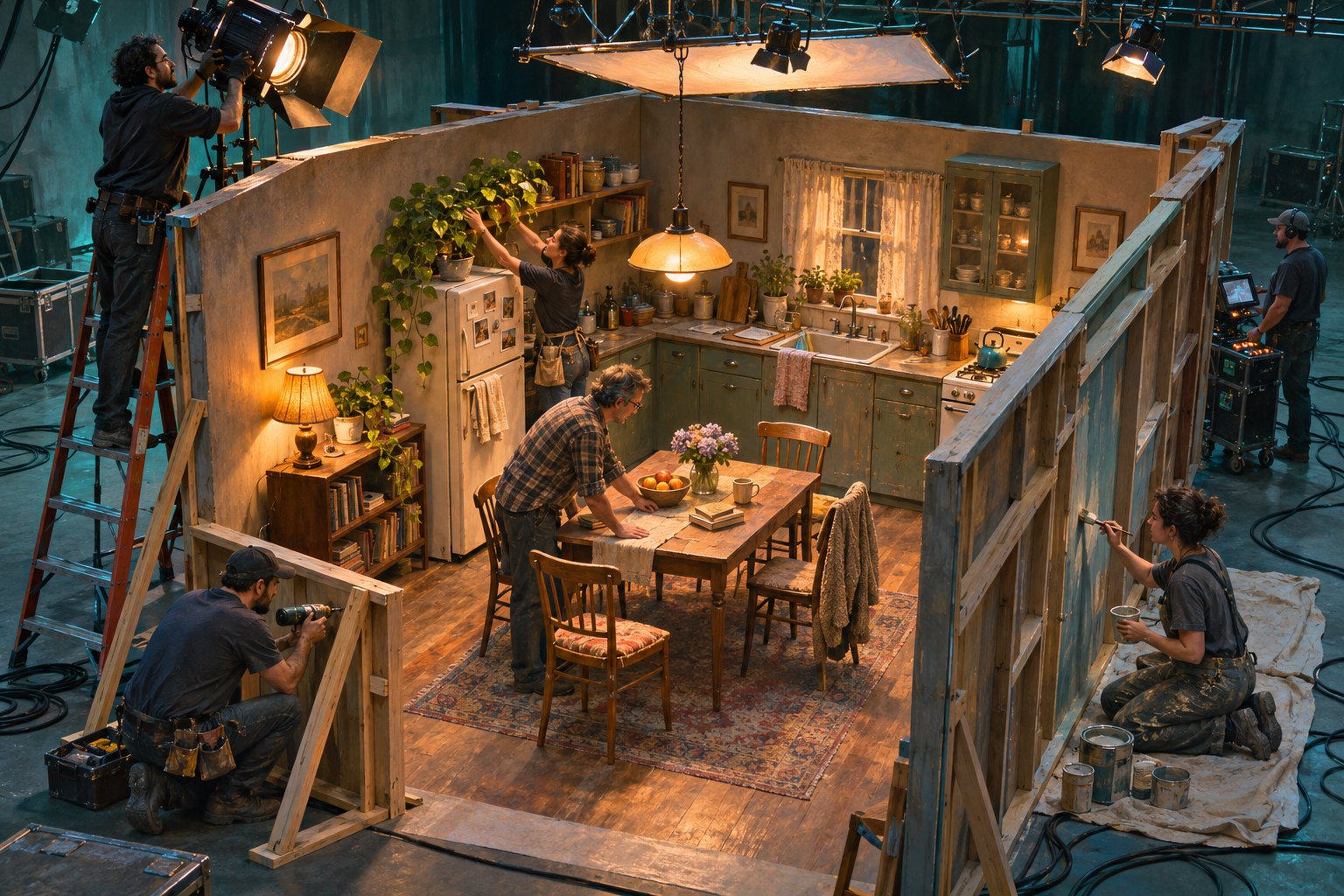
The illustration above represents that collective work. A convincing domestic scene depends on more than an actor entering a room. Its surroundings must support movement, lighting, sound, and the emotional logic of the encounter. Even details that barely register consciously can help the performance feel grounded.
That makes preserving craft a more persuasive artistic goal than preserving a postcard image of Hollywood. A city’s filmmaking identity includes the knowledge needed to construct believable worlds, including worlds that look nothing like the city itself.
More production and more distinctive movies are separate goals
A federal incentive, if established, would need to be evaluated according to its actual rules and results. Its existence alone would not show that films had become more adventurous, more observant, or more connected to their settings. Those are creative judgments requiring attention to the finished work.
Additional resources might protect an unusual location. They might also support a familiar spectacle. A producer might use savings to extend a schedule, absorb another expense, or change the financing arrangement. Without project-level evidence, assigning an artistic benefit to an incentive would be speculation.
This distinction also informs our discussion of what cultural support could mean for independent filmmaking: backing creative activity and enabling creative independence are related ambitions, but one does not prove the other.
Public evaluation should therefore keep economic evidence and artistic criticism distinct. Employment, expenditure, and program costs belong in an assessment of public value. Character depth, visual imagination, and emotional credibility belong in a review. Neither set of judgments should substitute for the other.
How viewers can recognize a setting that matters
When watching a new release, three questions can reveal whether its environment contributes something substantial:
- Does the space influence a decision? Look for moments when distance, privacy, visibility, or access changes what a character chooses.
- Do different characters experience the same place differently? A room might offer comfort to its owner and humiliation to a visitor. Strong staging makes that difference legible.
- Would relocating the scene change its meaning? If almost any backdrop would work, the setting may be decorative. If the scene depends on that environment, production design and storytelling are working together.
These questions are not a demand that every movie embrace realism. Artificial worlds can be extraordinarily specific. What they require is consistency: surroundings that respond to the story’s emotional and physical rules.
The creative opportunity behind the county’s position
Los Angeles County’s backing of a federal film tax credit deserves attention as a production-policy development. Its artistic significance remains a possibility to examine, not a result to announce.
The deeper opportunity is to sustain the conditions in which filmmakers can choose environments deliberately and give skilled collaborators time to make those environments convincing. That could serve an intimate apartment drama as meaningfully as a large production.
For audiences, the reward would not necessarily be more skyline shots. It would be movies in which people seem to belong somewhere: characters whose rooms reveal their compromises, whose journeys carry a cost, and whose surroundings make their choices understandable. Political support cannot promise that achievement. The films themselves would have to deliver it.
Original content by this site's editorial team. Published: November 17, 2026 at 20:46:39 PST (Los Angeles time)