Josh Giuliano is set to direct Occupant, a horror film for Blumhouse Atomic, according to Deadline. For readers looking for the essential news, that director-and-project pairing is the starting point. The announcement gives audiences a filmmaker to follow and a title to consider; it does not, by itself, establish the story, its characters, or how effectively the finished movie will frighten anyone.
This is a spoiler-free critical preview. There is not enough verified story material here to offer a scene-by-scene review, quote dialogue, or interpret an ending. What can be explored is the creative question Giuliano’s assignment raises: how might a horror film make the person experiencing fear matter as much as the thing causing it?
What the Occupant announcement actually tells us
The useful distinction is between an announced directing assignment and evidence of a film’s dramatic identity. Giuliano’s involvement identifies who will guide the movie’s realization. The horror designation establishes a broad genre. Neither tells us whether Occupant concerns supernatural events, human violence, psychological uncertainty, or something that crosses those boundaries.
For anyone searching for an Occupant release date, cast list, or plot explanation, those details require separate confirmation. A directing announcement should not be treated as a release calendar. It also cannot support assumptions about a rating, a particular kind of monster, or connections to another movie.
That leaves room for curiosity without requiring a premature recommendation. My interest is in the relationship between this unusually impersonal title and the intimate experience horror can create. That is an editorial response to the title, rather than a description of Giuliano’s intentions.
A title that identifies a person by their location
An occupant is someone who occupies a space. The word tells us where a person stands in relation to a place while revealing almost nothing about who they are. It lacks the warmth of resident, the welcome of guest, and the accusation of intruder. That emotional distance makes it an intriguing horror title.
Read as language alone, Occupant invites a question about recognition: who gets regarded as a person, and who gets reduced to a presence? Someone might be entirely at home in a room while another person sees their being there as a problem. The unease comes from the competing interpretations, even before any threat enters the picture.
This reading does not establish a domestic setting or a conflict over property. The film may use its title differently. Still, the word’s ambiguity offers a useful way to approach future story information: pay attention to who applies the label, who receives it, and whether its meaning changes with perspective.
Whose fear will the audience be asked to share?
For my taste, the most compelling character-driven horror begins with a legible desire. A person wants privacy, reassurance, independence, acceptance, or simply an ordinary evening. Fear becomes more involving when it interrupts something specific. Survival matters immediately, but understanding what survival would preserve gives the suspense emotional depth.
That is the character question I would bring to Occupant once its premise is established. What does its central figure want before the frightening events begin? What would they consider a reasonable response? Which relationship or obligation might complicate that response?
These questions also help avoid the familiar habit of treating horror characters as puzzles whose errors viewers must spot. A decision that looks foolish from a theater seat may make sense to someone with limited information, conflicting responsibilities, or good reasons to distrust an apparent escape. A strong film makes those pressures understandable through behavior.

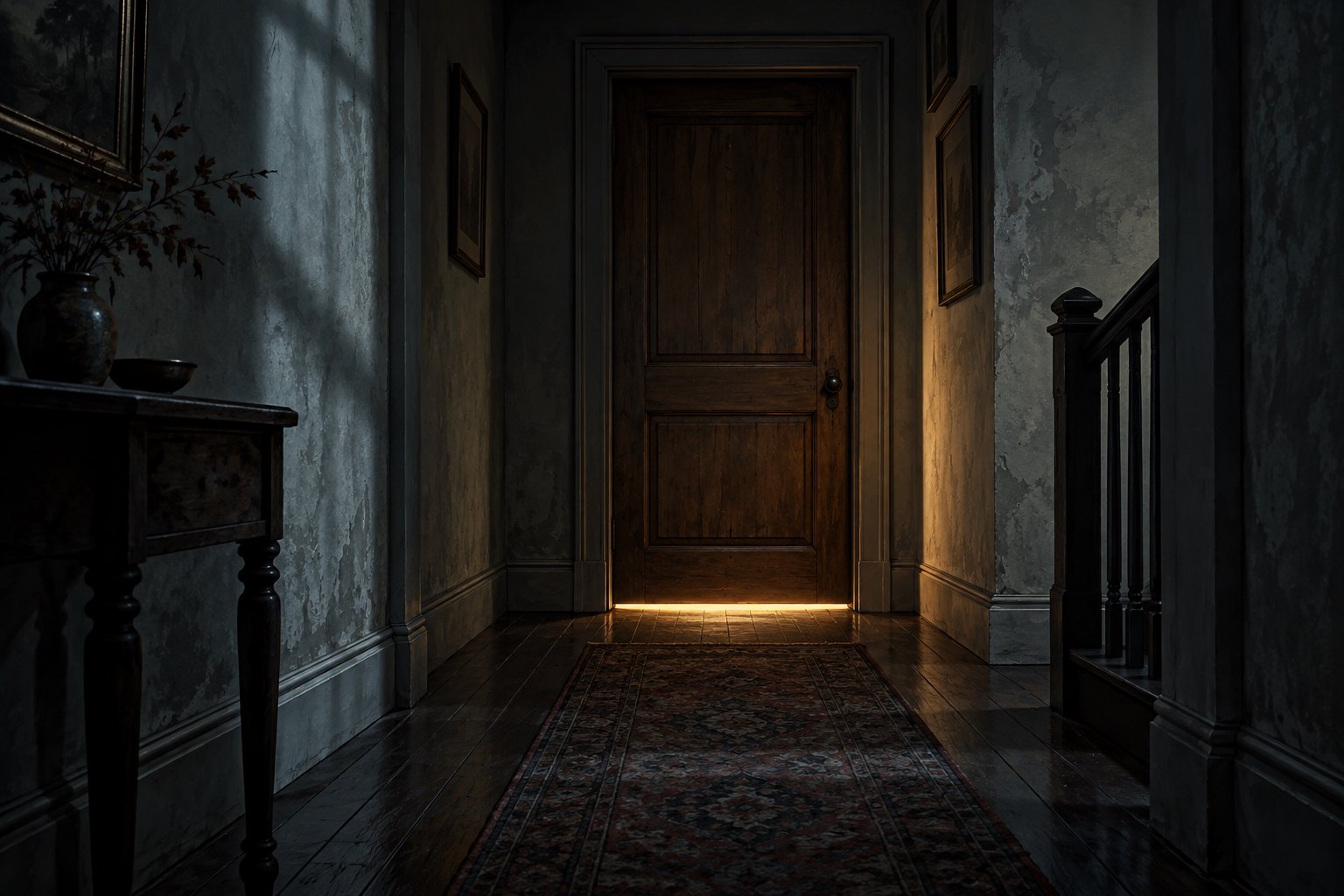
The illustrations accompanying this preview explore uncertainty and restricted perception; they do not depict scenes from Occupant. That distinction matters because an evocative image can suggest a premise almost as quickly as a title can.
How directing choices can make uncertainty personal
Giuliano’s assignment puts directing at the center of the news, making perspective a particularly useful subject for discussion. Consider a general filmmaking choice: a camera can show an empty space before a character enters it, or reveal that space only when the character looks. The first approach lets the audience anticipate. The second makes discovery a shared experience.
Neither is automatically more effective. What matters is the relationship the movie establishes between the viewer’s knowledge and the character’s. If we know more, suspense can come from waiting for recognition. If we know less, an ordinary reaction can become troubling because we cannot yet explain it.
Sound offers another choice. A noise heard clearly by both audience and character creates one kind of problem. A noise that remains indistinct creates another: the character must decide whether it deserves attention. For Occupant, these are possible criteria for eventual criticism, not claims about its sound design or visual style.
I would especially value consistency. A film can withhold explanations while allowing viewers to understand how its characters perceive events. Uncertainty becomes frustrating when information is concealed solely to postpone a reveal; it becomes involving when incomplete knowledge shapes a difficult decision.
What would make the next reveal meaningful?
A useful first look would give audiences a sense of a person under pressure. A striking image can sell atmosphere, but a small exchange or consequential choice can reveal the dramatic engine. The question is whether a viewer can describe what someone stands to lose beyond their life.
That emphasis connects with our discussion of character agency in Seth Rogen’s Figment movie: secrecy can preserve surprises, while the eventual story still needs people whose actions matter. It also informs our look at the dramatic questions facing Steven Knight’s James Bond script. Early project news becomes more interesting when it leads to specific standards for storytelling.
The deeper possibility in Occupant
The title’s strongest implication, to my ear, is the difference between being present and being understood. Calling someone an occupant acknowledges their existence while leaving their history, attachments, and wishes outside the frame. Horror could make that distance frightening by bringing us close to the person the label obscures.
Whether Giuliano’s film pursues that possibility remains to be seen. The directing announcement provides a reason to follow Occupant; a judgment on the movie must come from the movie itself. The most promising outcome would be a film that gives its title a more personal meaning by the end—because we have come to understand exactly who occupies its story, and why their experience matters.
Original content by this site's editorial team. Published: September 12, 2026 at 23:22:47 PDT (Los Angeles time)