
Johnny Depp’s Ebenezer led the box office on opening day, according to Variety. That gives Ti West’s Christmas adaptation an immediate commercial headline. It also creates an opportunity to look past the star attraction toward the story’s more uncomfortable question: what does a wealthy, wounded man owe the people whose lives he makes harder?
The opening-day result and the character’s moral accounting belong to different conversations. Our earlier analysis of Ebenezer’s opening-weekend expectations considered the financial picture. Here, the focus is Scrooge, his relationships, and the dramatic choices described in the film’s official production coverage.
Scope and spoilers: This is a critical companion based on verified character and production information, rather than a firsthand assessment of the completed film. It discusses the adaptation’s premise and character relationships. No unverified screen dialogue or ending details are presented as fact.
The opening-day lead brings a familiar character back into focus
TheWrap independently reported an opening-day gross of $6.7 million from 3,535 locations. That is a concrete snapshot of initial business; it does not establish what viewers thought about the performance or why they bought tickets. [TheWrap’s opening-day report](https://www.thewrap.com/creative-content/movies/ebenezer-johnny-depp-saturday-box-office-20-million/)
For a character-focused reading, the useful question is what those viewers encounter beneath the recognizable name. Scrooge is unusually vulnerable to becoming shorthand: the scowl, the money, the refusal to celebrate. Familiarity can make an audience recognize him before it has actually considered him.
Paramount identifies Depp as Scrooge in West’s adaptation of Charles Dickens’ A Christmas Carol, written by Nathaniel Halpern and released theatrically November 13, 2026. Its documented premise follows a supernatural confrontation with the past, present, and future. The PG-13 rating for frightening material also matters for families expecting an entirely gentle holiday outing. [Paramount’s film guide](https://www.paramountplus.com/sneak-peak/ebenezer-everything-you-need-to-know/)
Scrooge’s pain can explain his cruelty without excusing it
In Paramount’s production feature, Depp describes approaching Scrooge as someone who withdrew because caring had become painful. That provides an intelligible psychological foundation: emotional isolation becomes a defense that has outlived whatever first made it necessary. [Paramount’s cast and production feature](https://cms-corp.paramount.com/news/inside-ebenezer-with-its-all-star-cast)
As an interpretation, this is promising because it gives the miser something to protect besides money. A man who simply enjoys cruelty offers one kind of story. A man who mistakes emotional numbness for safety offers another: every invitation to care threatens the arrangement that allows him to get through the day.
But sympathy needs limits. Understanding how someone became harmful does not settle what they owe the people they hurt. An adaptation can explore Scrooge’s history while keeping his responsibility visible. The dramatic test is whether his suffering deepens our understanding of his choices or becomes a reason to stop examining them.
That distinction is especially important in a star-centered film. An expressive performance can command attention so thoroughly that everyone else becomes evidence of the protagonist’s complexity. Scrooge’s story needs the opposite pressure: other people must become more real to him, and therefore more real to the audience.
Bob Cratchit makes generosity a practical question
The same official production feature describes Rupert Grint’s Bob Cratchit through the competing pressures of exhausting employment and responsibility to his family. His warmth coexists with frustration. That combination gives the character an emotional life beyond patient endurance.
From Bob’s perspective, his employer’s personality is not an entertaining eccentricity. It affects the conditions under which he works and the energy he can take home. Reading the relationship through the employee changes the scale of the story. A small decision for the powerful person may occupy an enormous part of someone else’s day.
My critical preference is for a Scrooge adaptation that allows this imbalance to remain uncomfortable. Bob’s kindness should express his character, rather than reassure viewers that hardship has done no lasting damage. Good spirits are not proof that someone has been treated well.
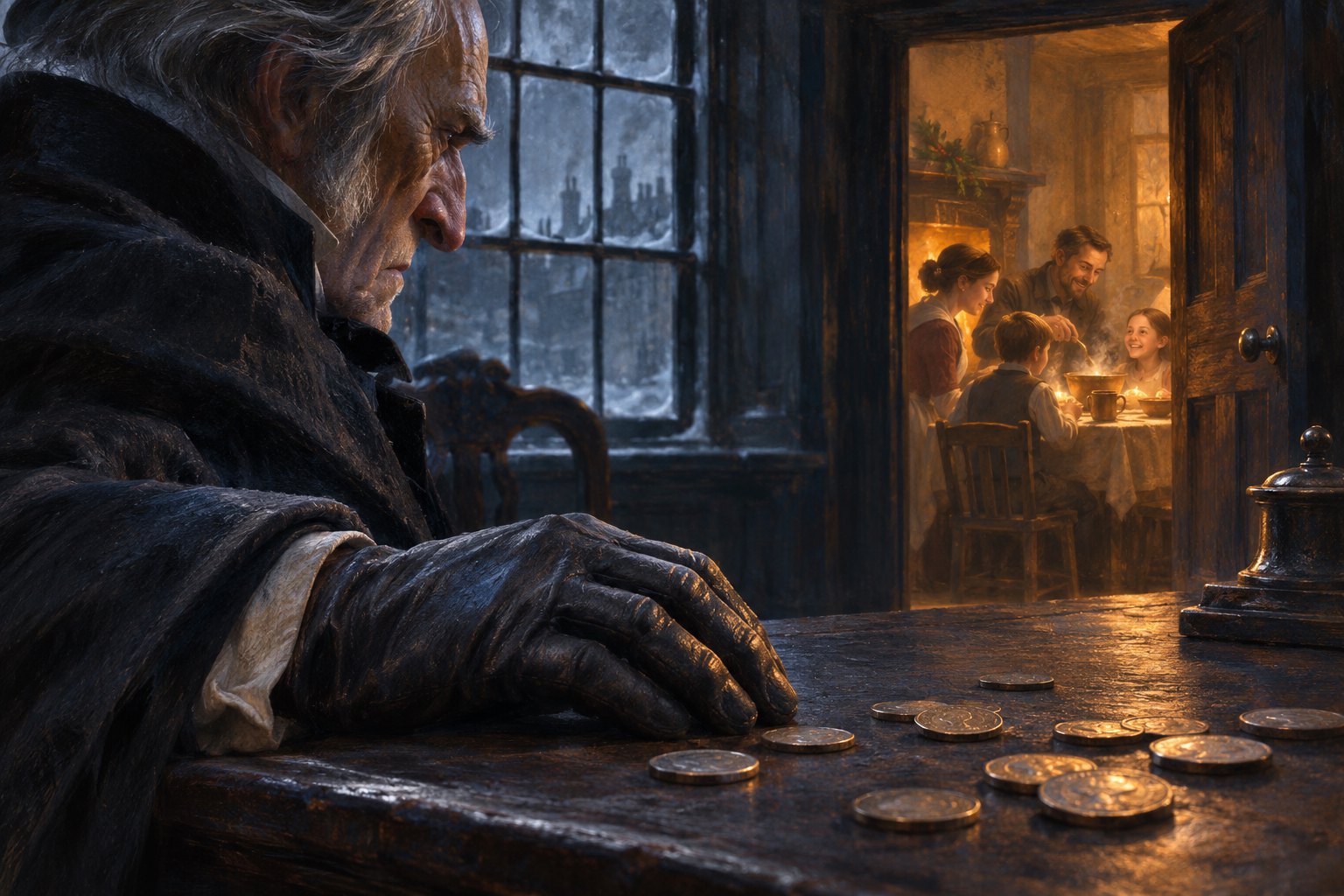
This is where redemption becomes measurable. A changed feeling matters, but a changed relationship requires action. Viewed from the counting room’s less powerful side, the compelling question is whether Scrooge’s awakening changes what another person can reasonably expect from him.
Fred’s invitation has an emotional cost
Paramount’s account gives Sam Claflin’s Fred a specific motivation: connection with his uncle also offers connection with his late mother. His optimism therefore has a personal stake. Family affection is tied to memory, rather than functioning only as seasonal cheer.
That detail invites a more sympathetic reading of persistence. Repeatedly reaching toward a resistant relative can look effortless from the outside. From within, it can involve hope, grief, and the risk of another rejection. Fred’s desire for contact deserves attention independently of whether it eventually benefits Scrooge.
The distinction also protects Fred from becoming a moral prop. He need not exist solely to demonstrate how forgiving someone ought to be. A persuasive family relationship leaves room for the generous person to have needs, limits, and disappointments.
It is the same performance question raised in our discussion of why a character’s perspective matters more than casting excitement: a recognizable actor draws attention, but the role becomes meaningful through particular desires and relationships.
Why the ghosts should do more than frighten him
One documented adaptation choice is that Ian McKellen’s Marley appears alive as well as in his spectral role. Without assuming how those scenes play, the structural possibility is clear: a warning about consequences can carry additional weight when the person delivering it has also been understood as a living participant in the same world.
The broader supernatural framework offers three different challenges to Scrooge’s self-understanding. Memory can trouble the account he gives of himself. Attention to the present can expose what his habits allow him to overlook. The future can challenge his assumption that postponing change leaves every option available.
Those are interpretive functions, not claims about particular shots or scenes. Horror can make them immediate, but fright alone cannot complete the moral argument. A person may fear punishment without developing concern for anyone else.
For that reason, the most revealing question to carry into Ebenezer is whether the supernatural encounters enlarge Scrooge’s attention. Does he become concerned only about his own fate, or capable of recognizing another person’s experience as important in itself?
The deeper issue is responsibility after recognition
The opening-day lead establishes that Ebenezer attracted an initial audience. Its lasting interest as a story rests on a more demanding transformation: a man accustomed to protecting himself must learn to take other lives seriously.
Seen through Scrooge, redemption concerns the possibility of change. Seen through Bob and Fred, it concerns whether that change can be trusted. Holding those perspectives together prevents the emotional release of forgiveness from swallowing the harder work of repair.
That is the interpretation worth testing against the film: generosity becomes meaningful when it changes somebody else’s circumstances. Scrooge’s most consequential discovery is not simply that he wants another chance. It is that other people have been living with the consequences of his choices all along.
Original content by this site's editorial team. Published: November 14, 2026 at 11:37:36 PST (Los Angeles time)