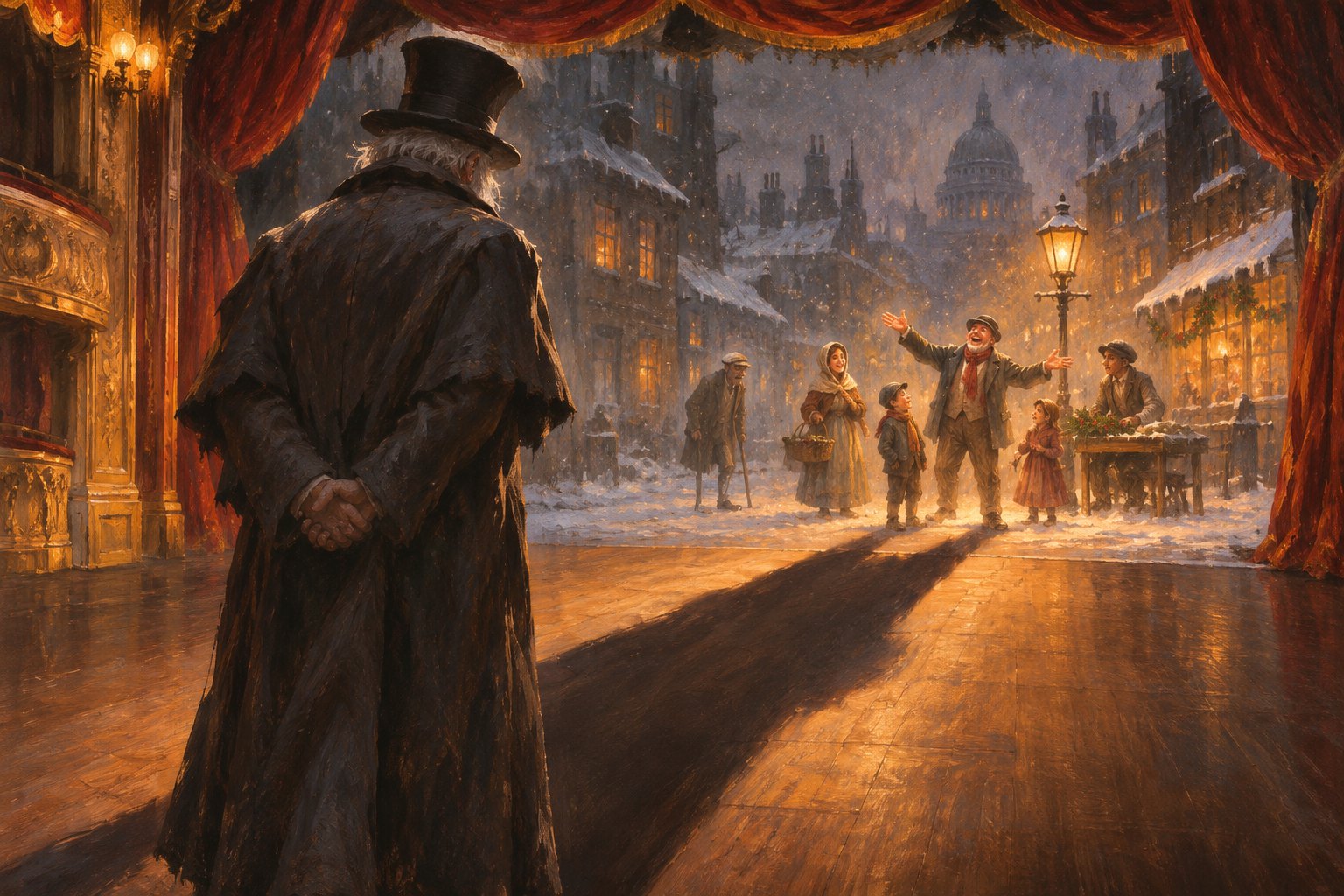
Johnny Depp is the focus of Vulture’s sharply negative assessment of the lead performance in Ebenezer. That judgment raises a useful question for anyone considering the film: can a story about learning to value other people work when its central actor becomes the overwhelming attraction? Scrooge must command our attention, but the people he overlooks must eventually command it, too.
Vulture’s headline establishes its verdict on Depp; it does not, by itself, establish which acting choices justify that verdict. Calling a performance the weakest element is a critical judgment, not a fact that another reviewer can simply inherit. The discussion here examines that judgment through the characters and dramatic structure of Charles Dickens’s A Christmas Carol, rather than claiming a firsthand screening verdict.
Spoiler note: The following discusses major developments and the ending of Dickens’s original story. Quotations come from that text and are not presented as verified dialogue from Ebenezer. The illustrations are conceptual literary images.
The problem is dominance, not simply exaggeration
Scrooge invites a large performance. His contempt is theatrical, his habits are extreme, and his resistance to ordinary pleasure can be funny. A restrained interpretation is not automatically a better one. The relevant distinction is between expressive behavior that reveals a character and expressive behavior that repeatedly asks us to admire the performer.
Consider “Bah! Humbug!” In Dickens, the expression dismisses an invitation to participate in life beyond business. Its dramatic value lies partly in what it does to another person: it interrupts warmth, rejects goodwill, and closes a conversation. Treated only as a recognizable catchphrase, it risks becoming an applause cue for precisely the behavior the story must challenge.
That is the strongest question suggested by the criticism of Depp. Does a conspicuous performance make Scrooge’s defensive habits legible, or does it make those habits the entertainment? The headline alone cannot answer. But it identifies why a leading performance can matter disproportionately in this particular story: the audience must eventually revise its relationship with the man it has been watching.
Bob Cratchit gives the story a different center
From Scrooge’s perspective, Bob Cratchit is an expense. From Bob’s perspective, Scrooge controls the conditions under which he earns a living. Those are radically different ways of occupying the same room. An adaptation gains substance when the audience can feel both, even while the employer dominates the conversation.
Bob’s restraint should not be confused with an absence of feeling. A worker who cannot safely answer back has reasons to measure his words. The space between what he experiences and what he permits himself to express offers an actor considerable dramatic material. A pause can reveal economic dependence more effectively than a speech explaining it.
Dickens also gives Bob a household in which his employer is not the most important person. That shift matters. The Cratchits have affection, anxieties, and rituals that exist independently of Scrooge’s eventual generosity. Their humanity precedes his recognition of it.
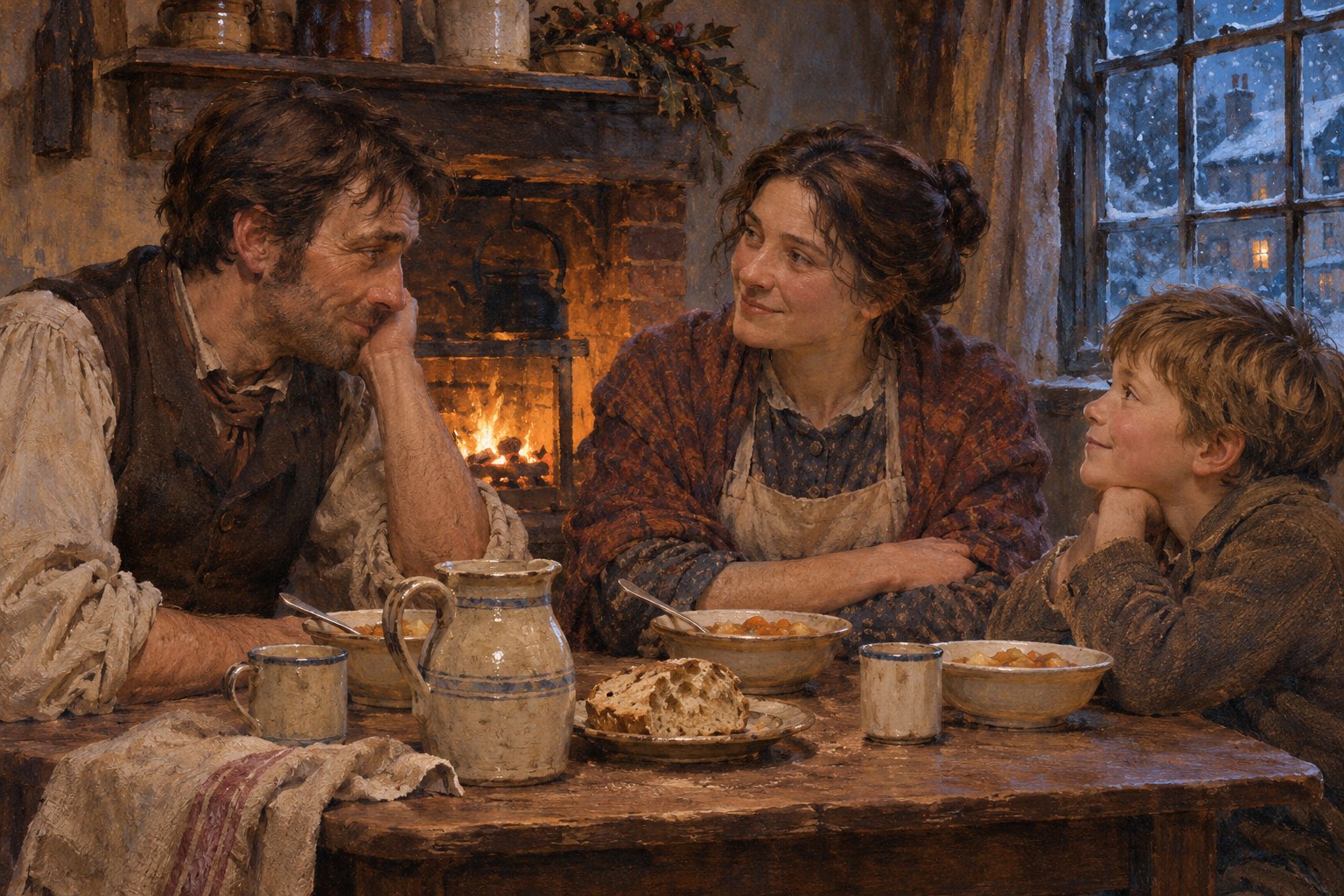
My standard for a persuasive adaptation would therefore include a simple test: can we describe what Bob wants without mentioning Scrooge’s redemption? If the answer includes security, time with his family, and his child’s well-being, the story has preserved his independent stakes. If he exists chiefly to demonstrate that the protagonist has become generous, something essential has narrowed.
Belle is a person making a decision
Belle, the woman the younger Scrooge loses in Dickens’s story, presents a related challenge. Her departure can easily become one more reason to feel sorry for him. Yet her perspective is more demanding: she recognizes that the values governing their relationship have changed and acts on that recognition.
Her decision should carry weight beyond the pain it causes Scrooge. She is evaluating the future available to her. Money has become an organizing principle that leaves less room for mutual affection, and she refuses to pretend otherwise. Reading the episode this way preserves her judgment instead of reducing her to a beautiful emblem of his regret.
For a star-centered adaptation, this is a revealing pressure point. Does the emotional emphasis allow the departing person a future, or does everything become a close-up of the man left behind? That is a question about framing, editing, and scene construction as much as acting. A performer cannot single-handedly determine how much room another character receives.
Fred offers connection without surrendering his own happiness
Scrooge’s nephew Fred provides another corrective to the protagonist’s worldview. In Dickens, he extends an invitation despite rejection. His generosity is not proof that rejection does no damage; it shows that he chooses to keep a possibility open.
Fred also enjoys a social world that does not depend on his uncle’s participation. This gives his invitation dignity. He is offering Scrooge access to something already alive, rather than waiting for the wealthy relative to make the occasion meaningful.
That distinction helps explain why supporting characters need more than likability. They need lives that remain imaginable when the lead leaves the frame. Our discussion of star presence and dramatic intimacy in Ramayana approaches a related issue: a commanding central figure still needs relationships that feel reciprocal.
What would make the criticism of Depp persuasive?
A convincing performance critique would move from a broad verdict to observable choices. It might examine whether reactions repeat regardless of whom Scrooge faces, whether vocal effects obscure shifts in thought, or whether scenes give other actors enough time to register an impact. Those are examples of evidence to look for, not claims about what Depp does in Ebenezer.
Equally, a defense should explain what the performance contributes. Stylization can expose vanity, make authority look absurd, or establish defensive habits that later break down. Calling an actor excessive settles very little unless the critic explains how that excess affects a particular exchange.
This emphasis on relationships complements our earlier discussion of Ebenezer’s atmosphere and emotional conviction. The question here is how much dramatic independence the people surrounding Scrooge retain.
Redemption means other people become harder to ignore
Dickens gives Marley the declaration “Mankind was my business.” Its force comes from expanding responsibility beyond the narrow measures by which Scrooge judges a successful life. The correction concerns what deserves attention as much as what deserves money.
Likewise, “God bless Us, Every One!” reaches beyond the individual who has undergone the most conspicuous transformation. The story’s emotional destination is shared life. Scrooge’s change matters because it alters his participation in that life and the conditions other people experience.
That makes the criticism surrounding Depp worth examining without treating it as a ready-made verdict. A Scrooge performance succeeds, in my reading, when its growing openness makes everyone else more visible. The deepest achievement would be to leave viewers remembering the people he finally learns to notice—not merely the spectacle of his discovery.
Original content by this site's editorial team. Published: November 13, 2026 at 00:44:27 PST (Los Angeles time)