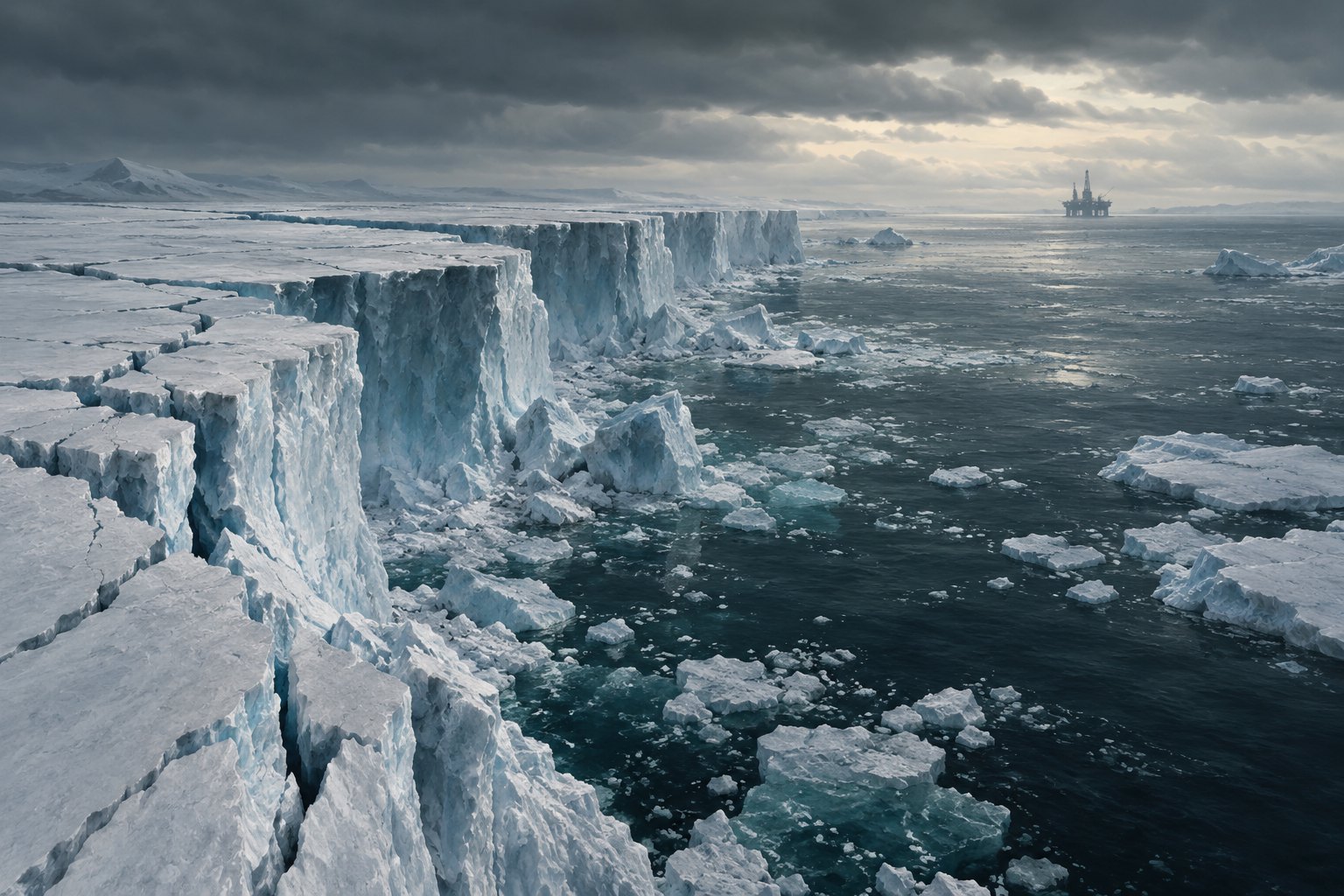
Digger draws on real environmental concerns, but that does not make its escalating catastrophe a scientifically established scenario. Ice shelves can fracture, warming can destabilize ice, and methane can contribute to warming. The crucial question is whether those processes connect at the speed and scale required by the movie. Its recognizable ingredients warrant attention; its complete disaster mechanism needs more evidence than a dramatic premise provides.
Spoiler notice: This analysis discusses the reported setup and selected dialogue. It examines documented scenes alongside established science, rather than offering a firsthand assessment of the complete film.
The emergency begins with a failure to listen
In Alejandro G. Iñárritu’s film, Tom Cruise plays Digger Rockwell, an oil magnate confronted with trouble at a Greenland drilling operation. Jake Coyle’s Associated Press review describes scientific concern about a glacier crack and a seabed methane leak, followed by the separation of an enormous ice shelf called Judy that threatens Europe. Digger’s response to the early warnings includes a demand for more “hustle” in oil production. Those are reported plot details, not findings about how a real Arctic emergency would unfold. [Associated Press review](https://www.dailyherald.com/20261001/movies/movie-review-in-digger-a-dr-strangelove-for-the-climate-change-era/)
The studio’s premise places the character’s motivation in unusually revealing terms: he wants to establish himself as humanity’s rescuer before the catastrophe he caused destroys everything. That makes reputation part of the emergency from the outset. [Official film synopsis](https://www.diggermovie.com/synopsis/)
My reading of that premise is that the rescue fantasy contains the central trap. A person who needs to be indispensable may struggle to accept a solution that requires stepping aside. For viewers, the useful character question becomes whether Digger can accept responsibility without demanding ownership of the recovery.
What the ice science supports
An ice shelf is floating ice connected to ice on land. Its breakup can matter enormously, but floating ice and grounded ice play different roles in sea-level change. The National Snow and Ice Data Center explains that a floating shelf’s collapse does not directly raise sea level in the way that additional land ice entering the ocean does. Losing a shelf can nevertheless remove resistance that slows the glaciers feeding it, allowing their flow toward the sea to accelerate. [NSIDC explanation of ice shelves](https://nsidc.org/learn/parts-cryosphere/ice-shelves/why-ice-shelves-matter)
That distinction is essential when evaluating Digger. A giant piece of ice breaking loose is not, by itself, an explanation for every subsequent threat. A credible assessment would need to distinguish the breakup, the detached ice’s movement, any resulting waves, and changes in the flow of grounded ice. Each requires its own physical explanation.
There are real mechanisms behind ice-shelf weakening. Warm air can produce surface meltwater that penetrates and enlarges cracks; warmer ocean water can thin a shelf from underneath. These are interacting processes, rather than a universal switch that turns one fracture into a predetermined catastrophe. [NSIDC account of ice-shelf breakup](https://nsidc.org/learn/parts-cryosphere/ice-shelves/science-ice-shelves)
The fair verdict is therefore limited but useful: the movie’s vulnerable ice has a basis in reality. The reported trajectory toward continent-scale destruction cannot be validated simply by pointing to real glacier retreat.
Methane is a real concern, with an important missing step
Methane complicates the picture because releasing gas at the seabed is not equivalent to adding the same quantity to the atmosphere. A 2017 review by Carolyn Ruppel and John Kessler explains that sediment and ocean processes can intercept methane, while bubbles frequently fail to carry it all the way to the sea surface. Its atmospheric effect depends on what actually escapes. [Ruppel and Kessler’s methane-hydrate review](https://www.usgs.gov/publications/interaction-climate-change-and-methane-hydrates)
This does not make underwater methane harmless. The U.S. Geological Survey notes that processes converting it into carbon dioxide can contribute to oxygen loss and acidification in seawater. It does mean that an environmental assessment needs more than the sight of escaping bubbles. [USGS explanation of gas hydrates and the environment](https://www.usgs.gov/programs/coastal-and-marine-hazards-and-resources-program/science/gas-hydrate-and-environment)
For Digger, the unresolved questions concern quantity, depth, duration, and the route from the leak to the claimed consequences. Without those details, neither an exact accuracy score nor a confident dismissal would be justified. Scientific vocabulary can identify a legitimate hazard without proving a screenplay’s entire sequence of events.
Why the language of power matters
Two reported phrases sharpen the character conflict. President Compson, played by John Goodman, calls the situation “a pickle.” Digger later describes oil as “the mother’s milk of Earth.” Both appear in Coyle’s account of the film. [Associated Press review](https://www.dailyherald.com/20261001/movies/movie-review-in-digger-a-dr-strangelove-for-the-climate-change-era/)
As language, the first phrase makes an emergency sound manageable and familiar. The second turns an extractive industry into something nurturing and necessary. My interpretation is that these expressions reveal competing methods of avoiding an uncomfortable decision: minimize the problem, or make the activity behind it sound inseparable from life itself.

The distinction matters for a character-focused reading. Someone may understand a warning perfectly and still resist what it demands. More information cannot automatically solve a conflict over status, control, or whose losses count. Our related analysis of Digger’s scientist offers another perspective on that tension between knowledge and authority.
How much exaggeration can the satire carry?
A climate satire can compress events and magnify personalities. The critical test is what those choices help an audience understand. Exaggeration becomes useful when it makes a recognizable conflict clearer; it becomes less persuasive when spectacle supplies the causal argument that the story has not earned.
For that reason, scientific accuracy and dramatic effectiveness deserve separate judgments. A physically implausible emergency may still illuminate a convincing refusal to accept responsibility. Conversely, an accurate scientific explanation cannot guarantee that a character feels complex or a joke lands. Our discussion of Guillermo del Toro’s defense of Digger explores the related distinction between artistic ambition and achievement.
The deeper question: who gets to define a rescue?
The most productive interpretation of Digger begins with its protagonist’s need to be recognized as a savior. Measured against that desire, an effective response could look like personal defeat: conceding limits, accepting outside expertise, and allowing someone else to lead.
That is where the climate-accuracy question becomes a character question without ceasing to be scientific. Evidence imposes conditions that a powerful person cannot negotiate away. My provisional judgment is that the premise’s strongest idea lies in that collision. The physical disaster requires scrutiny; the moral test is whether saving people matters more to Digger than being seen saving them.
Original content by this site's editorial team. Published: October 3, 2026 at 19:00:24 PDT (Los Angeles time)