
Glee is returning at Disney+ and Hulu. Variety reports that a reboot is officially set, while Deadline describes the project as receiving a series order. That gives fans a concrete reason to anticipate more musical television, though it does not establish what the finished show will look or sound like.
The most interesting question is who will need the choir room this time—and why. The original series made that room a refuge, an audition, and a battlefield. Its students wanted acceptance, but they also wanted solos. Sometimes those desires supported each other. Sometimes they could not have been further apart.
For this critic, that contradiction is the strongest reason to revisit Glee. A successful return needs characters whose reasons for singing collide, rather than simply a collection of familiar songs and recognizable faces.
Original-series spoilers: The following commentary discusses the pilot and its character dynamics. It is not a review of the reboot’s unreleased episodes.
What the Glee reboot announcement establishes
The central news is straightforward: a new Glee project has been ordered for Disney+ and Hulu. The announcement should not be treated as confirmation of any particular returning performer, character relationship, song selection, or premiere date.
Even the distinction between a reboot and a revival matters. A reboot can rebuild a premise; a revival can continue an existing story. Reporting uses both terms around this return, but neither label alone tells viewers how much continuity the new series will retain. Familiar branding is not a plot synopsis.
That uncertainty leaves room for meaningful criticism without pretending to have seen the new show. The original gives us a standard against which to judge the eventual result: does singing change what the characters can admit, risk, or understand?
Rachel’s ambition was both armor and an obstacle
Rachel Berry offers the clearest expression of Glee’s central tension. In the pilot, she explains, “My gold stars are a metaphor for me being a star.” The joke works because she treats a tiny symbol of approval as evidence of an inevitable future.
Her certainty is funny, but it also reads as protective. If she can insist that recognition is coming, present humiliation becomes something temporary. The future star can endure what the lonely student cannot comfortably acknowledge.
Then comes the simpler admission: “I’m tired of being laughed at.” It punctures the performance of confidence. Rachel does not merely want applause because she enjoys winning. She wants to control the way other people see her.
That makes her an effective lead and a difficult ensemble member. A group can offer companionship, yet she also needs it to recognize her exceptional status. Her talent does not erase that conflict; it intensifies it. She has a credible argument for taking the spotlight, which makes fairness harder than simply telling an untalented bully to step aside.
A new central character need not imitate Rachel’s mannerisms. What matters is preserving this kind of friction between a sympathetic need and a frustrating method of pursuing it. Ambition becomes drama when it costs someone else something.
Finn shows why belonging carries unequal risks
Finn Hudson approaches the club from a different position. As a football quarterback, he already has a place within the school’s social structure. Singing threatens the terms on which that place has been granted.
His decision to participate in both football and glee club is therefore more revealing than a simple transformation from athlete to artist. He resists the demand to reduce himself to one acceptable identity. The conflict is about whether his peers will tolerate a version of him they did not authorize.
For Rachel, joining the club offers a possible escape from exclusion. For Finn, it risks exclusion from somewhere he already belongs. Putting those motives in the same rehearsal room gives an ordinary group activity dramatic pressure.
The pilot also complicates the adult encouragement behind that activity. Will Schuester uses planted marijuana to pressure Finn into joining. The result may help the choir, but the method deserves scrutiny. An inspirational outcome does not automatically make the teacher’s conduct admirable.
A return could draw strength from that discomfort. Adults who sincerely value artistic expression can still misuse authority. Letting students question those adults would deepen the premise rather than weaken its optimism.
The ensemble needs more than permission to stand behind a lead
Mercedes, Kurt, Artie, and Tina make the original club more than a setting for Rachel and Finn. Their presence creates the possibility of a community with different ambitions, insecurities, and standards of recognition.
But the idea of inclusion needs testing at the level of storytelling. Who gets to initiate a scene? Whose disappointment changes the next rehearsal? Who gets to be unreasonable without losing the audience’s sympathy?
Those questions matter because a musical ensemble can look inclusive while distributing dramatic importance narrowly. Someone can be visible in every group number and still have little influence over the story.
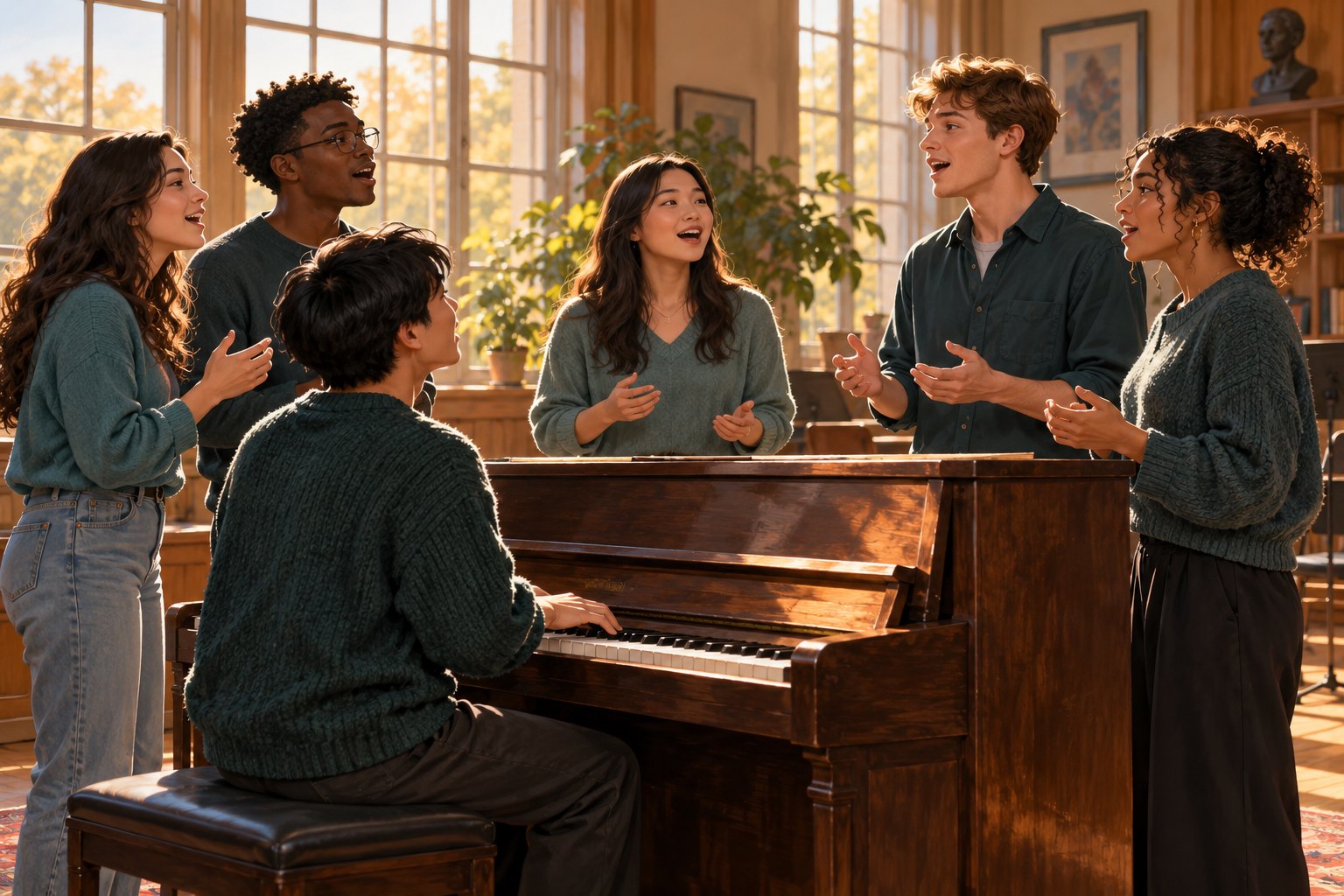
My preference for the reboot would be an ensemble whose members occasionally want incompatible things. One student might value artistic experimentation; another might want the reliable arrangement that wins a competition. These are possibilities, not announced storylines. Their value is that neither position needs to be foolish for the disagreement to hurt.
Our discussion of how television identities can trap the people on screen raises a related question about fixed roles. In scripted drama, the writers have a direct remedy: allow the supposedly predictable character to make a consequential, believable surprise.
A great musical number changes the scene around it
The pilot’s performance of “Don’t Stop Believin’” works as an expression of collective possibility. The song supplies uplift, but the characters give that uplift its stakes. People who have struggled to occupy the same social space briefly sound as though they belong together.
The important achievement is temporary unity. Singing does not settle every conflict or guarantee that these students will treat one another well tomorrow. It lets the audience hear a relationship they have not fully learned to sustain.
That is a useful standard for the reboot’s musical choices. A recognizable song can attract attention, but recognition alone does not explain why this character must sing it at this moment. The arrangement, the distribution of voices, and the reactions of listeners should reveal something that dialogue has left unresolved.
As our commentary on emotion and competition on Dedication Night explores, personal meaning and performance judgment can coexist without becoming interchangeable. Glee has room for the same tension: a number can matter deeply to its singer and still fail to persuade the room.
The deeper promise is a place for people who do not win
The reboot’s most revealing choice may be how it treats ordinary talent. A series about outsiders can accidentally suggest that exclusion becomes unjust only when the excluded person turns out to be extraordinary.
My reading of Glee’s more generous promise is broader: participation itself can change a life. Friendship, rehearsal, and the courage to be heard matter even when they do not produce a star.
Rachel’s hunger for distinction and Finn’s resistance to a single identity expose two sides of that promise. One wants to be exceptional; the other wants permission to be more than expected. A choir can accommodate both, provided it also makes room for the person who simply wants to sing.
Disney+ and Hulu have ordered another opportunity to explore that space. The creative test will come when the spotlight moves away from the strongest voice. Does everyone else still have a story worth hearing?
Original content by this site's editorial team. Published: October 21, 2026 at 07:14:42 PDT (Los Angeles time)