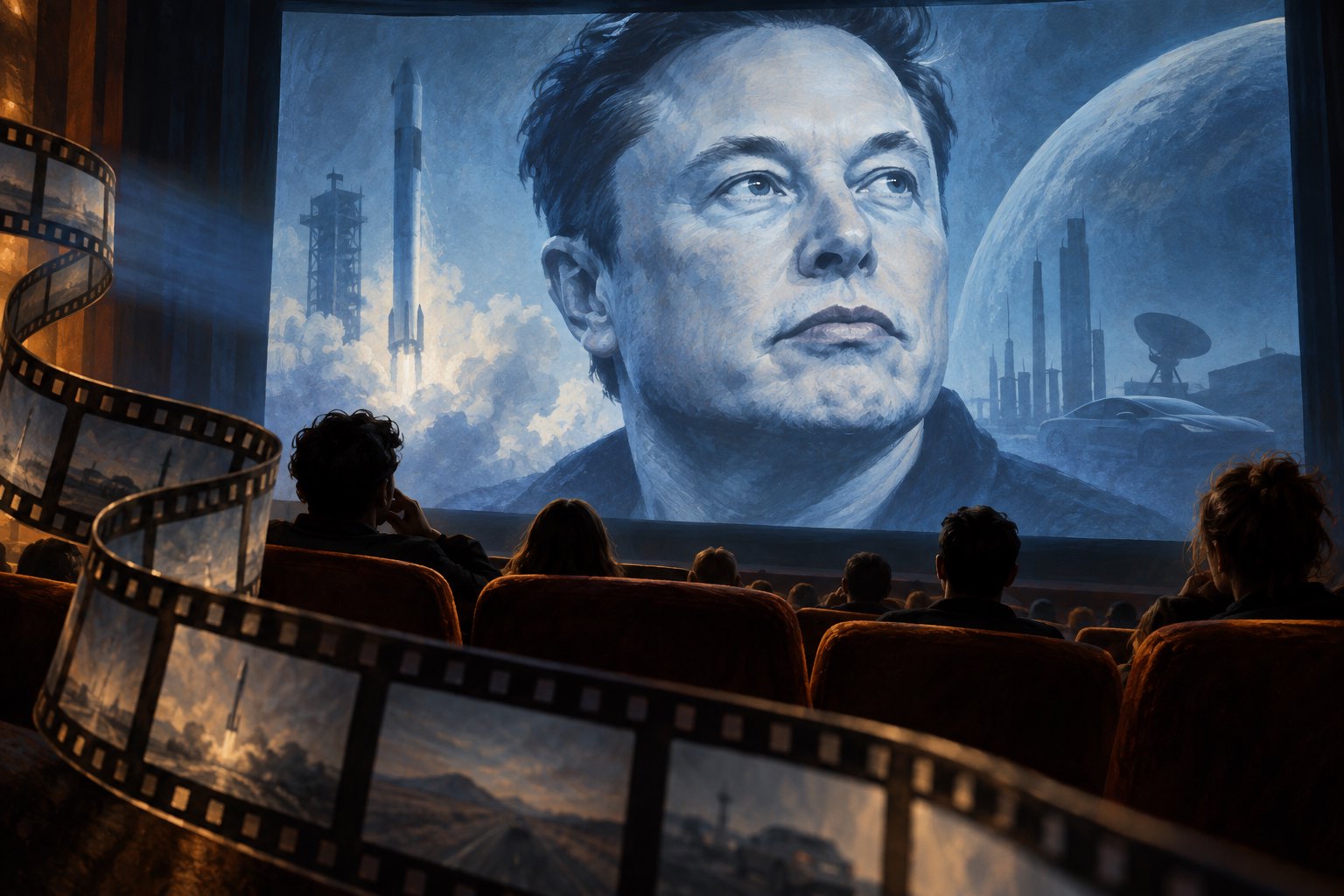
Elon Musk occupies enough public attention that a nearly four-hour documentary about him can sound like an endurance test before the projector starts. Alex Gibney’s Musk raises a more interesting possibility: sustained attention might reveal relationships that daily fragments conceal. The question is whether its length helps viewers understand the people and institutions surrounding Musk, or simply gives an already dominant personality an even larger stage.
The precise commitment is 225 minutes of film plus a 10-minute intermission, according to the [Venice festival listing](https://www.labiennale.org/en/node/20671). That distinction matters for anyone planning a screening: the programmed experience approaches four hours before trailers or introductions.
Structural spoilers follow. This is a critical analysis of the film’s documented construction and published screening accounts, rather than a firsthand assessment of every scene. Its central concern is duration: what an expansive documentary can explain, and what sheer accumulation cannot.
Length needs to change our understanding
A long documentary earns its space when later material alters the meaning of earlier material. Additional examples alone are insufficient. If the viewer has understood a pattern and another half hour merely repeats it, the running time becomes an obstacle to the argument.
That makes chronology an important formal choice in Musk. Ben Croll’s [screening account for TheWrap](https://www.thewrap.com/creative-content/movies/musk-review-alex-gibney-punishing-elon-musk-documentary/) describes a broadly chronological progression through business ventures, personal relationships, and political influence, with the post-intermission section picking up in 2020. He also reports Gibney’s organizing question: “And why did we give it to him?”
The pronoun is the useful provocation. It directs attention beyond Musk’s personality toward the audiences, organizations, and decision-makers that authorize a person’s importance. A biography organized around that question has a reason to revisit earlier success: viewers need to understand why confidence once seemed persuasive before considering where that confidence led.
There is also a danger in arranging a life as an uninterrupted march toward the present. Chronology can make contingent events feel inevitable. The strongest reading resists treating every early ambition as evidence of a predetermined destination.
The entrepreneur’s perspective: promises take time to test
Variety’s [published review](https://au.variety.com/2026/film/global/musk-review-elon-musk-alex-gibney-40069/) describes the documentary’s attention to SpaceX’s early launches and its treatment of Tesla co-founder Martin Eberhard’s place in the company’s history. Those strands bring two different questions into the same biography: what was accomplished, and who receives credit.
From the entrepreneur’s perspective, an unfinished project can always be described as a future achievement. Cinema has a useful advantage here: editing can place a promise beside a later outcome without accepting the speaker’s preferred timetable. Time becomes an instrument of evaluation.
But attribution deserves equal attention. When a company’s history becomes the story of one famous individual, the labor and judgment of other people can disappear. Listening for those contributions changes the viewing experience. A rocket launch becomes an occasion to ask whose expertise made the event possible, rather than merely another milestone in the protagonist’s ascent.
My view is that this is a stronger justification for an extended runtime than comprehensiveness. A film need not include every venture. It needs enough context to separate ambition, execution, ownership, and publicity—activities that a celebrity biography can too easily collapse into a single idea of genius.
The people around Musk should have time of their own
The festival credits identify participants including Justine Musk, Ashley St. Clair, Kara Swisher, Martin Eberhard, Zoë Schiffer, and Geoffrey Hinton. Their presence establishes a range of perspectives; it does not make their accounts interchangeable.
A former partner, a business colleague, and a journalist occupy different positions in relation to the subject. Each can know things another cannot. Each also speaks from a particular history. Good documentary analysis pays attention to those limits instead of turning every interview into another vote for the same conclusion.
Our earlier discussion of Musk’s contested personal narrative examines the struggle over who gets to describe him. The running-time question adds another measure: do the people speaking receive enough space to become intelligible on their own terms?
This is where a lengthy film can become more humane. A pause, qualification, or unresolved feeling may contribute less to a rapid argument than a sharp accusation, yet reveal more about someone’s experience. Conversely, collecting intimate testimony merely to intensify a portrait of the central figure risks making everyone else supporting material again.
What the intermission gives the audience

An intermission changes the conditions of attention. Viewers leave the sequence of images temporarily and recover some distance from its rhythm. That pause can be especially valuable in a documentary built around a forceful argument.
A useful question during the break is what has actually been established. Which conclusions rest on an interviewee’s recollection? Which depend on archival material? Which emerge primarily from the order in which information appears? These distinctions do not weaken criticism. They help an audience understand its basis.
The same concern informs our analysis of how documentary testimony shapes interpretation: access to a compelling speaker is the beginning of evaluation.
For Musk, the break also invites viewers to notice whether their curiosity has changed. Wanting to know what one man does next is different from wanting to understand how his decisions acquire consequences. A successful second half would deepen that shift.
Exhaustion is an effect, not a verdict
Gibney described the project to the [Associated Press](https://apnews.com/article/elon-musk-documentary-venice-film-festival-e4e9c5eca6e2656b54f1c639d339109f) as an examination of contemporary power. He also explained his interest in how commitment to an ostensibly beneficial mission can become permission to excuse harmful conduct. That is the director’s interpretive framework, rather than a neutral description of Musk’s motives.
The distinction matters because an overwhelming experience can feel conclusive. After hours of material, fatigue may resemble conviction. Viewers should still be able to identify the steps connecting the evidence to the argument.
One reported line from St. Clair compresses the film’s alarm into four words: “Elon is a nuke.” It is a memorable metaphor of destructive capacity. The documentary’s larger responsibility is to explain the mechanisms that a metaphor necessarily leaves out.
The deeper question is who deserves our attention
Four hours with Elon Musk is not automatically too much. Four hours that keep returning to the same personality judgment could be. The meaningful distinction is whether the additional time enlarges the viewer’s understanding of everyone affected by the central subject.
That is the most productive interpretation of this film’s scale. A biography can begin with a recognizable face and gradually reveal a network of work, trust, dependence, and institutional choices. Its achievement would be to make that network visible enough that the famous face no longer explains everything.
The best reason to commit to Musk, then, is an interest in how biography can expose the distribution of power. Its length deserves to be judged by the clarity it creates—and by whether the people outside its title finally become harder to overlook.
Original content by this site's editorial team. Published: September 10, 2026 at 15:54:42 PDT (Los Angeles time)