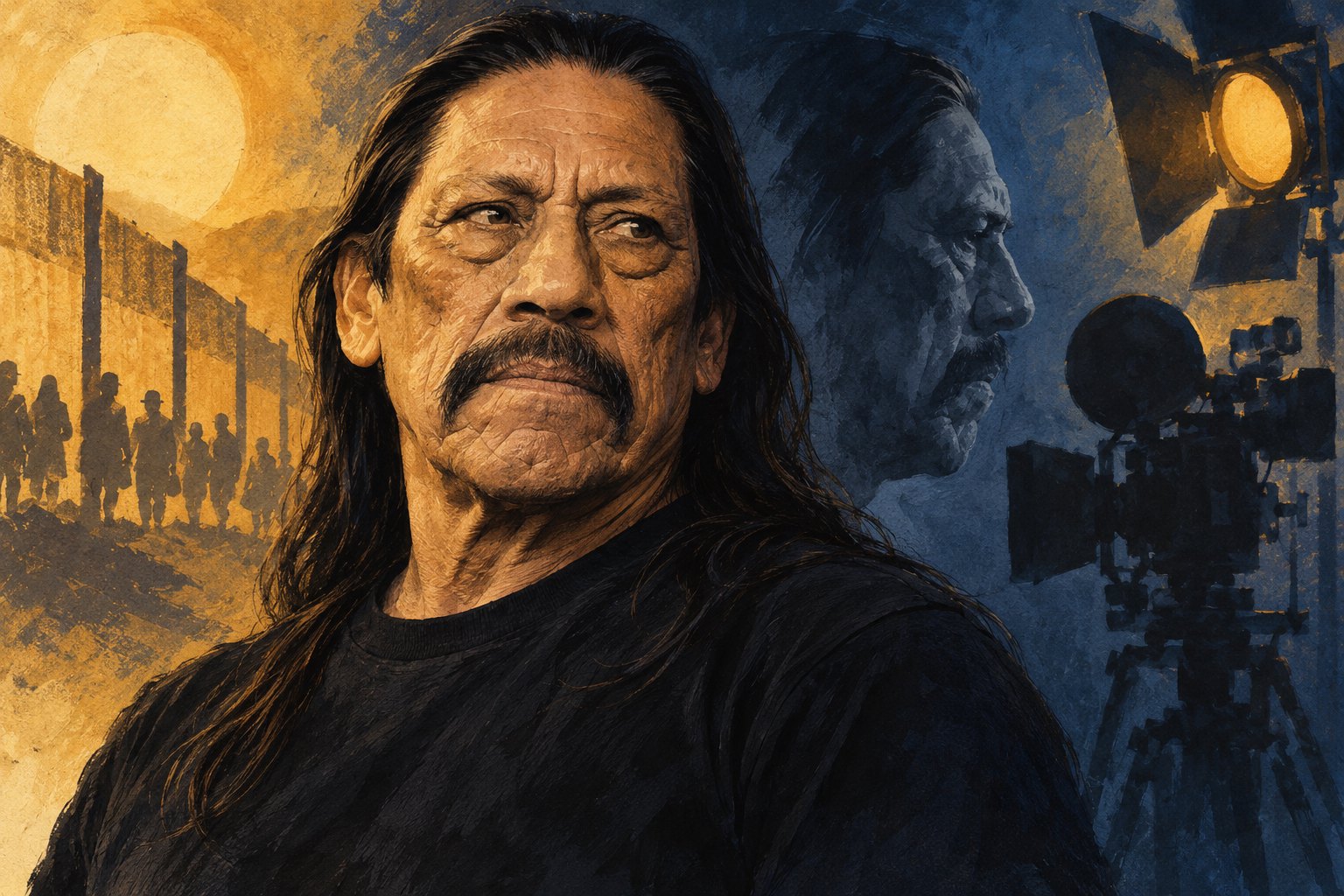
Danny Trejo has made his personal position explicit while addressing his involvement in the Daily Wire movie Pawn Shop. Variety’s coverage foregrounds his declaration: “I am not pro-ICE. I am pro-immigrant.” For readers wondering whether his participation establishes his support for the agency, that statement provides a direct answer about his expressed beliefs. It also leaves a separate question for film criticism: what meaning will his performance acquire within the movie?
The distinction matters because an actor can describe his convictions in a sentence, while a film communicates through the accumulated effects of scenes, performances, editing, and consequences. Trejo’s statement deserves to be understood on its own terms. Evaluating Pawn Shop requires attention to what the movie actually asks viewers to believe.
This is spoiler-free commentary on Trejo’s statement and the questions it raises for interpreting his screen role. It is not a review of the completed film.
What Trejo’s statement establishes
The language is unusually direct. Its first sentence rejects an institutional alignment; its second affirms solidarity with people. Read together, the two sentences resist treating participation in a movie as a complete description of the performer’s politics. Neither sentence is dialogue from Pawn Shop, and neither should be mistaken for a description of his character.
That distinction gives the statement its immediate value. Readers do not have to infer Trejo’s stated position from a casting announcement. They have his words. Whether they find those words sufficient to address their concerns is a matter of judgment, but an assessment should begin by representing them accurately.
The statement does not, by itself, establish what he knew about every aspect of the production, what creative influence he exercised, or how his work will appear in the finished edit. Assigning any of those conclusions to this short declaration would make it answer questions it does not address.
Our earlier discussion of creative responsibility and the reported crew departures approached the controversy through production participation. Trejo’s declaration introduces a more specific interpretive issue: how much authority an actor’s public explanation should have over our reading of his performance.
An actor’s beliefs and a character’s reasoning
Acting requires entering perspectives that may differ from the performer’s own. A convincing expression of anger, loyalty, fear, or prejudice is not automatically a personal confession. That basic distinction makes dramatic performance possible. Collapsing actor and character would make almost any morally complicated role impossible to discuss intelligently.
Still, audiences encounter a recognizable performer rather than an anonymous body delivering dialogue. Familiarity can bring trust, affection, skepticism, or expectations into a scene before the character has earned them. Casting therefore affects meaning even when it does not reveal personal belief. A viewer may understand that distinction and still question what a performer’s presence contributes to a project.
My view is that both considerations belong in the discussion. Trejo should not have fictional beliefs assigned to him simply because he accepts a role. His statement also cannot determine the political effect of the finished film. Personal intention and artistic effect are related questions, but they require different evidence.
The character question that matters most
A character-focused assessment of Pawn Shop should begin with motivation: what does Trejo’s character want, and what experiences make that desire intelligible? The answer must come from actual scenes. A character description, a publicity argument, or an actor’s explanation cannot substitute for the dramatic work of showing someone think and choose.
The next issue is agency. Does the character initiate consequential actions, reconsider assumptions, and bear the cost of decisions? Or does his presence principally validate someone else’s position? These are useful critical distinctions because a character can receive substantial screen time while having surprisingly little influence over a story’s moral direction.
A third issue is contradiction. People can feel attachment to a place, affection for another person, and discomfort with an institution simultaneously. Strong characterization allows competing commitments to remain visible. Whether Pawn Shop grants its characters that complexity is something a review must demonstrate with evidence, rather than assume from either praise or controversy.
How editing can change what a performance means

An actor supplies expressions, gestures, pauses, and spoken lines. Their significance also depends on placement. A reaction shot can suggest agreement, hesitation, or alarm according to what precedes it and how long it remains onscreen. Music can encourage admiration or unease. A scene’s ending can leave a challenge unresolved or make one participant appear decisively vindicated.
These are general features of filmmaking, not claims about particular sequences in Pawn Shop. They explain why an actor’s sincere understanding of a role cannot settle every question about the resulting movie. Viewers experience a constructed whole, including choices made beyond any individual performance.
The same distinction informs our examination of how warning signs should influence expectations for a movie: concerns can justify closer scrutiny without supplying the missing evidence for a verdict. Here, that scrutiny should focus on the relationship between the character Trejo plays and the perspective the film ultimately privileges.
What viewers can fairly look for
For anyone approaching Pawn Shop with Trejo’s declaration in mind, three questions offer a practical way to move beyond assumptions:
- Whose experience becomes understandable? Look for the people given motives, relationships, and room to explain themselves.
- Whose mistakes carry consequences? Notice whether the story examines favored characters as closely as their opponents.
- What does the resolution reward? An ending can reveal which choices the narrative treats as justified, even when earlier dialogue sounds more ambiguous.
Those questions do not require a movie to give every position equal weight. They ask whether its judgments emerge from persuasive drama. Political conviction can coexist with complex characterization; the critical task is to show how that relationship works in the film under discussion.
The deeper issue is who controls meaning
Trejo’s statement exposes a tension that extends beyond any casting controversy. A performer has authority to state his beliefs. A character has motives established within a fictional world. A film creates an argument through the way it arranges that world. Audiences bring their own experiences to the result. None of those perspectives automatically absorbs the others.
The most defensible reading, for now, is therefore precise: Trejo has publicly identified himself as pro-immigrant and rejected being characterized as pro-ICE. His participation in Pawn Shop does not erase that declaration. The declaration, in turn, leaves the movie available for independent scrutiny. An eventual review should follow the character’s choices closely enough to explain what the performance contributes—and whether the surrounding film supports, complicates, or limits that contribution.
Original content by this site's editorial team. Published: October 9, 2026 at 18:56:42 PDT (Los Angeles time)