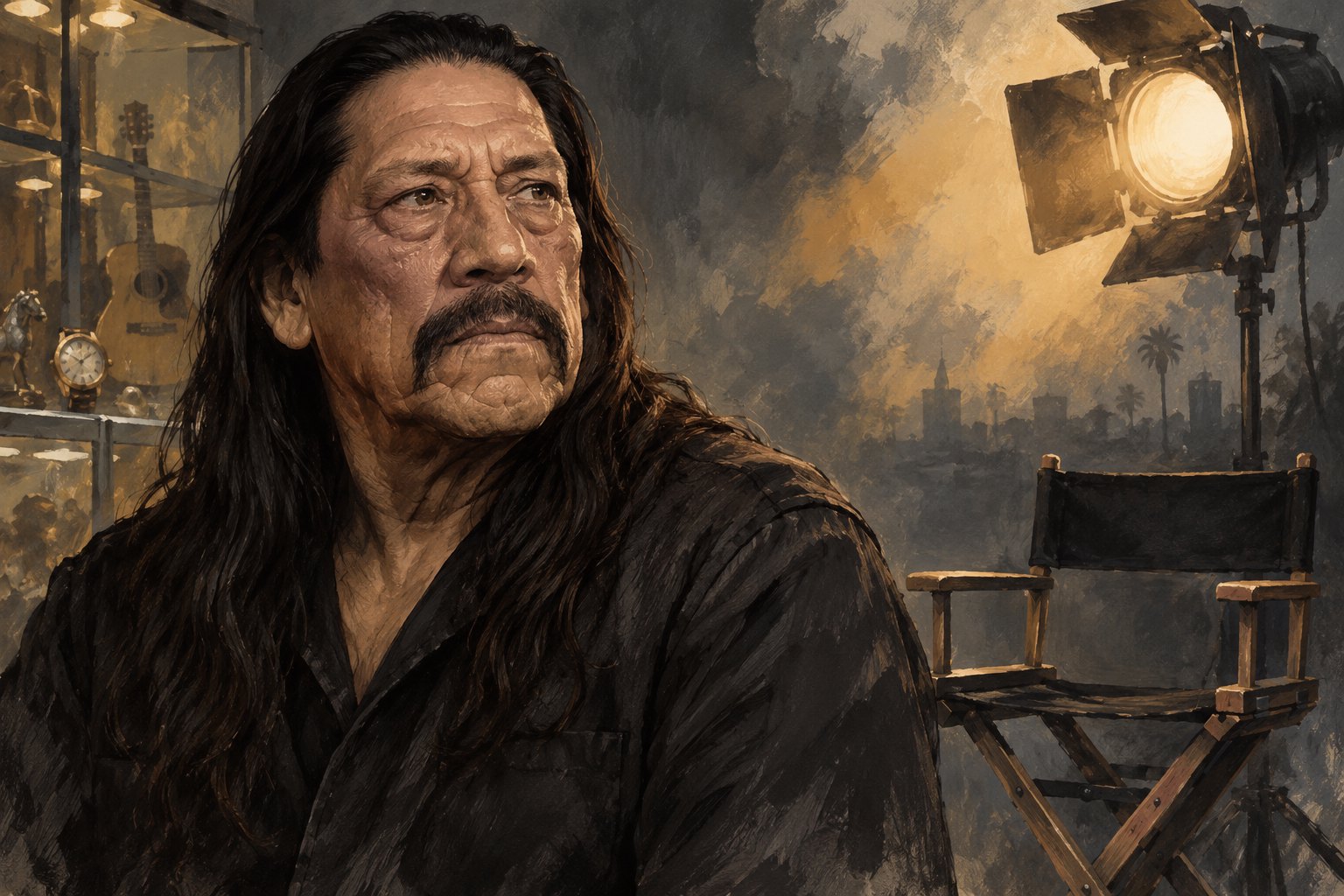
Danny Trejo says he is “not pro-ICE” amid backlash over the Daily Wire movie Pawn Shop, according to The Hill. His statement addresses the immediate question about his personal position on Immigration and Customs Enforcement. It also brings a familiar tension in movie culture into focus: how much should an actor’s participation tell us about the politics of a production?
The distinction matters in both directions. Taking a role does not establish agreement with every message associated with a movie. But an actor’s stated beliefs do not automatically settle questions about the work that actor helps bring to audiences. Trejo’s clarification deserves to be represented accurately, while his professional choice remains open to criticism.
This is commentary on the controversy, not a review of the finished film. No scene descriptions, character conclusions, or purported movie dialogue are offered here. A responsible judgment about Pawn Shop needs evidence from the film itself.
What Trejo’s statement actually establishes
The central reported facts are limited and clear: Trejo is facing criticism connected to the Daily Wire movie Pawn Shop, and he has said he is “not pro-ICE.” That phrase is a statement about his position. It should not be rewritten as an admission that he supports the agency, nor expanded into a detailed account of his beliefs that the words alone cannot provide.
Equally, the statement does not function as a synopsis or an explanation of the film’s dramatic choices. It cannot establish whose perspective the movie favors, how it presents conflict, or whether its characters complicate its apparent arguments. Those are questions about storytelling.
The useful distinction is between what Trejo says he believes and what viewers may conclude about his involvement. Reporting should preserve the first accurately. Criticism can examine the second without pretending to read his mind.
Why casting becomes part of a movie’s public meaning
An actor contributes more than a performance once a project enters public discussion. A recognizable face can attract attention and encourage viewers to consider a movie they might otherwise overlook. That gives casting a significance beyond the boundaries of an individual role.
This helps explain why a statement of personal disagreement may not satisfy someone concerned about participation. Their objection might concern the attention or credibility an actor brings to a production, rather than a claim that the actor privately agrees with every aspect of it. These are different arguments and require different answers.
At the same time, treating a credit as a complete political confession makes an unjustified leap. Actors can portray beliefs they do not share. The stronger criticism identifies the consequence of a professional choice and explains why it matters, instead of assigning an unspoken motive.
The Daily Wire connection is relevant context
The Daily Wire association is part of the reported controversy surrounding Pawn Shop. It belongs in coverage because readers need to understand which project prompted Trejo’s response. Removing that association would make the dispute harder to follow.
For film criticism, however, a production association begins an inquiry rather than completing one. It can shape expectations, but it does not describe how a particular scene is staged or how a character’s decisions are presented. A critic still needs to connect an interpretation to choices visible and audible on screen.
A comparable distinction appears in our discussion of what Antonio Banderas’s involvement in Cortes leaves unanswered: a prominent performer and a production label provide context, while the finished work must supply the basis for an artistic judgment.
Character perspective is where the eventual film analysis should start
For an eventual assessment of Pawn Shop, the most revealing question will be whose experience organizes the story. A movie can make a character understandable without endorsing that character’s decisions. It can also appear to accommodate disagreement while giving only one person meaningful reasons, relationships, and consequences.
That difference emerges through specific details. Who gets time to explain a choice? Whose fear receives a close-up? Which actions have consequences the narrative remembers? Who exists primarily as an obstacle to someone else? These are ways of examining dramatic construction, not conclusions about what Pawn Shop contains.
Trejo’s performance would need to be considered within that structure. A sympathetic portrayal might enrich a complicated character, or the surrounding film might use that sympathy to simplify a conflict. Neither possibility can be established from his public statement. The relationship between performance and narrative is what a review would have to demonstrate.

Dialogue needs its dramatic context
Memorable lines often become shorthand for a film’s meaning, but their significance depends on who speaks them and what follows. A forceful declaration may be challenged by another character, undermined by an action, or rewarded by the ending. Quoting the declaration alone can reverse the point of the scene.
Trejo’s “not pro-ICE” statement belongs to the public discussion around Pawn Shop; it is not movie dialogue. Keeping that boundary clear prevents the controversy from supplying an imagined screenplay. There is no sound basis here for attributing lines to his character or describing how the film resolves its conflicts.
The same attention to context informs our analysis of character perspective and power in Ex Machina, where interpretation depends on the relationship between what characters say, what they control, and what they do.
How viewers can make a useful distinction
Audiences do not owe a movie their money or attention. Someone can decide that a production association is sufficient reason to skip it. That is a viewing decision, and it does not require pretending to have evaluated the acting or screenplay.
For readers following this dispute, three distinctions help keep the discussion precise:
- Personal position: Represent Trejo’s stated opposition accurately.
- Professional participation: Explain any objection to his involvement without inventing his motives.
- Artistic judgment: Support claims about the film’s perspective with evidence from the film.
These categories can inform one another, but none automatically settles the others. Accepting the accuracy of Trejo’s statement does not require approving his career decision. Questioning that decision does not establish that his statement is false.
What the controversy ultimately asks of film criticism
My view is that Trejo’s clarification should be taken seriously, while the implications of his participation remain fair subjects for discussion. The deeper issue is how individual intention relates to a collective work. An actor controls neither every interpretation of a performance nor every use of the attention that performance attracts.
For Pawn Shop, the decisive artistic questions concern how its characters are allowed to think, choose, and bear consequences. Until those choices can be assessed, the clearest conclusion concerns the controversy itself: Trejo has stated his position, and that statement answers a narrower question than whether the movie earns an audience’s trust.
Original content by this site's editorial team. Published: October 12, 2026 at 16:34:45 PDT (Los Angeles time)