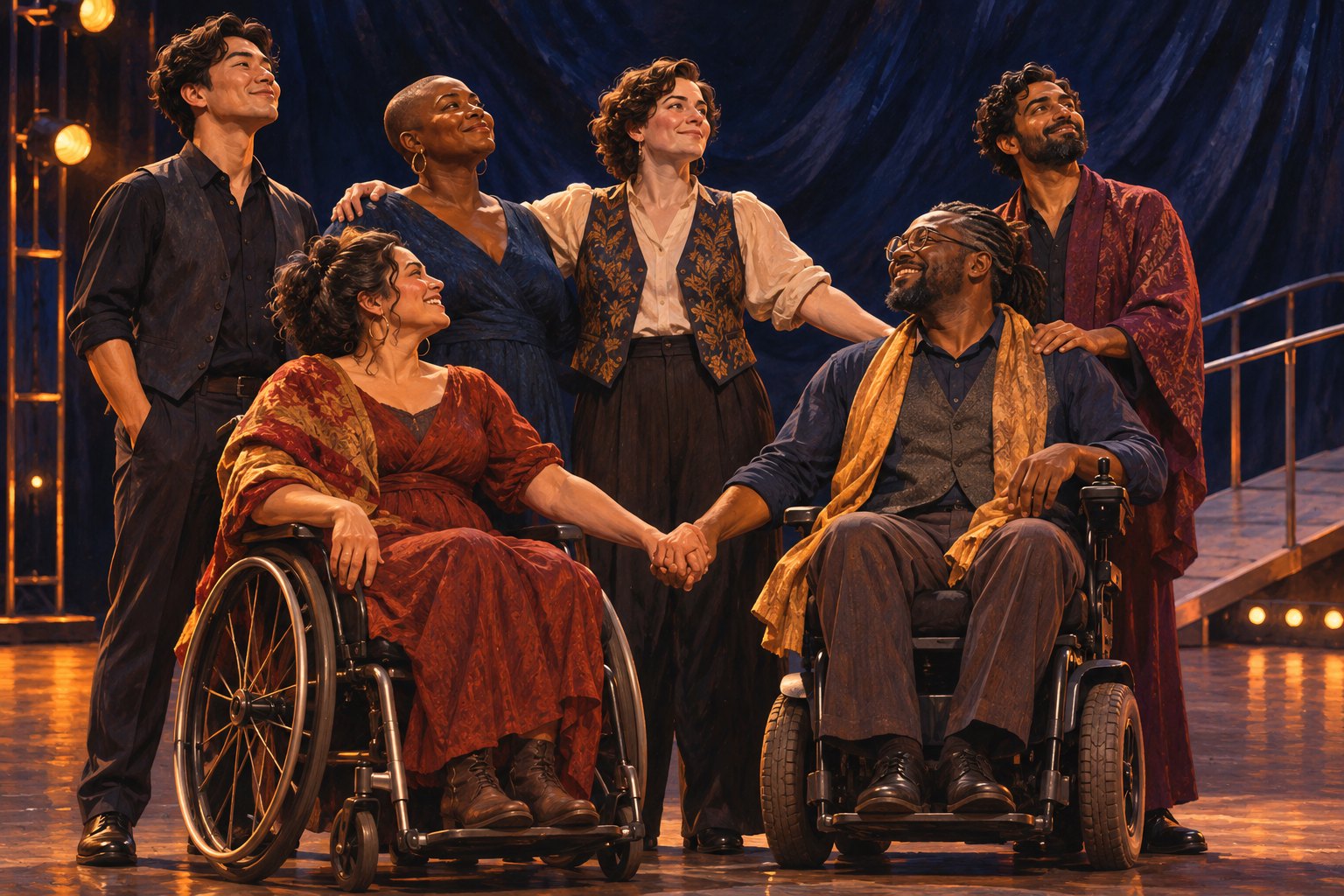
Being Heumann will receive the Gotham Film Awards’ Ensemble Tribute, according to Deadline. The announcement directs attention toward a shared achievement: the work of performers whose contributions can be difficult to separate when a movie comes together. For viewers deciding how to approach the film, that emphasis offers something more useful than another reason to count awards-season mentions.
The word ensemble invites us to consider relationships. Who gives a scene its tension? Who changes another character’s mind? Whose reaction makes a speech land differently? Those questions can reveal aspects of acting that a conversation organized entirely around a leading performance might overlook.
This is spoiler-free commentary on the announced tribute, not a firsthand review of the film. The recognition alone cannot establish how particular scenes work, justify a performance ranking, or authenticate dialogue. Its value here is as a starting point for examining what collective recognition asks audiences to notice.
What the Gotham announcement establishes
The reported news is specific: Being Heumann is to receive an Ensemble Tribute at the Gotham Film Awards. That wording should remain intact. A tribute should not be casually rewritten as a competitive best-ensemble victory, and the announcement does not establish additional nominations, future wins, or the identities of everyone who will participate in the presentation.
For readers, this distinction matters because awards coverage can make different forms of recognition sound interchangeable. An announced honor is a concrete development. A claim that it proves a film is the season’s strongest acting showcase is a critical judgment requiring evidence from the performances themselves.
My view is that the most interesting consequence of this particular honor is the viewing perspective it encourages. It gives the group a place in the headline. Whether the film earns that attention artistically remains a question to answer through its dramatic choices.
Look for influence, not equal screen time
An ensemble does not require every performer to receive the same number of scenes. A character who appears briefly can substantially change our understanding of the central figure. Another can remain present throughout a movie while having little influence over its direction. Visibility and dramatic importance are related, but they are not identical.
A useful test is to ask what changes because a particular character is there. Perhaps their resistance forces someone to reconsider a decision. Perhaps their confidence makes a risk possible. Perhaps their silence exposes a disagreement that the dialogue has been avoiding. These are examples of how ensemble storytelling can work, not descriptions of verified scenes in Being Heumann.
Applied to the Gotham tribute, this approach turns an abstract compliment into a concrete viewing question: do the performances affect one another? The strongest evidence would be relationships that develop, choices that have consequences, and characters who remain recognizable as individuals when they share the frame.
That concern also informs our discussion of how acting and directing honors bring character work into focus. Recognition becomes more interesting when it sharpens our attention to the movie itself.
The performance happening around the speaker
Memorable dialogue is an obvious entry point into film criticism. A sharply delivered line can concentrate a character’s frustration, wit, or determination into a few seconds. But its effect may depend just as much on the person receiving it. A listener can turn apparent confidence into vulnerability simply by refusing to respond as expected.
This is where ensemble acting often becomes most revealing. Watch the person who has just lost an argument, the person waiting to interrupt, or the person realizing that an ally has misunderstood them. A change in posture or a delayed answer can make the relationship legible without another explanatory speech.

No film dialogue is quoted here because memorable lines need verification in their actual context. A promotional phrase, a historical quotation, and a line spoken in the finished movie are different kinds of evidence. Treating them as interchangeable would obscure the very performance choices an ensemble tribute invites us to examine.
Shared recognition should leave room for disagreement
Calling a cast an ensemble can suggest harmony, but dramatic harmony is not the same as everyone agreeing. Characters become interesting when their priorities differ. Two people may want the same outcome while disagreeing about timing, methods, or the sacrifices they are prepared to make.
For a character-focused assessment of Being Heumann, the productive question is therefore how much independent perspective the surrounding figures receive. Can they complicate the central viewpoint? Do their objections matter? Are they allowed motives that extend beyond approving or challenging the leading character?
These questions do not require every supporting figure to have a separate subplot. They require the film to make other people’s presence consequential. A brief disagreement can suggest a life beyond the scene; an extended conversation can still reduce someone to a convenient source of encouragement.
Our commentary on who gets a voice beyond a film’s leading character explores a related distinction. Here, the Gotham announcement makes that question especially relevant to the way the film will be discussed.
How to use the tribute when watching
The honor offers a reason to pay attention, while the movie must supply the reasons for a recommendation. Viewers can keep three practical questions in mind without turning the experience into an acting checklist:
- Whose choices redirect the scene? Notice whether influence moves among characters or consistently belongs to one person.
- What happens during reactions? Consider how listening, hesitation, and interruption change the meaning of spoken dialogue.
- Which relationships evolve? Look for shifts in trust, authority, or understanding rather than simply counting shared appearances.
These observations provide a firmer basis for discussing ensemble work than a list of recognizable names. They also allow for a mixed response: a viewer might admire several performances while finding the relationships underdeveloped, or discover that a modest individual turn becomes essential within the group.
The deeper significance of collective credit
The most valuable interpretation of Being Heumann’s Ensemble Tribute is that performance deserves to be considered as an exchange. One actor creates an opportunity that another accepts, resists, or transforms. The resulting meaning belongs to the interaction as much as to either participant.
That is an argument for attentive viewing, not a verdict delivered in advance. The Gotham recognition places collective achievement at the center of the conversation. A thoughtful response will follow that invitation into the film’s relationships and ask how fully each person helps shape what the audience understands and feels.
Original content by this site's editorial team. Published: November 17, 2026 at 09:27:30 PST (Los Angeles time)