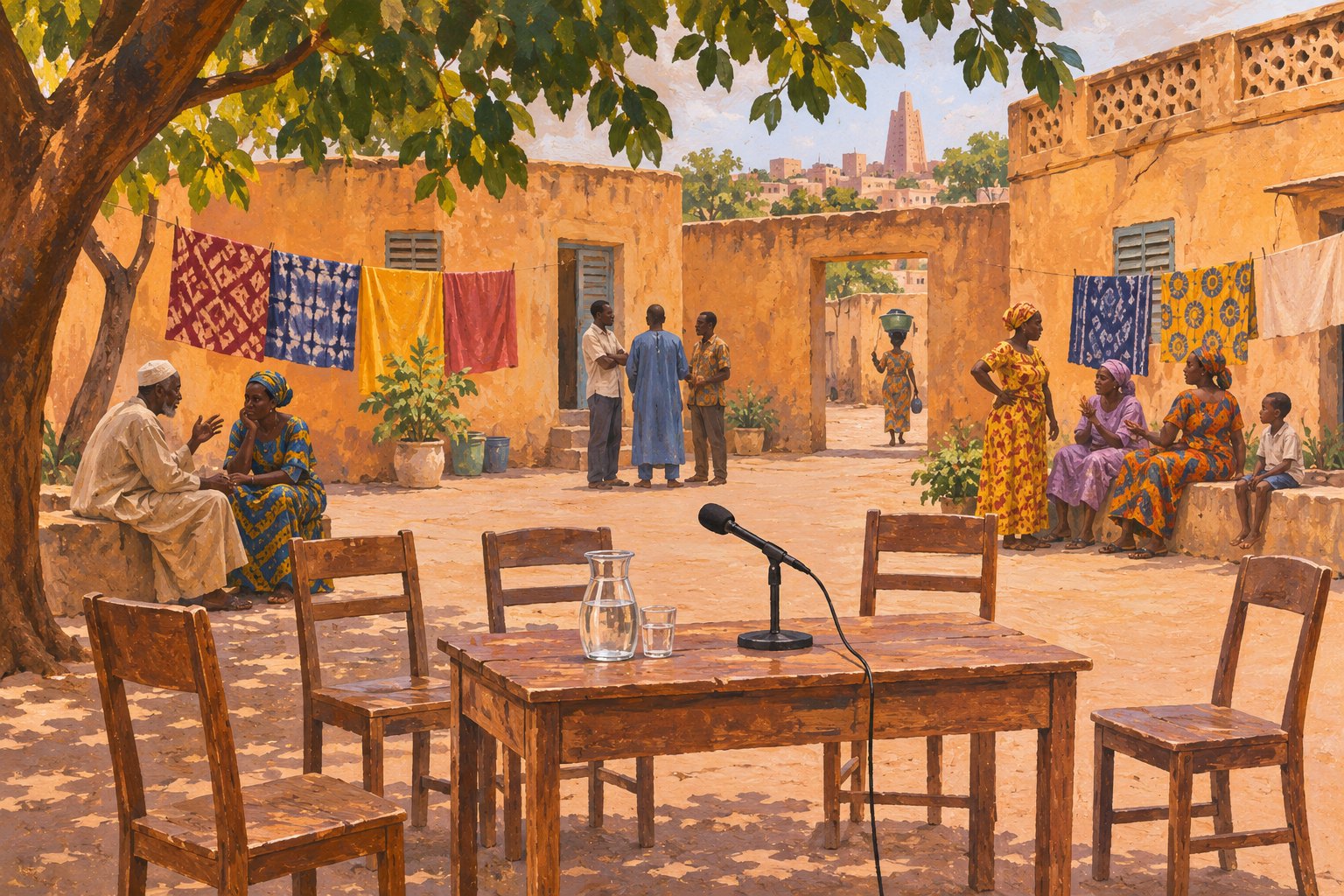
Bamako brings international finance into a residential courtyard and asks what justice might sound like to the people living there. Marquette Today’s announcement of a November 18 Politics and Film screening provides a timely occasion to revisit Abderrahmane Sissako’s 2006 film. The announcement establishes the screening topic and date; readers planning to attend should confirm the time, location, and admission arrangements with the organizer.
My judgment is that Bamako succeeds most powerfully through the tension between its public arguments and private lives. Its imagined trial gives grievances a microphone. Its troubled marriage asks whether having an explanation for suffering makes suffering any easier to endure.
Spoiler notice: This review discusses the film’s central relationships, testimony, and film-within-a-film sequence.
A courtroom that cannot shut out everyday life
The premise is deliberately extraordinary: representatives of African civil society bring a case against the World Bank and International Monetary Fund in a courtyard in Bamako, Mali. This is a staged tribunal, not a documentary record of an actual lawsuit. Witnesses and advocates debate debt, privatization, and responsibility while residents continue their daily activities around them.
That arrangement changes the usual courtroom movie. Ordinarily, a hearing organizes our attention: a witness speaks, opposing counsel challenges, and a judge restores order. Here, the surrounding life keeps making its own claims. Work, childcare, conversation, and domestic difficulty occupy the same space as formal argument.
Watch where your attention goes when something happens beyond the person speaking. The apparent distraction is part of the design. These residents do not exist merely to illustrate a lawyer’s point. They have immediate concerns that cannot wait for the proceedings to conclude.
The resulting rhythm can be demanding. Some testimony is lengthy, and viewers expecting a tightly plotted legal contest may feel the film resisting their expectations. For me, that resistance becomes productive: listening requires effort, but so does recognizing a person whose experience does not arrive as a polished speech.
Melé: a voice that cannot repair a marriage
Melé, played by Aïssa Maïga, sings in a bar. Her husband, Chaka, played by Tiécoura Traoré, is unemployed, and their relationship is breaking down. Their domestic story unfolds alongside the tribunal without becoming a neat demonstration of every argument made there.
Melé’s singing makes her especially compelling in a film preoccupied with being heard. Performance gives her voice a public setting and an audience. At home, however, the existence of that voice does not guarantee understanding. Being able to express emotion and being able to sustain intimacy are different capacities.
Maïga’s presence also complicates any temptation to regard Melé simply as a symbol of endurance. She works, performs, and occupies a life larger than her husband’s distress. Her emotional distance deserves attention without being treated as a moral failure. The film leaves room for exhaustion, disappointment, and desires that no economic argument can completely explain.
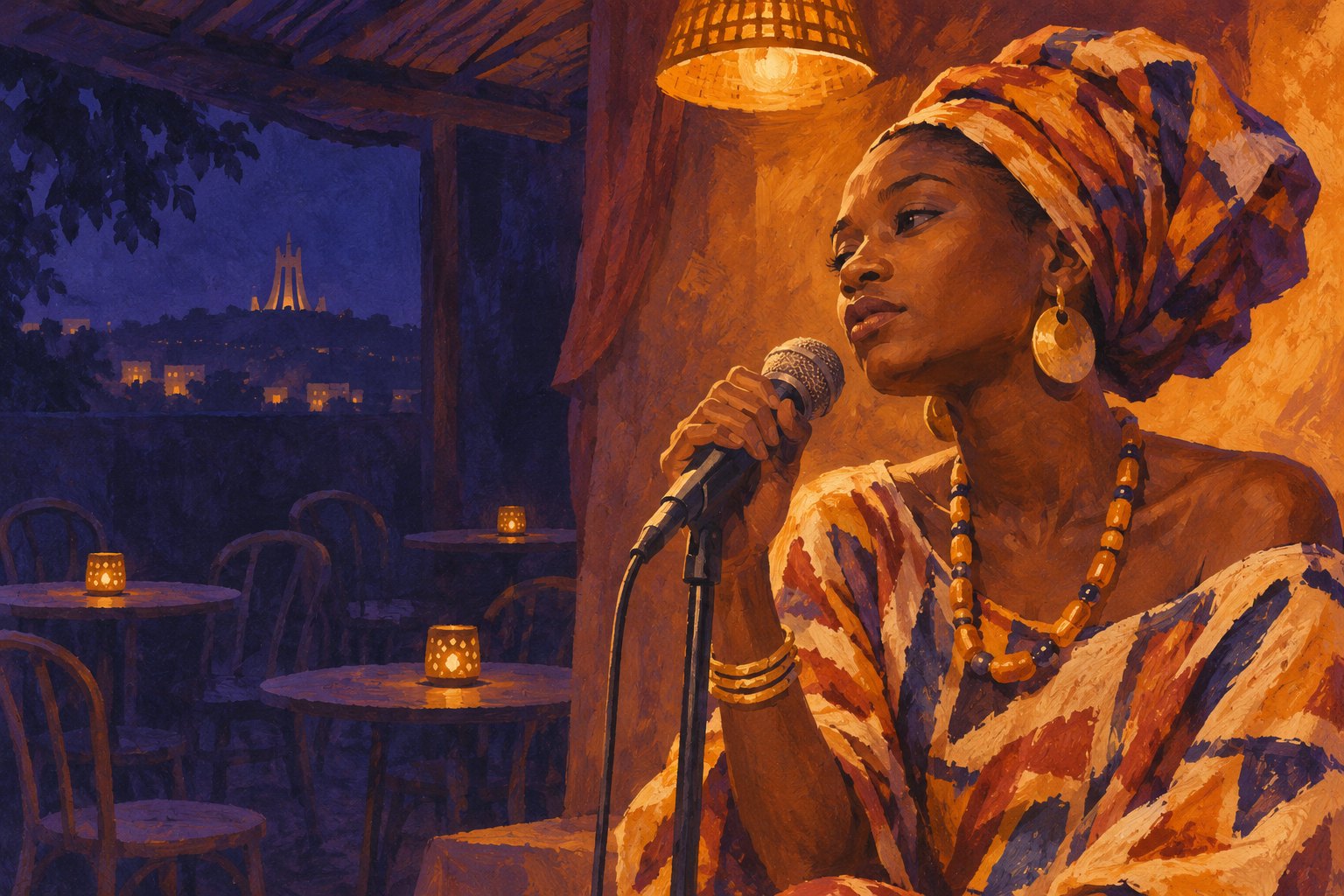
The contrast between her performances and the courtroom speeches creates two ways of addressing an audience. Testimony seeks recognition through explanation. Singing can communicate feeling without settling its meaning. Neither form automatically reaches the person who matters most.
Chaka: imagining a place for himself
Chaka’s unemployment becomes more than background information. It shapes how he imagines his future and how he moves through a world that seems to have little use for him. One revealing exchange concerns his hope of working as a guard at an Israeli embassy that does not yet exist in Mali.
“The guard will be me,” he says in the English subtitles. The line is memorable because of its small, determined certainty. Chaka cannot summon the institution or create the position, but he can briefly assign himself a role within an imagined future.
I read this as a painful mixture of initiative and powerlessness. He is not without imagination. What he lacks is a reliable connection between preparation and opportunity. The scene gives unemployment a personal texture that an abstract count of jobs could never provide.
It also sharpens the marriage story. Chaka’s withdrawal occurs beside a public forum filled with people explaining structural causes. Yet an explanation circulating nearby cannot necessarily reach someone emotionally isolated. Sissako allows social analysis and personal loneliness to coexist without pretending that either exhausts the other.
Who gets to describe Africa?
Among the film’s most forceful interventions is Aminata Traoré’s challenge to the assumption that poverty defines Africa. “Africa is rather the victim of its wealth,” she argues. The sentence redirects attention from an alleged absence of resources toward questions of extraction, ownership, and benefit.
This is a position voiced within the film’s political argument. It should not be mistaken for a complete economic history or a substitute for evaluating particular policies. Its dramatic importance lies in the change of perspective it demands: who has the authority to name a society’s problem?
The same concern appears in the film’s treatment of speech itself. People possess experiences before a court grants them time to speak. Formal procedure can make those experiences audible, but it also sets conditions on their expression. An orderly hearing and an adequate hearing are not necessarily identical.
That distinction gives the film a useful connection to our analysis of evidence and understanding in Minority Report: institutions may collect information while still failing to recognize the person in front of them.
Why a Western interrupts the proceedings
Bamako includes a television Western titled Death in Timbuktu, featuring Danny Glover and Palestinian filmmaker Elia Suleiman. Its sudden genre shift can feel startling after the measured pace of testimony and courtyard observation.
The sequence is worth watching as an argument about images. Westerns often make domination legible through immediately recognizable figures: armed men, vulnerable inhabitants, threatened territory. Here, that cinematic shorthand sits inside a film examining power whose operations are harder to show directly.
My reading is that the interruption challenges the viewer’s appetite for obvious villains and decisive action. Spectacular violence supplies immediate visual certainty. Debt and institutional authority require a different kind of attention. The tonal disruption is therefore meaningful, even if some viewers find it too abrupt.
Glover and Suleiman’s appearances are recognizable casting details rather than a hidden puzzle. Their presence rewards recognition, but the sequence’s relevance does not depend on knowing who they are.
What to carry into the November 18 screening
For a first viewing, follow three threads: what the witnesses say, what the residents do while they speak, and what Melé and Chaka cannot communicate to each other. Those threads sometimes reinforce one another and sometimes refuse to align. Our guide to attentive screening and post-film discussion offers a useful companion approach: begin with a specific moment before moving toward a broad judgment.
The deeper achievement of Bamako is its refusal to let public recognition stand in for personal repair. Giving grievances a hearing matters. So does acknowledging that people continue living with their consequences after the speeches end. The courtyard makes that uncomfortable proximity visible: an argument about justice can be eloquent while someone only a few steps away remains profoundly alone.
Original content by this site's editorial team. Published: November 13, 2026 at 16:59:02 PST (Los Angeles time)